

Uprooted
Ieva Saudargaitė Douaihi
Text by Ibrahim Nehme, Director of Beirut Art Centre
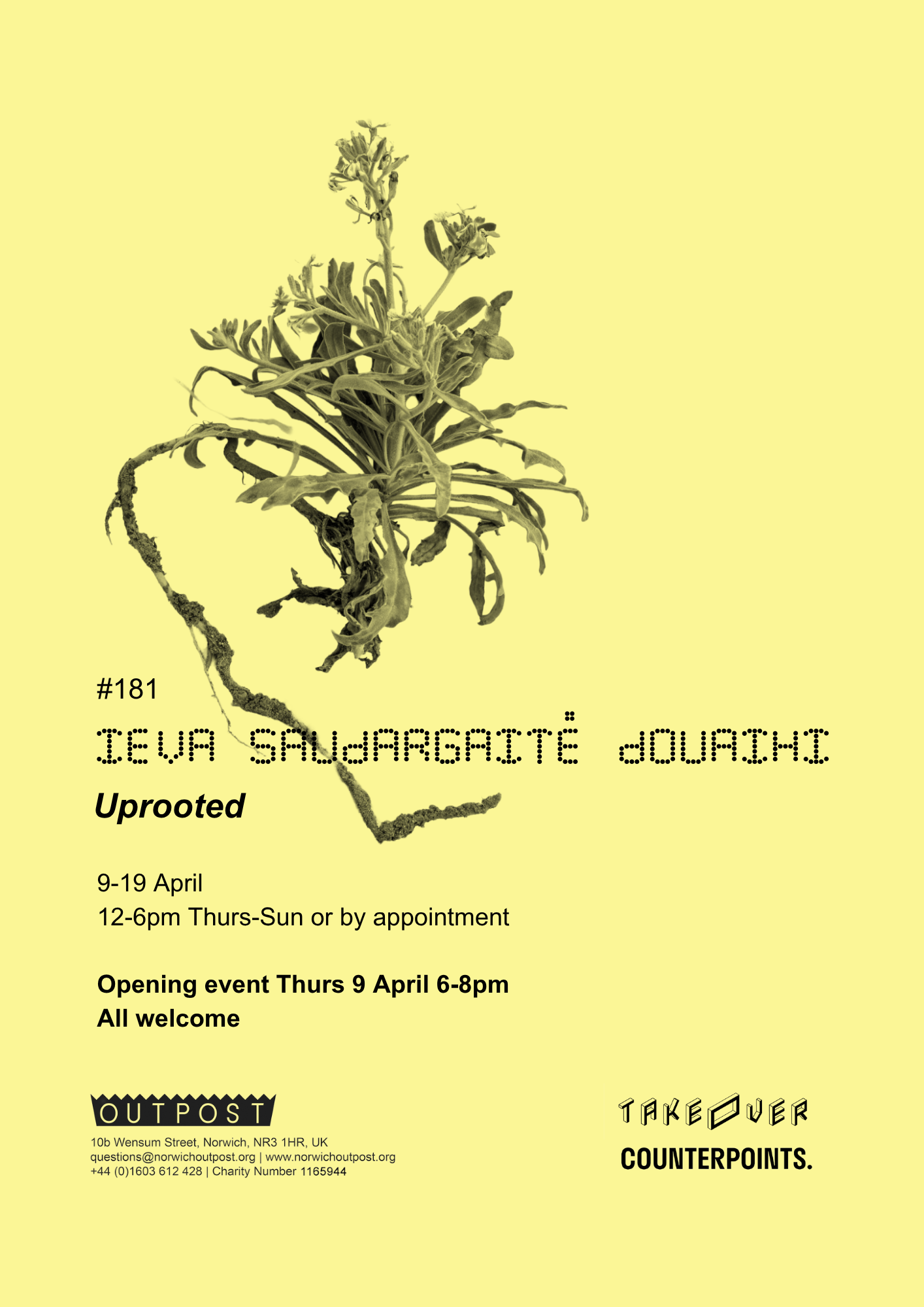
To uproot a plant is an act of violence. Ieva Saudargaité Douaihi knows this. Before she lifts anything from the ground, she digs carefully around it, working the soil loose, reading the resistance, trying to keep intact what has taken years to form. Whatever comes out with the plant stays: the clinging earth, the entangled roots of a neighbouring species, the whole dark argument of a life lived underground. Nothing is cleaned away. The wound is preserved as evidence.
The plants in these large-format photographs are native to the Lebanese landscape — ﻗﺼﺐ, ﺧﺒﻴﺰة, species whose Arabic names carry centuries of use, of knowing, of being known — ﺑﺨﻮر ﻣﺮﻳﻢ, ﺗﻔﺎف . Douaihi photographs them against white, with the care of a forensic record and the stillness of a devotional portrait. Roots exposed. Soil present. The full body, not just what grows above ground.
At this scale, you can see everything. Every filament. Every grain of earth still clinging. The image demands a quality of attention that slows you down, that makes looking feel like a responsibility.
This is, perhaps, the proposition: that the capacity for empathy does not disappear; it narrows. We learn, gradually and without noticing, to calibrate it. T o extend it toward some bodies and not others. T o feel the uprooting of a plant in a protected forest and to feel, somehow , less about other uprootings that move across our screens in the same season.
Douaihi does not make this argument directly. She makes these photographs instead. They are precise, tender, unglamorous, but she trusts that something in the looking will do the work. A body that belongs to a place. A system of roots and relations, broken. Soil that remembers what held it.
There is a dissonance she is sitting with, and she is asking us to sit with it too. Not to resolve it. Not to be instructed by it. Only to feel, for a moment, its full weight, and to notice what that feeling is, and where else it might go.
Ieva Saudargaitė Douaihi is a transdisciplinary artist working at the intersection of photography, architecture, and material research. Rooted in an ongoing exploration of vernacular landscapes, memory, and overlooked ecologies, her practice spans image-making, spatial interventions, and hybrid objects composed of found objects, natural matter and household materials. Drawing on her background in architecture and a deep sensitivity to ecological and social entanglements, she engages with overlooked spaces and slow processes of growth, decay, and adaptation.
Douaihi is the founder of Takeover, an artist-led para-institution in Beirut dedicated to fast-paced, experimental, and independent cultural production. In 2025, Takeover was twinned with OUTPOST Gallery. By twinning our galleries, we have moved beyond a temporary collaboration into a permanent, formalised kinship. This partnership between OUTPOST Gallery and Takeover recognises that while our geographic contexts differ, our goals (to protect cultural expression and sustain artistic practice) are the same, proving that solidarity is most effective when it is built on a foundation of institutional friendship and shared responsibility. While there is no formalised process for twinning cultural institutions, we have created our own framework which we continue to develop.