


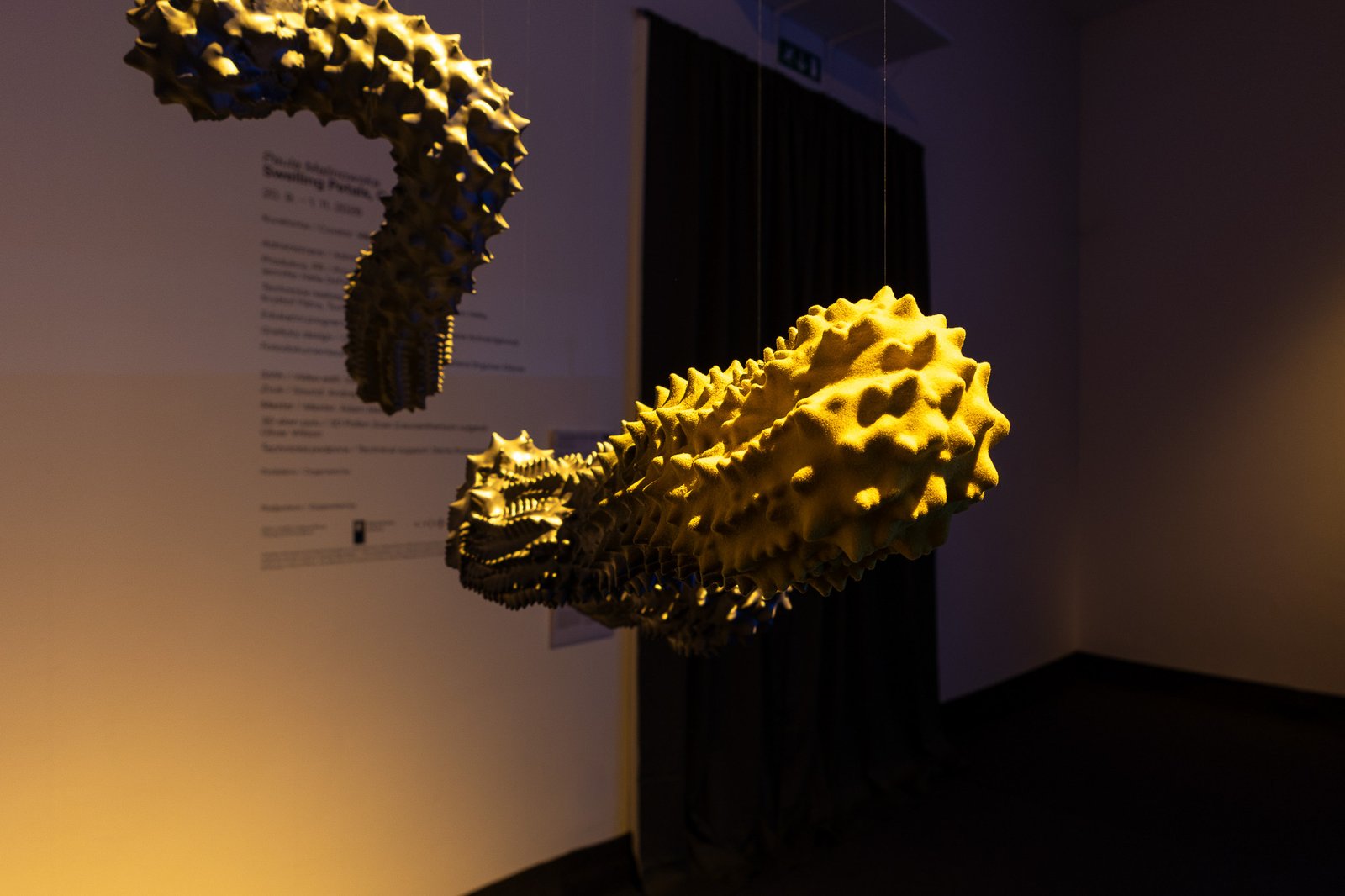
The abnormal fusion of stems, flowers, or other organs,
or their longitudinal flattening due to degeneration and loss
of the solid structure of the expected body form, is defined
in specialist botanical terminology as fasciation. It occurs
either randomly or under circumstances disturbing
the environmental balance in which an organism lives,
as a response to a state of threat, stress, or intoxication.
This extreme moment, known from the life of plants, forms
one of the aspects of Paula Malinowska’s project. Her
thinking, however, proceeds towards a reflection
on the limits of the human perceptual apparatus,
or on the environment between virtuality and physical
reality, applied to different forms of corporeality.
The bodies themselves assume the position
of an interconnected object, giving rise to both
collaboration and tension between technology, plant,
and human, while streams of awakening slowly emerge,
made present through fragments of the protagonist’s
perceptiveness.
The animated video becomes a continuation of the artist’s
research at the intersection of the allegorisation
of biological and botanical processes, animation,
and critical frameworks of digital image theory, which she
brings into presence through artistic scenarios and themes
of more-than-human beings. Her approach, communicated
through speculative fiction and referring to therolinguistics
and the essayistic work of Ursula K. Le Guin, draws
on the imagination and the creation of worlds that do not
offer instructions for better futures, nor a direct critique
of dysfunctional systems. Rather, they lead towards
an expanded perceptiveness and knowledge that, through
an artistic language, disrupts the everyday, established
formats through which we understand the world
and questions conformity.
Through the use of a motion-capture suit that records
movement, the artist enters a performative plane situated
between self-reflection and the communication of themes
of planetary and broader social significance. Also a 3D
pollen grain assumes the role of a co-actor, functioning
as both a metaphorical and active agent of the narrative,
a component of mutation processes, and an ambiguous
authority transgressing beyond the boundary
of the projection screen.
The installation mediates an encounter with a restless
situation or a story about the relationship between
a humanoid and a plant organism—a daisy, whose digital
(as well as physical) form is defined by the interface
of technology. The human perspective, burdened by years
of egocentric approaches to the exploitation of native
species and ecosystems, is confronted with an unspecified
spatiotemporal excess that can resemble a fictional
construct of a world model as much as a futuristic cockpit
of a research team or the black hole of the internet’s infinity.
What, then, is the object of investigation and concentrated
activity of control? How many times is the figure present
under the surveillance of the screen interface—or is it
precisely she who is the force shaping the mechanism
of the mind or organisation? What are her feelings in this
process, and what significance do the concepts of freedom
and threat acquire here?
Media historian and theorist Deborah Levitt develops, in her
book The Animatic Apparatus: Animation, Vitality,
and the Futures of the Image (2018), themes of technological
surveillance and the influence of visual representation
and the digital image on human corporeality, as well as
on forms of perception and the interpretation of the world.
Our everyday reality has long since become largely
a reflection of an immaterial, fragmented, and commodified
reality that we are unable to sufficiently reflect upon.
The degree of manipulation of image–sound–ecosystems
or emotions–senses–memory becomes uncontrollably
dispersed across interfaces of monetisation and simulation.
The image which, in the ancient times when optical image
making devices were invented, was modelled frame
by frame, capturing phases of movement until becoming
physically present as photograph or drawing, becomes
a fluid form, continuing to live within libraries of continuous
algorithmic generation.
Yet it also becomes part of memory, decision-making,
and perceptiveness or fatigue, which develop alongside its
virtual presence, touch, and the interface of everyday life.
Within the modes of visual representation made possible
by the invention of the moving image, the body enters
a mode of interpretation in which we do not naturally
perceive it; it is observed through the lens of technology,
its abstracted movement recorded in moments
of transformation, much like confused plant cells
in the process of fasciation. The body and its physical
trace are captured, recorded, and analysed, becoming part
of a system. Its status as a subject becomes that
of an object positioned as a fragment within
the functioning of infrastructures of power–commerce
surveillance, just as communities of other organisms
and ecosystems have become monetised resources
required to fulfil human desire.
Plants, which despite disrupted conditions are still
able to preserve their original memory and capacity for
resistant resilience, nevertheless become, much like
the bodily remains of other beings, objects of higher systems
within the threads of power machineries. Attempts
to manifest a state of growth excess, or forms of digital
reciprocity disturbing to the lens of ordinary human
imagination, are attempts to recall the activity of biological
and technological structures. They are also a horizon whose
critical examination and subjective voice of unease, close
to the everyday condition of digital loss of senses, emotions,
or physical proximity, could remind us of the need
to reconsider affectivity and activity within the looping
processes of assemblages of control and superiority
or dependency.