


Softshell Archipel
Group exhibition with works by Sasha Auerbakh, Jason Bunton, Vasco Costa, Uladzimir Hramovich, Bögdana Kosmina, Wolfgang Obermair, Lesia Pcholka, and Ekaterina Shapiro-Obermair
An anecdote about the coincidental convergence in the works of three artist friends stands at the beginning of the exhibition “Softshell Archipel”. The shared story can be read as the basis for a futuristic landscape, but also as a model for active collaboration between artists, who often experience growing isolation. This is only possible when similarities are not perceived as a threat to one’s own originality, but rather as something new that emerges from the exchange. The exhibition is based on the visual idea of “plateaus” and “archipelagos” that connect with one another. The dense juxtaposition of artworks reveals not only proximity, but also differences.
The selection of participants reaches into intra-European conflict zones. Geopolitics, memory culture, migration, history, and cultural archaeology form central levels of reflection. The works address both formal questions and social relationship structures, attempting to escape the dilemma of national attributions. The exhibition was curated by the Viennese artist-run space hoast.
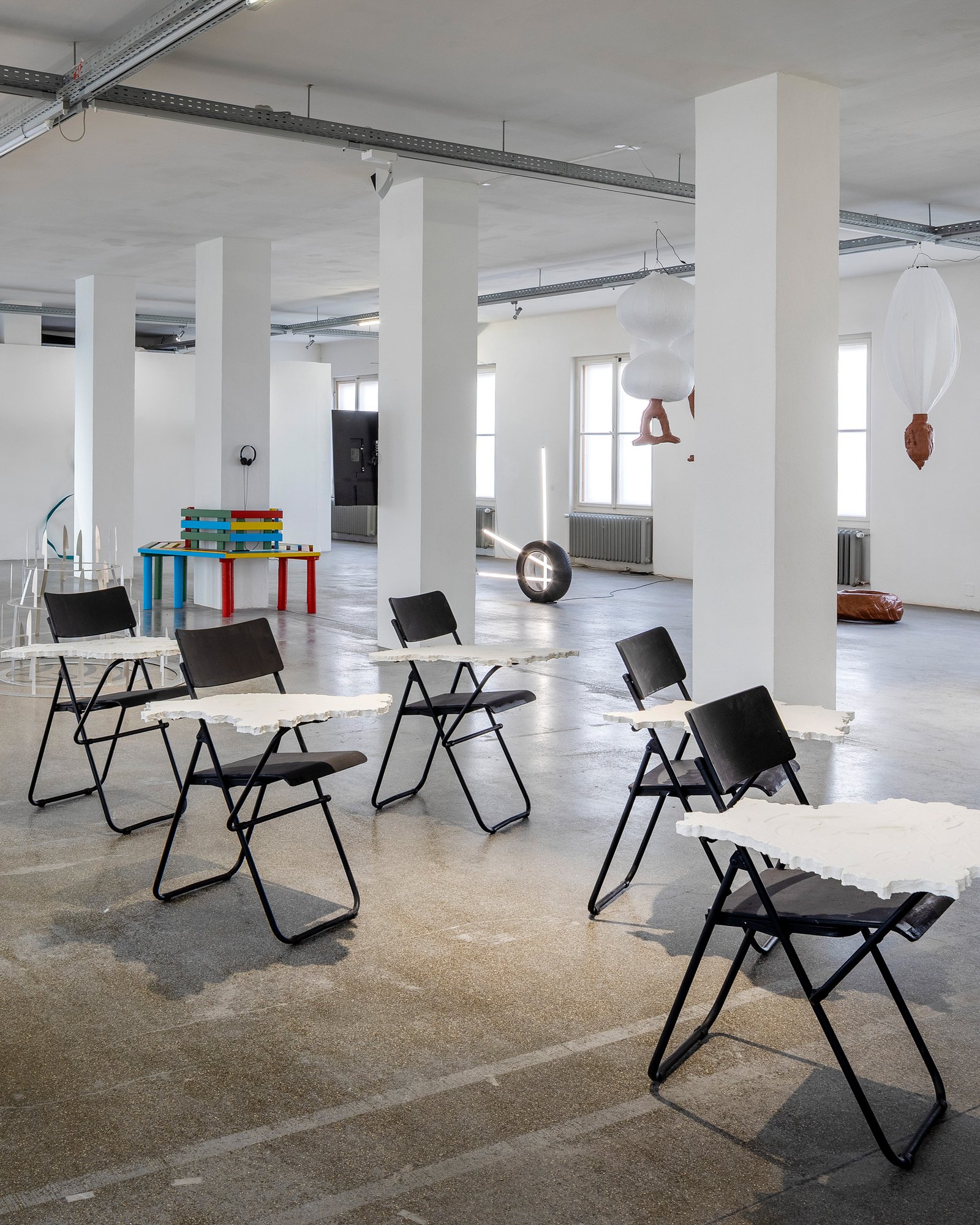
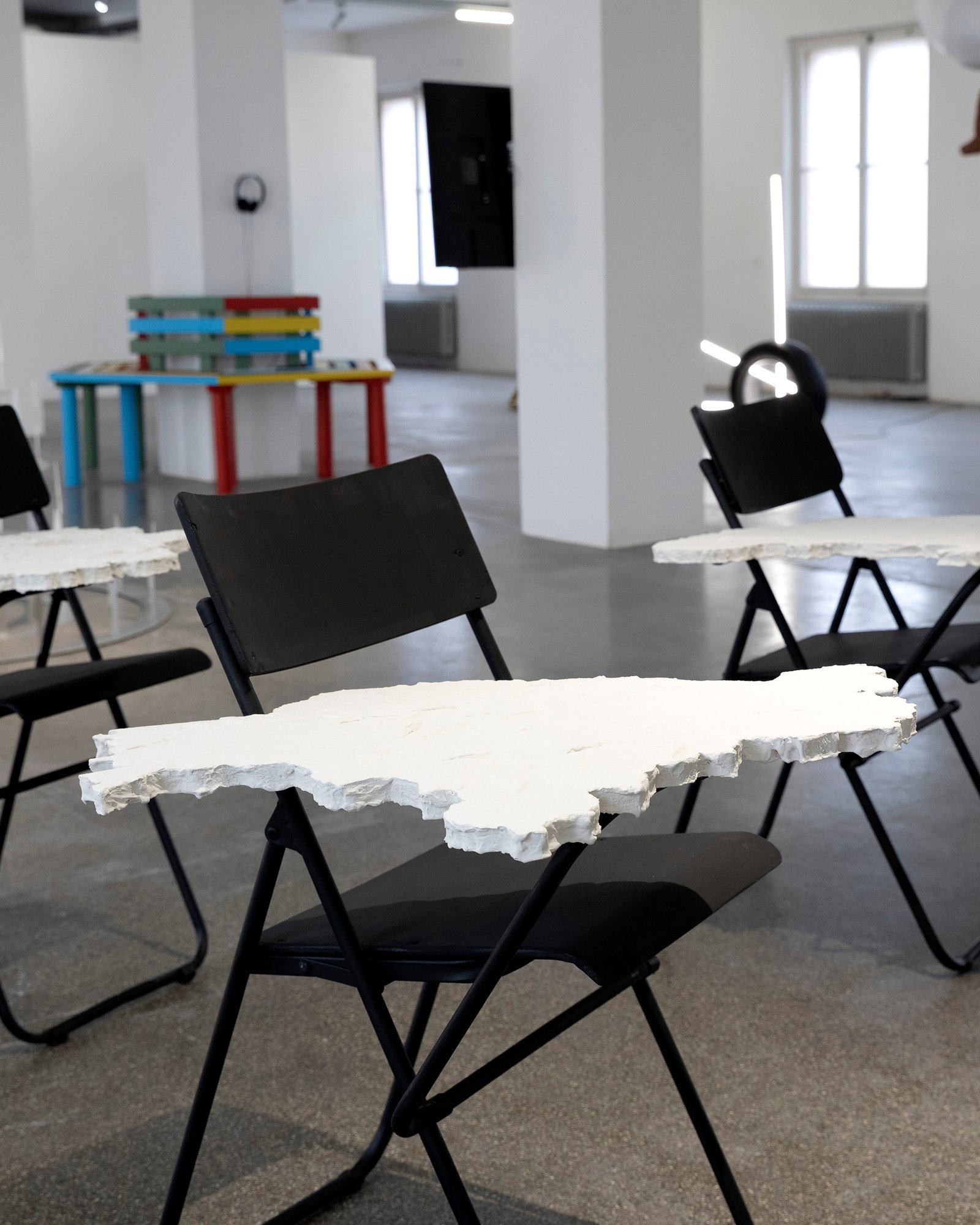
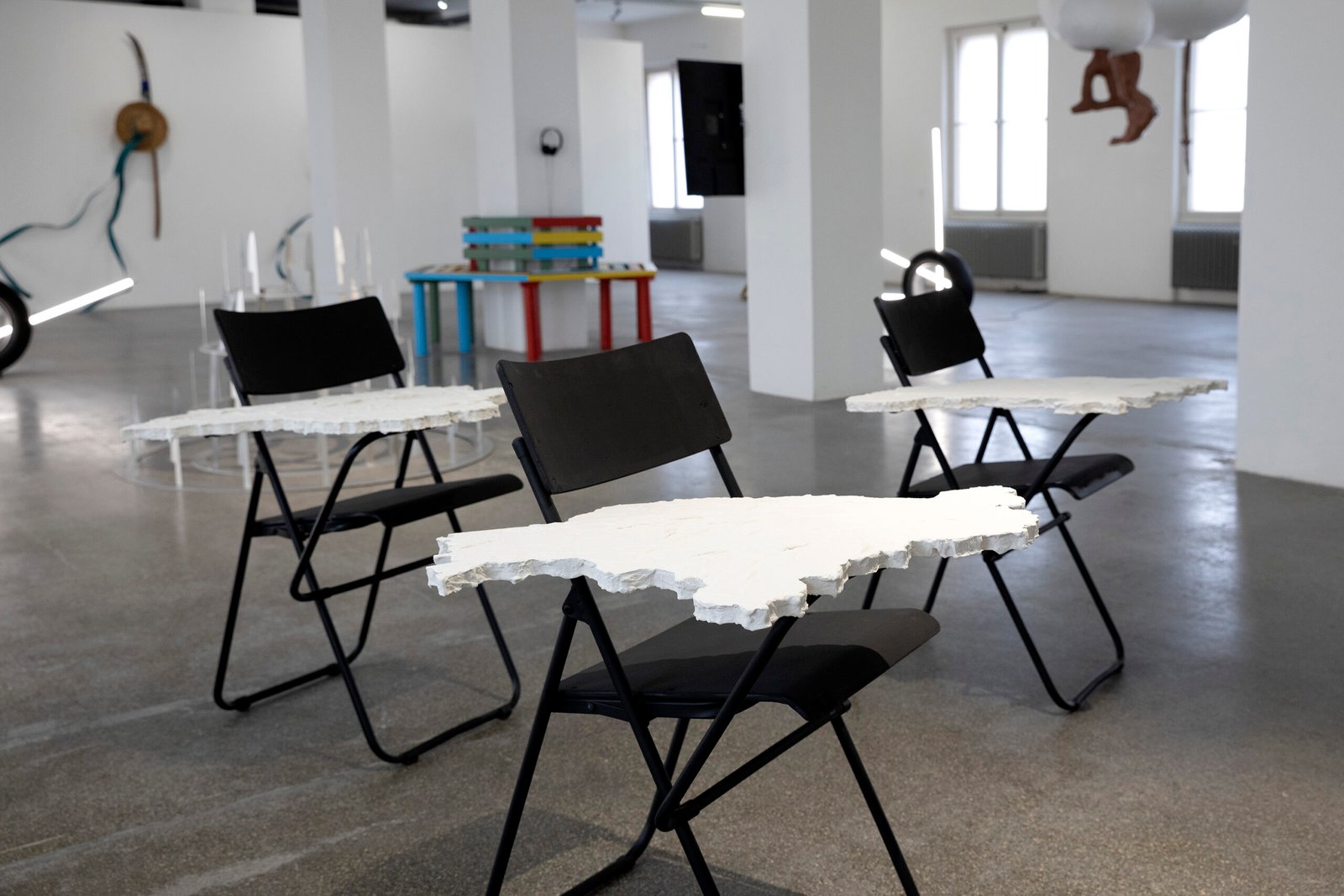
Lesia Pcholka’s work “Try to Read My Stones” at the entrance to the exhibition consists of seven historical maps of Belarus mounted on folding chairs. The sculpturally translated national borders visualize the violent transformations that the country experienced through regime changes, wars, and occupations in the 20th century. The installation is reminiscent of a classroom or lecture hall, thus creating a space in which Belarusian history can be reflected upon.
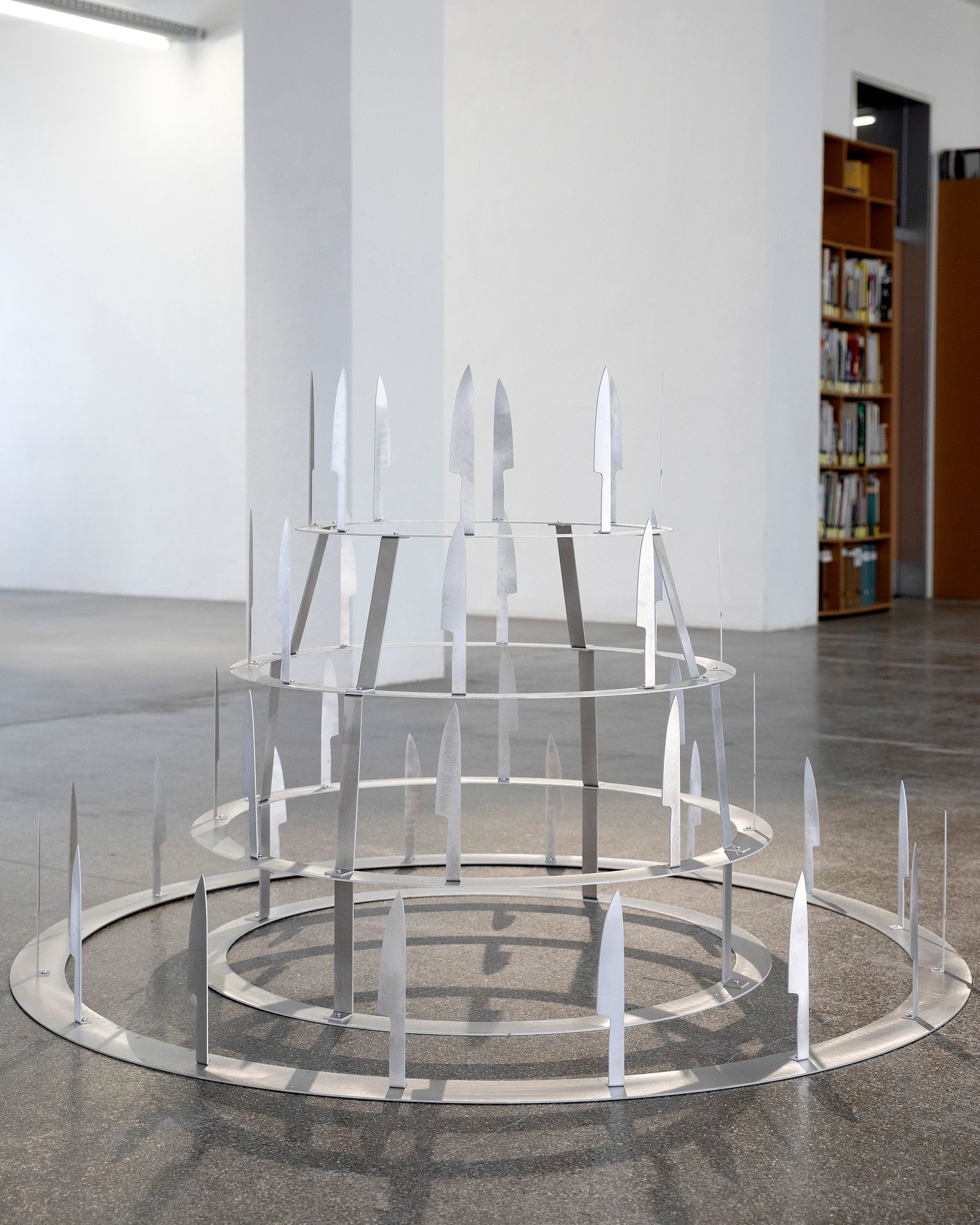
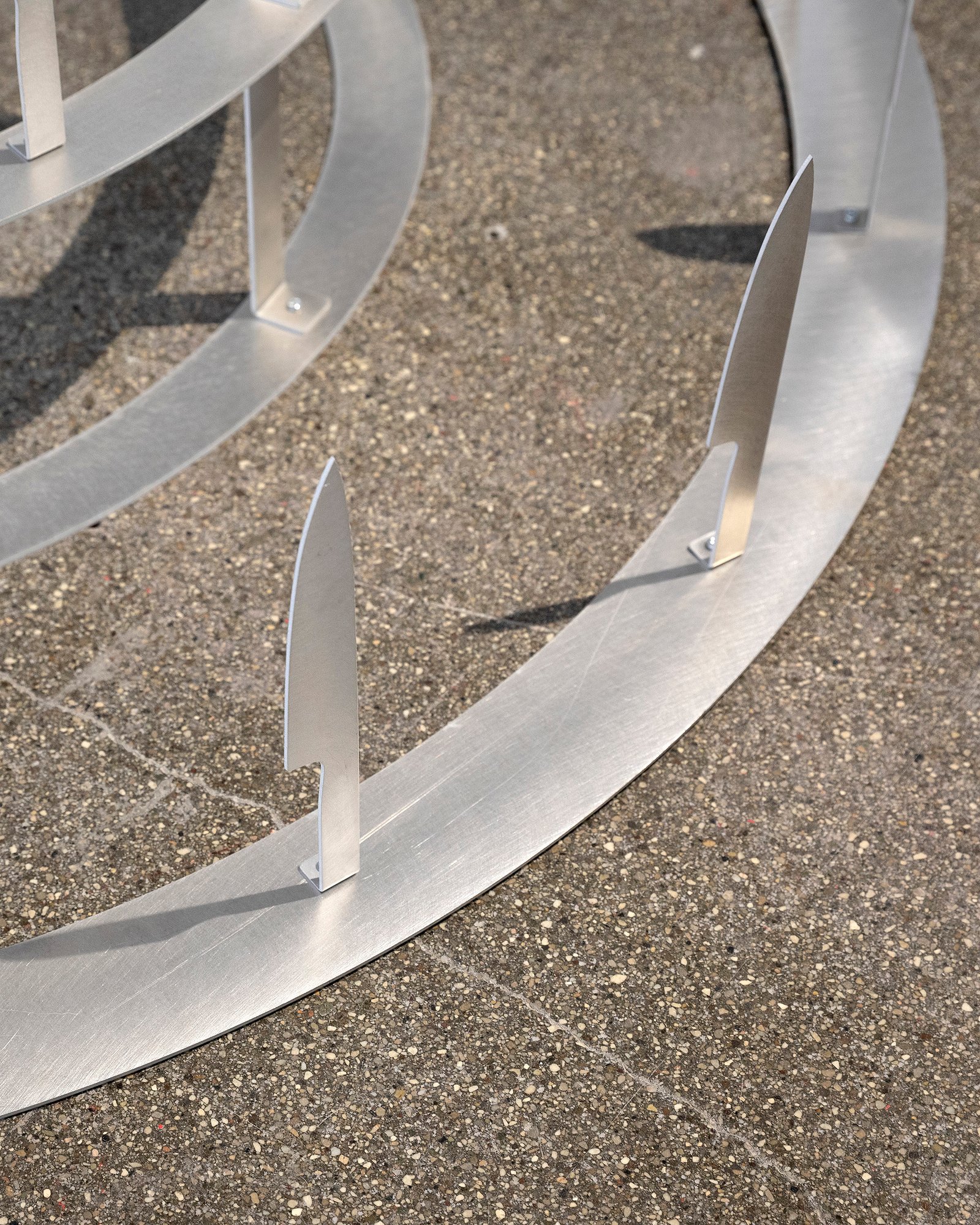
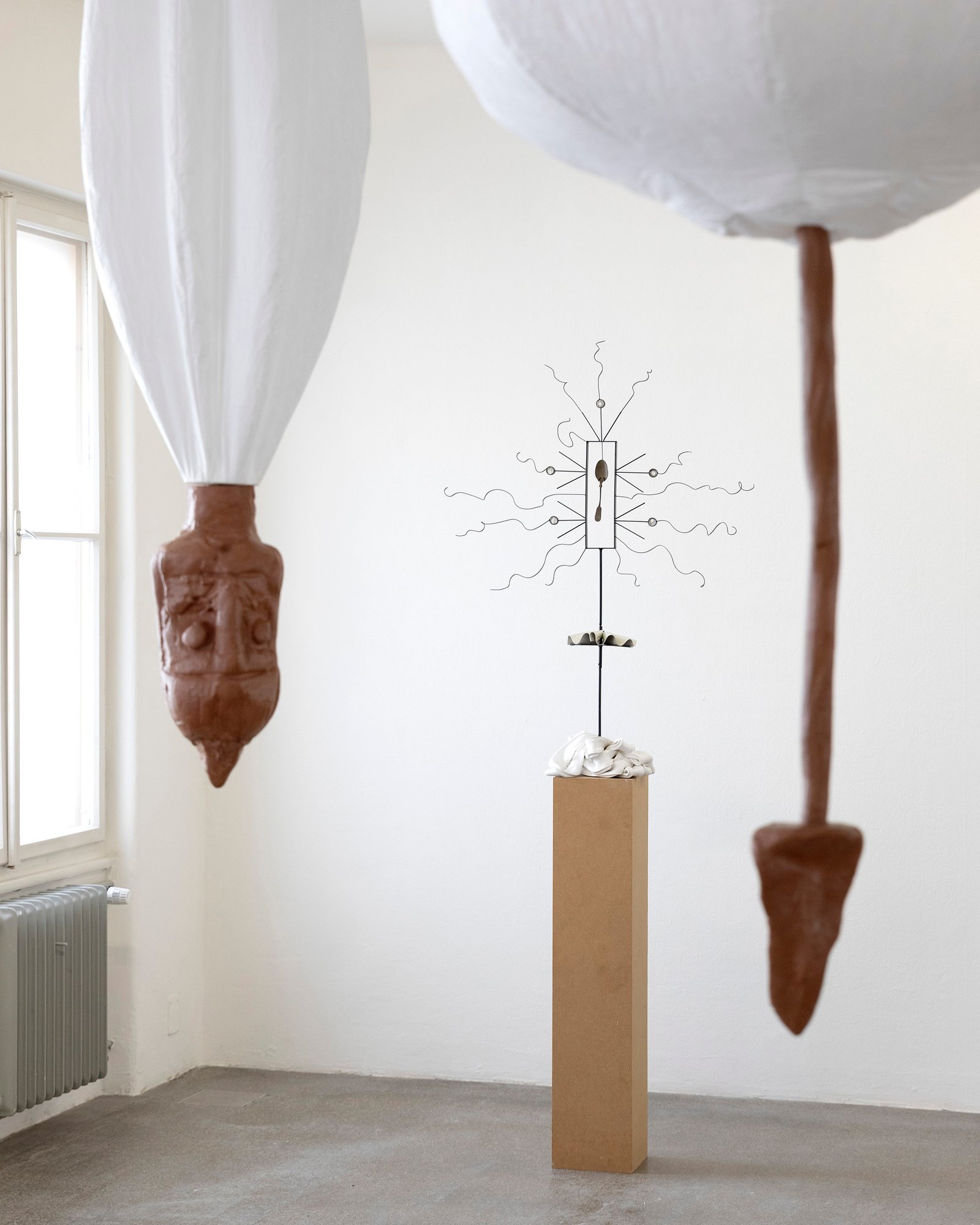
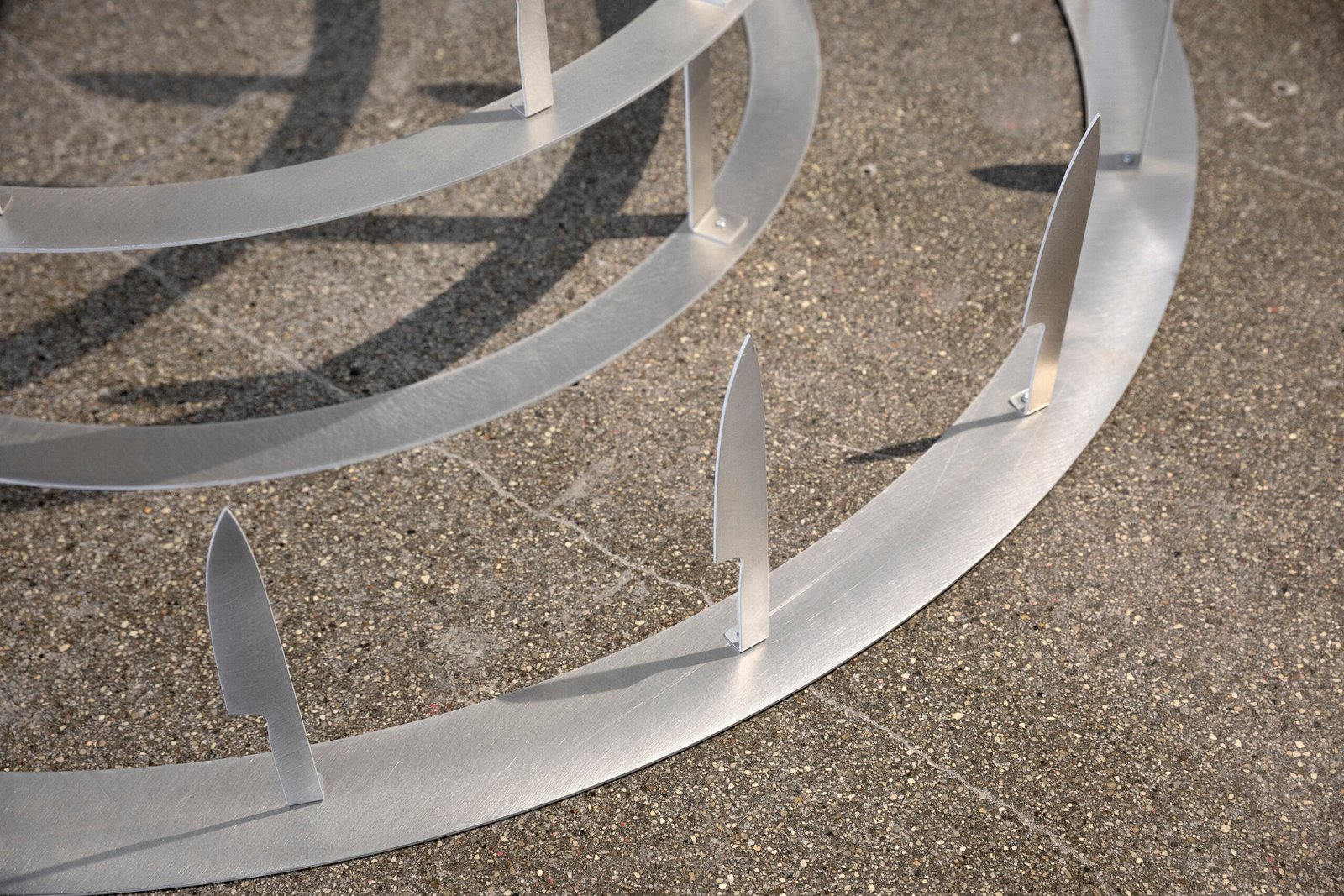
Directly behind it is Sasha Auerbakh’s “Knife-Hat”. The work formally alludes to Marcel Duchamp’s bottle rack, in which individual rods have been replaced by the silhouettes of knives. Auerbakh makes an associative reference to the turban of a 19th-century Sikh warrior, a headdress decorated with metal power emblems. The materiality makes the object appear almost transparent, yet the upward-pointing knives become—understood in a feminist reading—a symbol of violence and male dominance. Another work by Auerbakh in this exhibition presents an old spoon like a baroque reliquary. It is a found object from the Thames, part of a long-term project by the artist in which she uses the river as a resource for her sculptures.
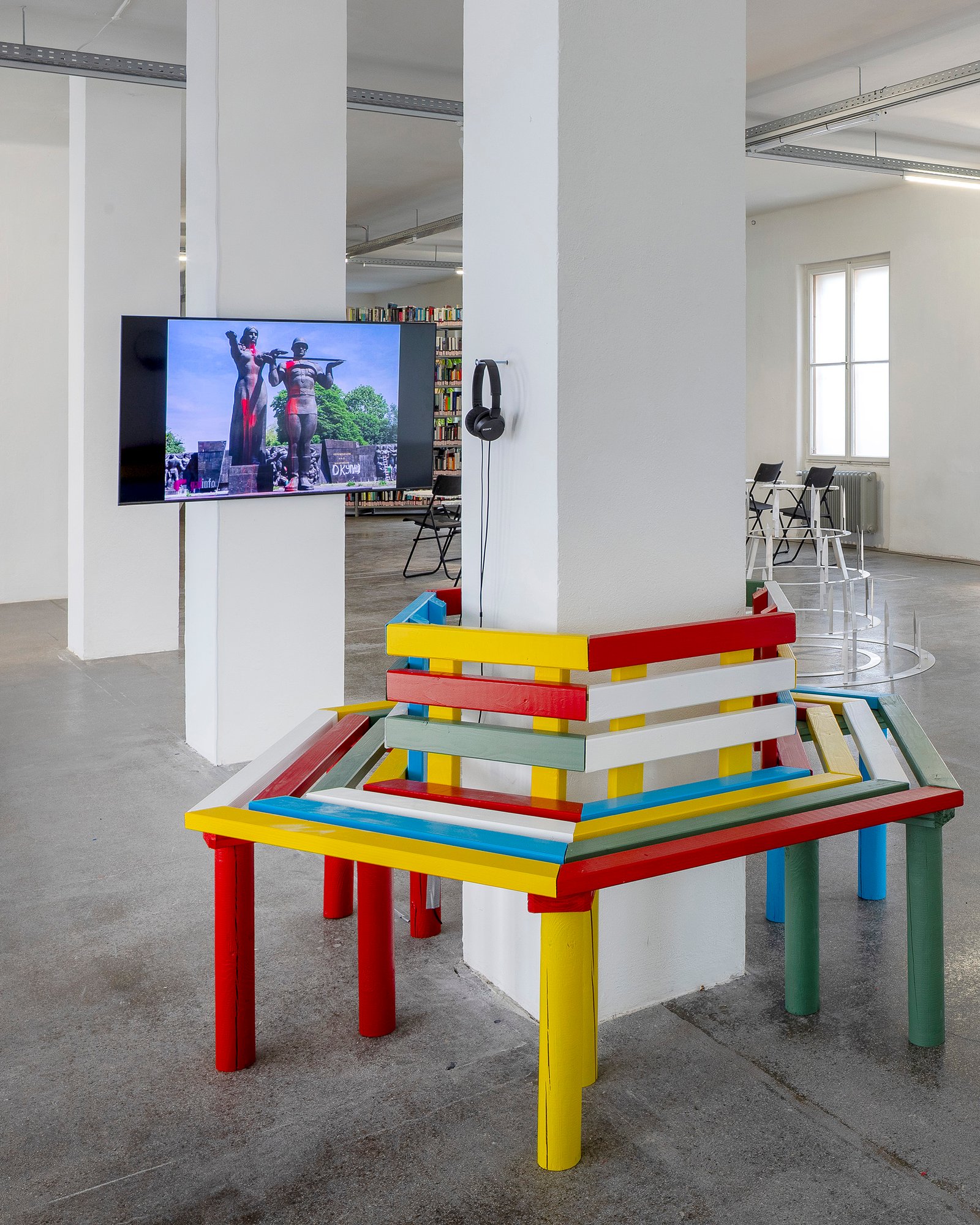
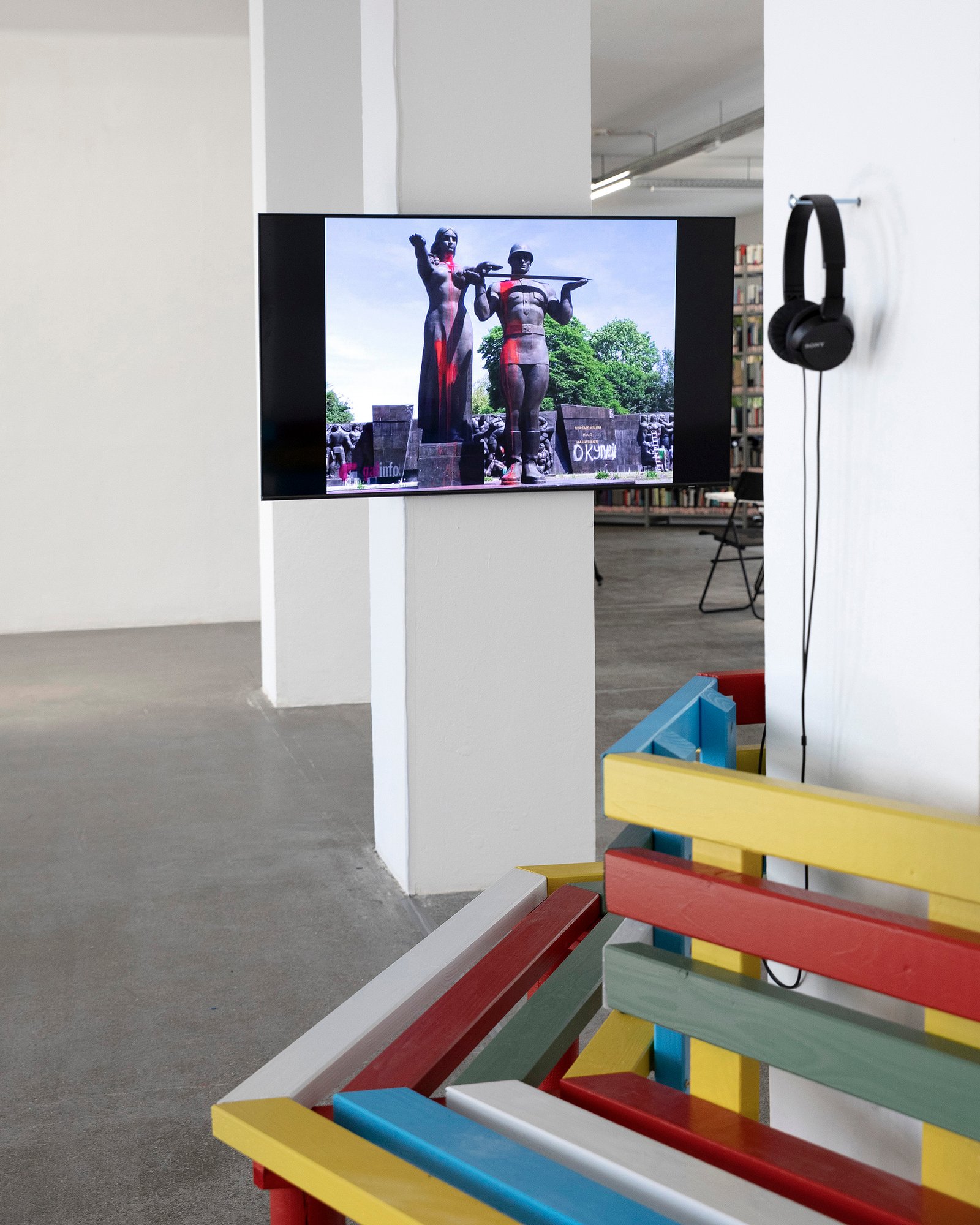
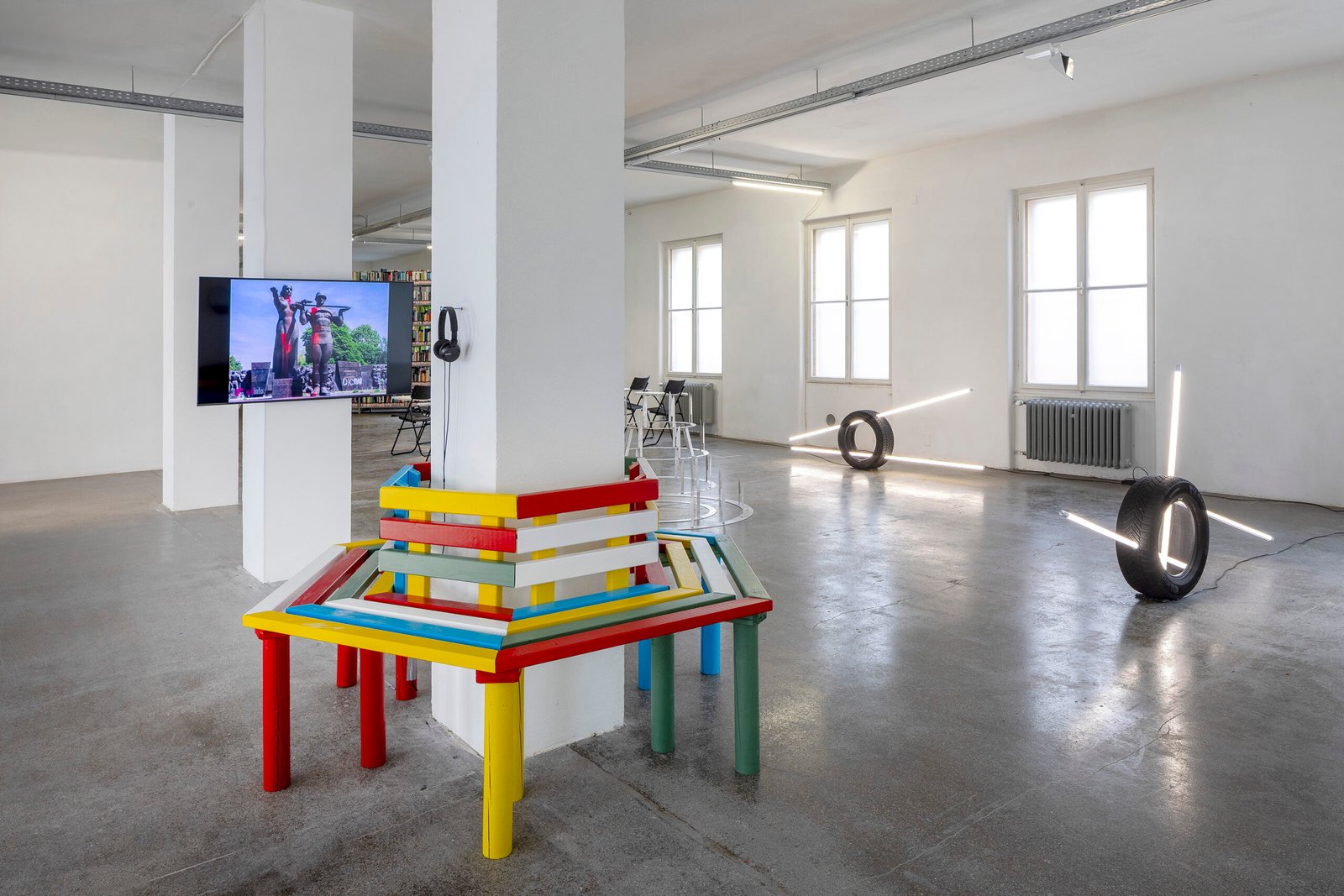
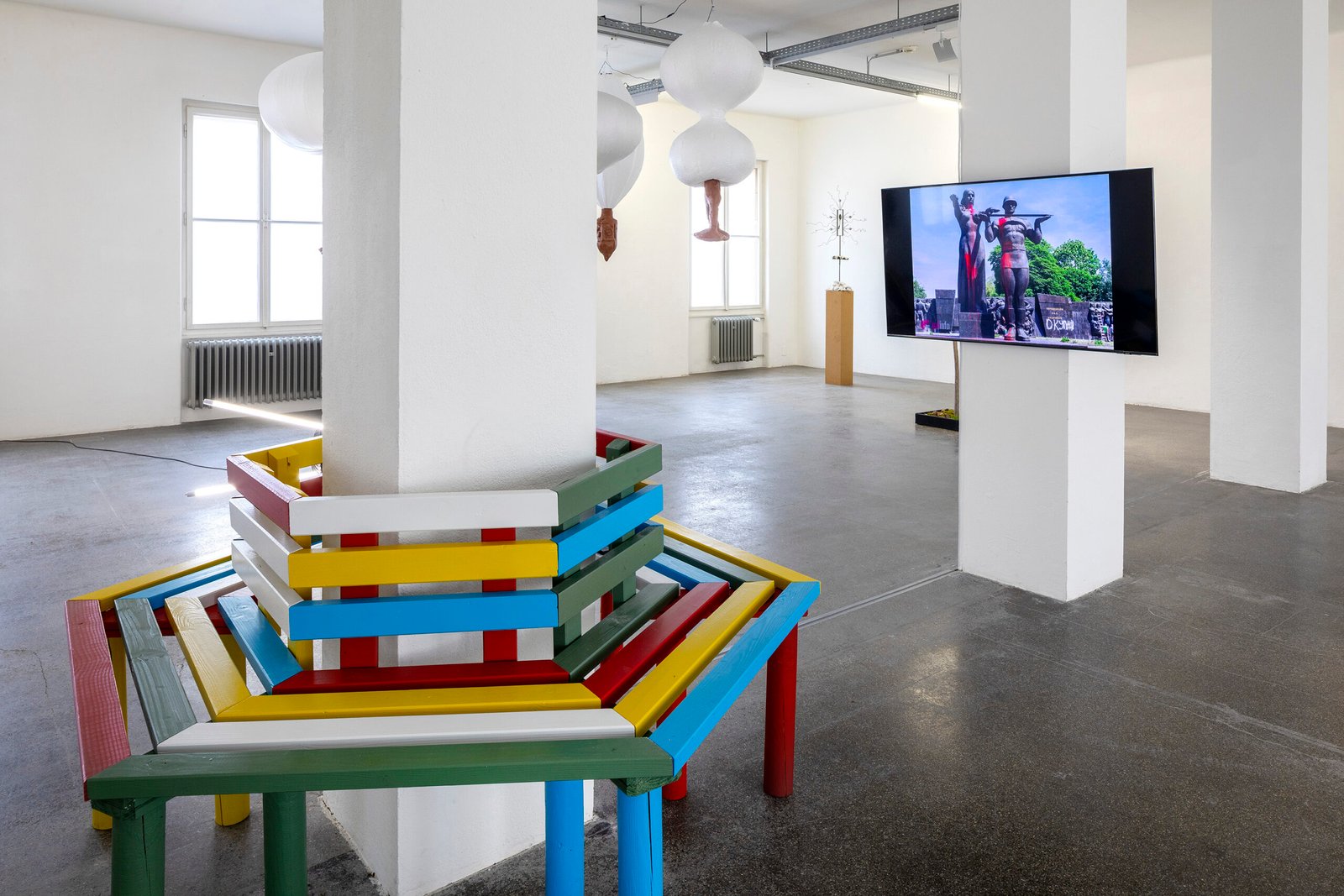
In the center of the room Ekaterina Shapiro-Obermair’s colorfully designed bench is located. It is built around a column—a direct replica of a bench from Bohdan Khmelnytsky Park in Lviv, which encircles a tree there. Sitting on it, one can look at both a filmic essay by the artist and other works of the exhibition. The video examines the “Monument of Glory” in Lviv, a war memorial that was erected in 1970 and dismantled in 2021, shortly before the large-scale invasion. The film interrogates the monument’s artistic quality and traces the history of its transformations.
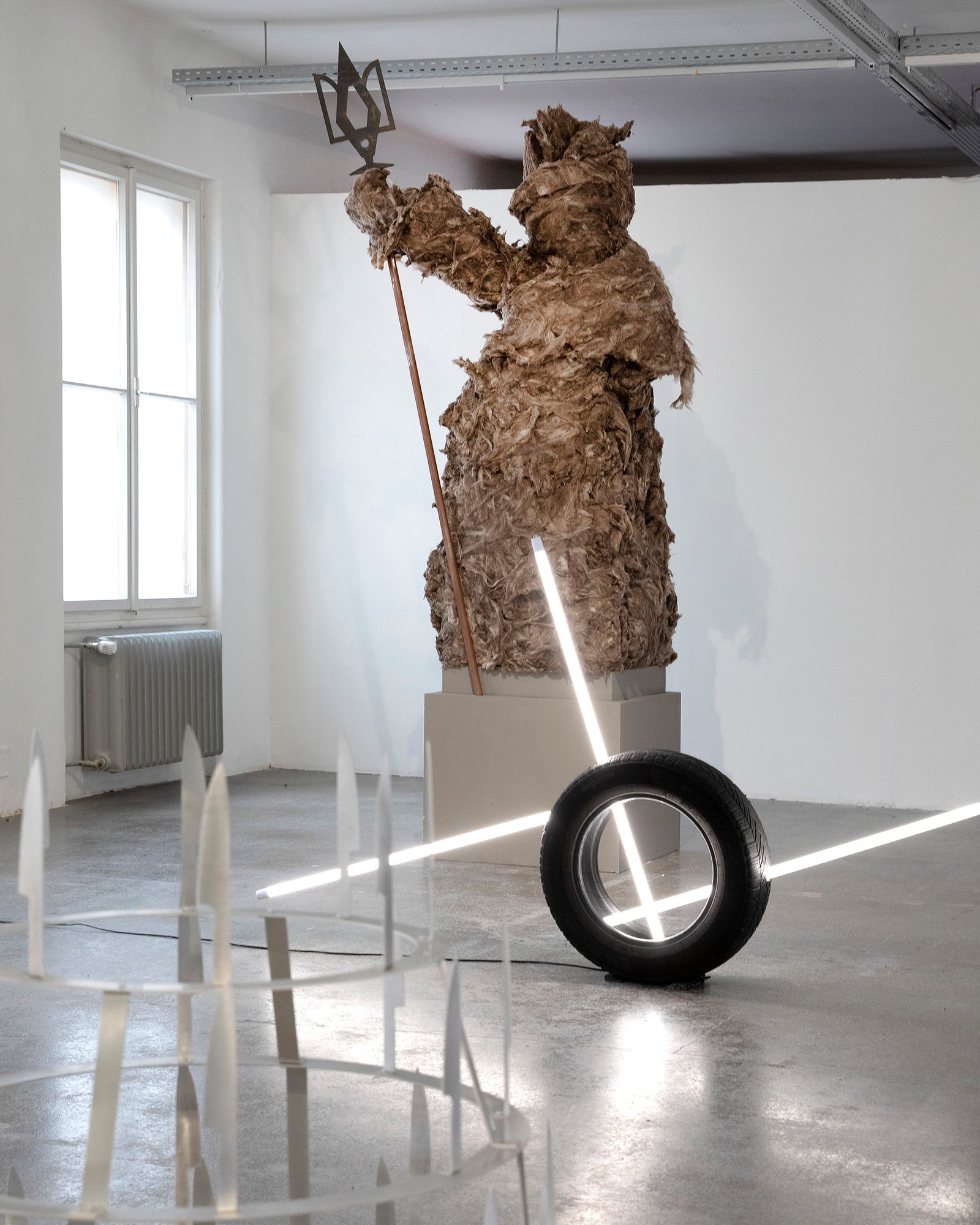
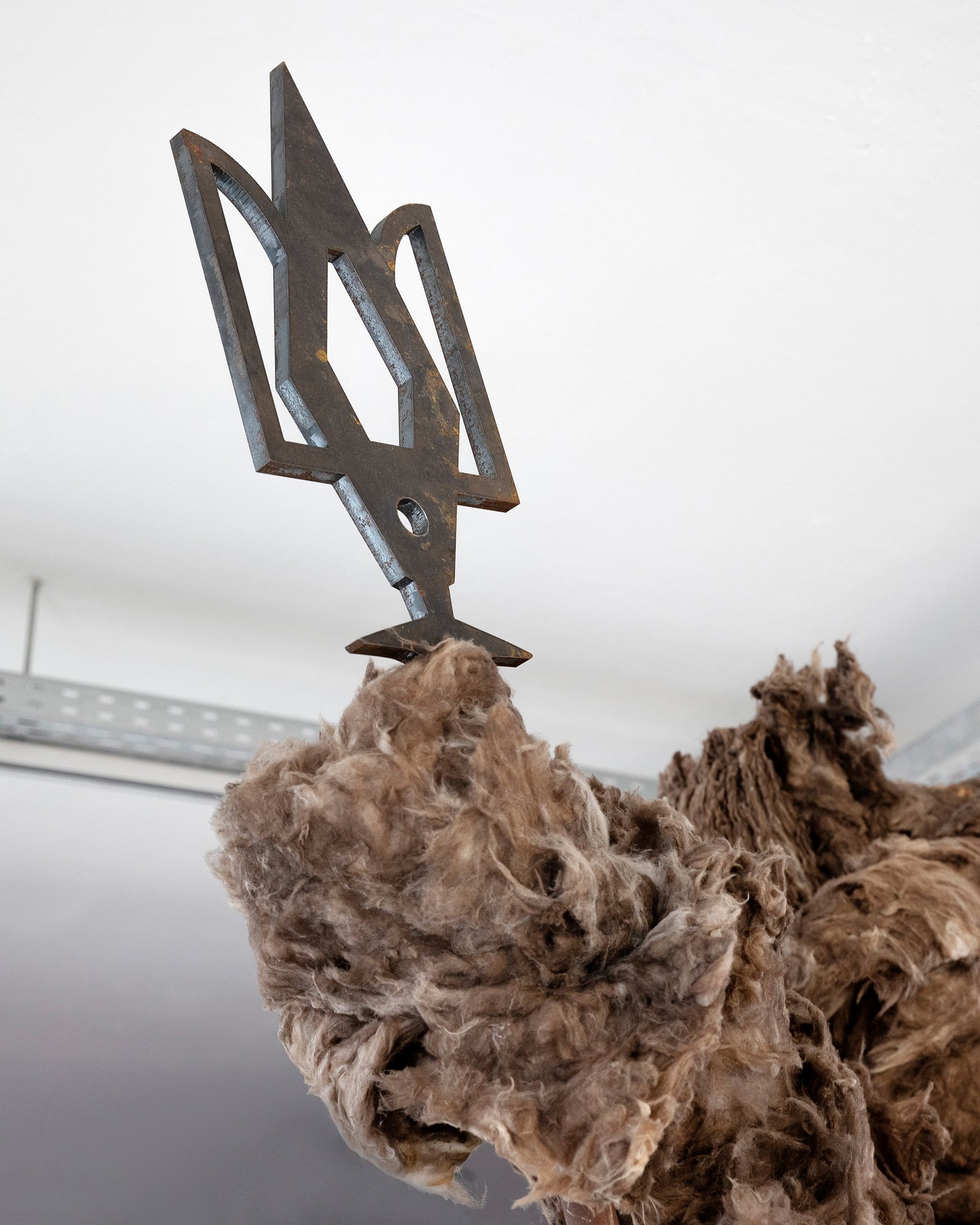
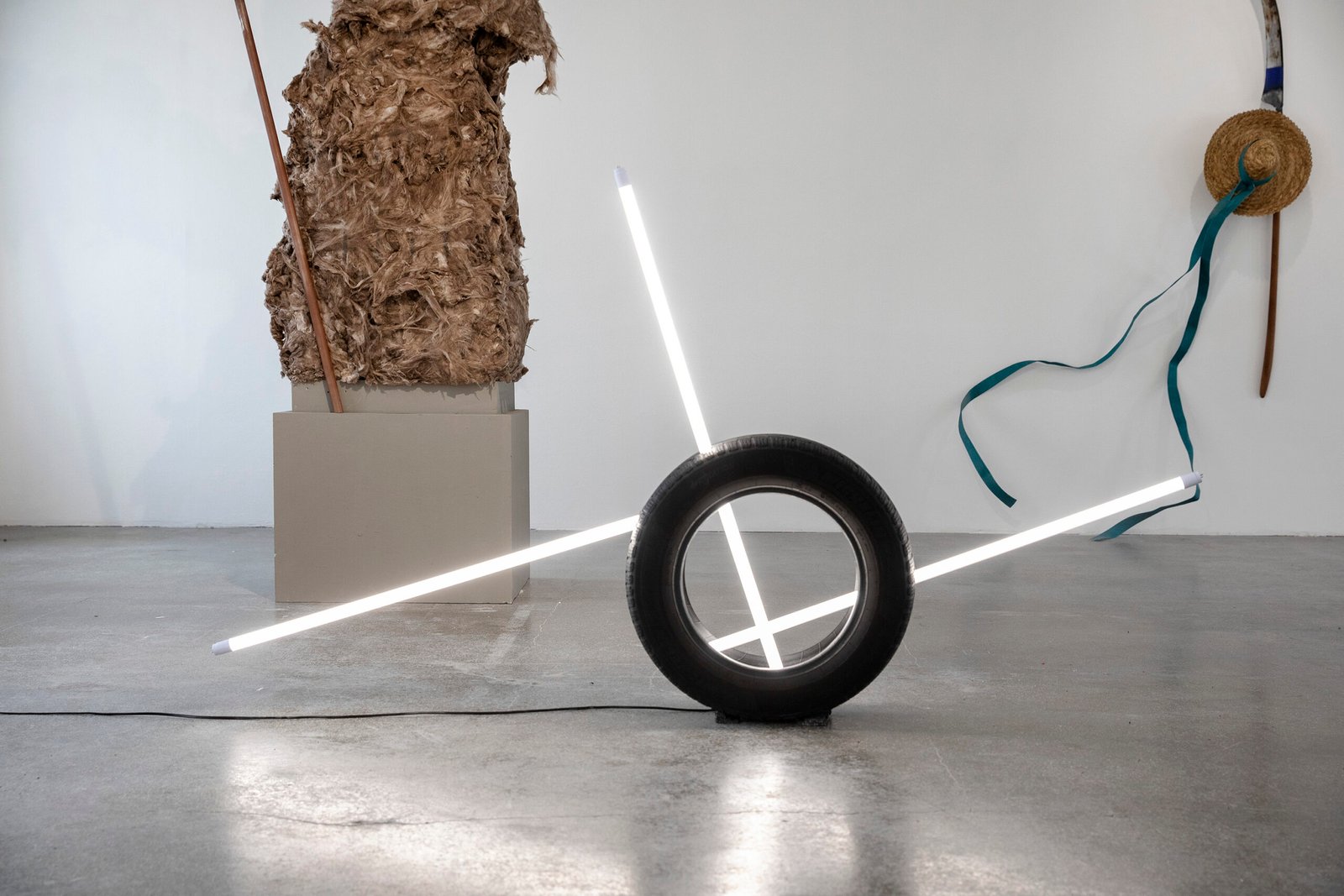
Bögdana Kosmina’s “Neptunia” is also dedicated to a monument in Lviv, but one that is to be preserved from destruction. The work addresses the Neptune statue that stands in the city’s market square. In the exhibition, the sculpture is wrapped in mineral wool—a practice that has been used in Ukraine since February 2022 to protect monuments. The tip of the trident has been replaced by the tryzub of the Ukrainian coat of arms, with which Kosmina references the rising of nationalism in Ukrainian society. Through the figure of Neptune as a sea god, she simultaneously refers to the loss of access to the sea and the ecological catastrophe caused by the destruction of the Kakhovka Dam.
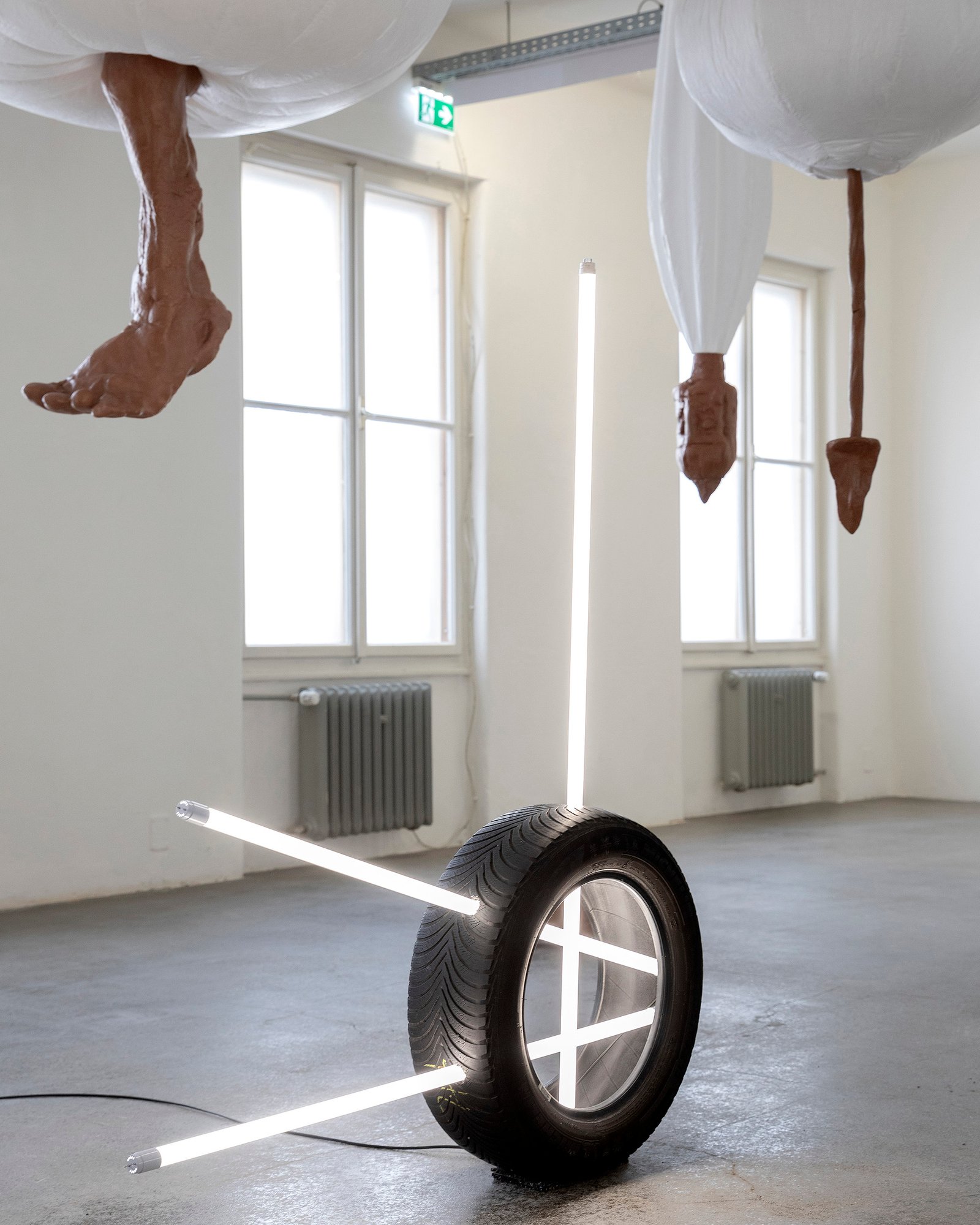
Other works also appear as if they have been transported from outdoor spaces into the gallery, such as Vasco Costa’s objects titled “Anarchists Turn Right”, “Driven by Numbers”, and “Dead Angle”, which are built on car tires. The three vertically oriented sculptures with their expansive LED bars structure the space and connect with other elements of the exhibition through their dominant light and, not least, through the form of the upright rings. Costa’s work operates in terms of an archaeology of modernity, drawing correspondences between the formal qualities of sculpture and 1990s media theories such as those of Paul Virilio.
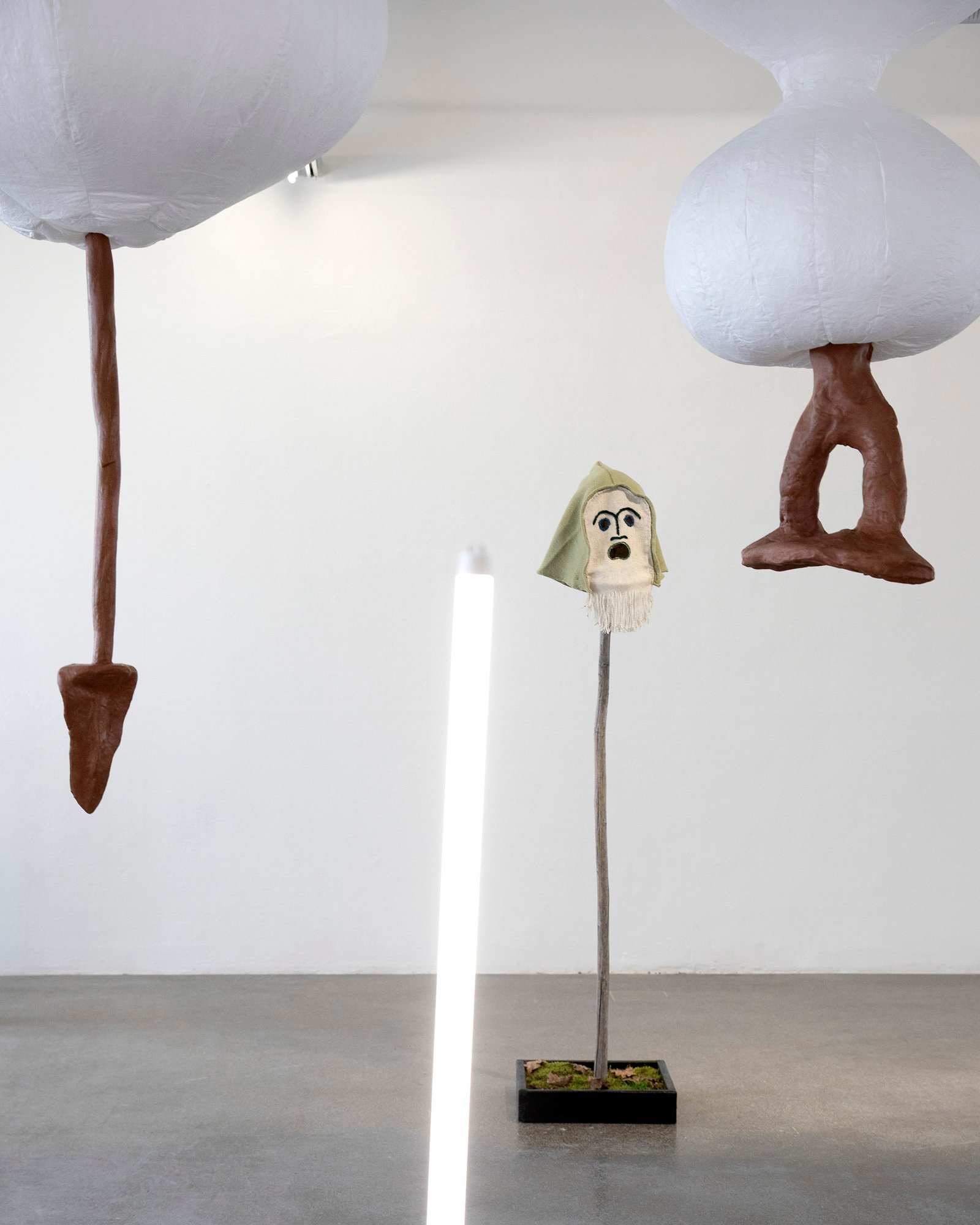
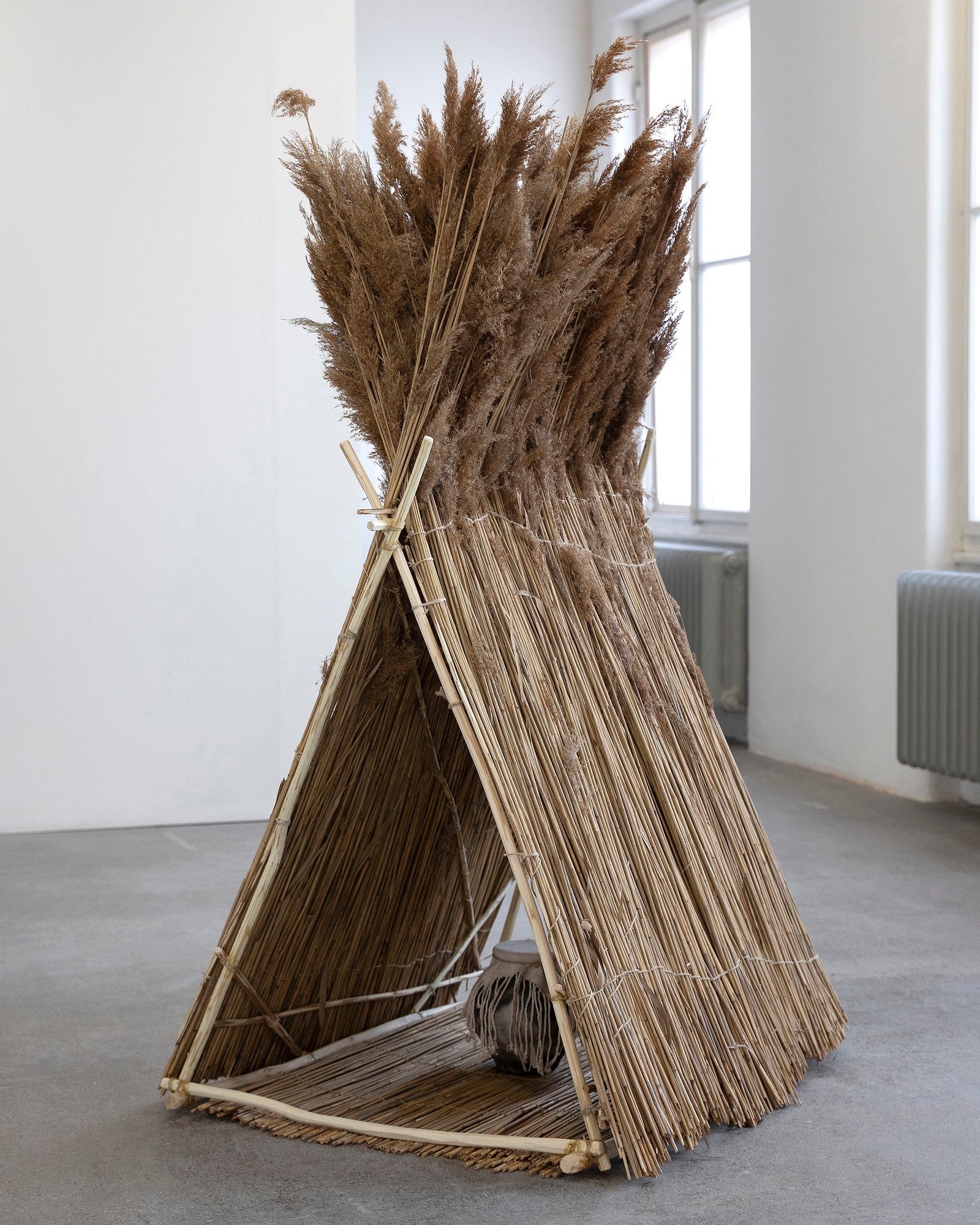
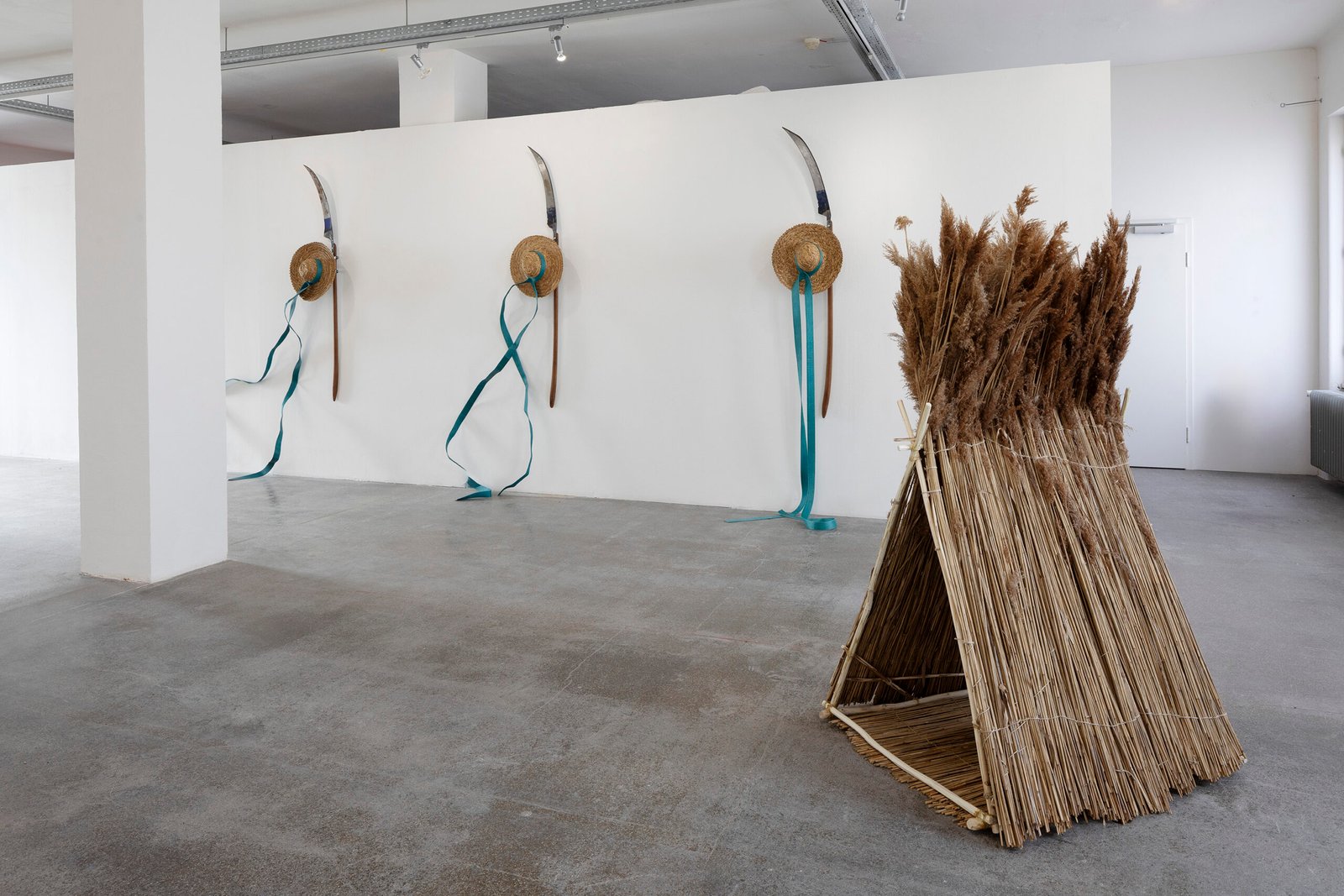
Jason Bunton’s piece “How It Might Have Been” can also be read in the context of a reification of history: a small hut, inside it an urn that is meant to house it after the structure burns down. A concept that understands the current form of presentation as an early stage of the sculpture. Another work by him, “Hooded Mask”, is a handmade fabric mask mounted on the end of a staff. The object, also used performatively, once again demonstrates his deep interest in and understanding of folk art, myths, and archaeology.
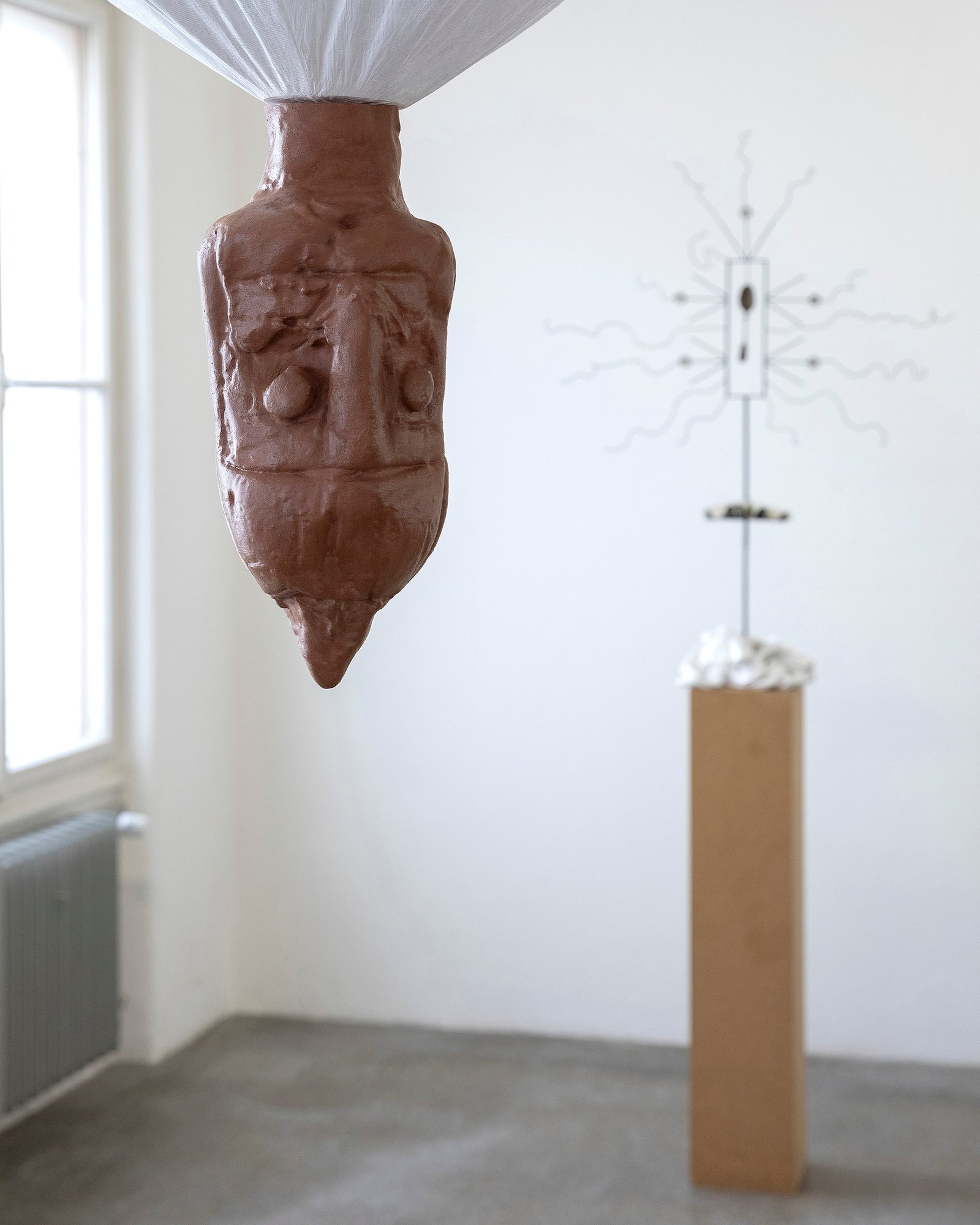
Wolfgang Obermair suspends oversized objects just below the ceiling: a car tire, arrowhead, a severed foot—archetypes referencing elements of the exhibition, which he first shaped as clay miniatures before digitally enlarging them. Attached to Tyvek balloons, they form an ironically fractured assemblage: heterogeneous elements torn from their original functional contexts, now constituting a fragmented historical panorama. The work points to Obermair’s method of thinking aesthetic and technical innovation together.
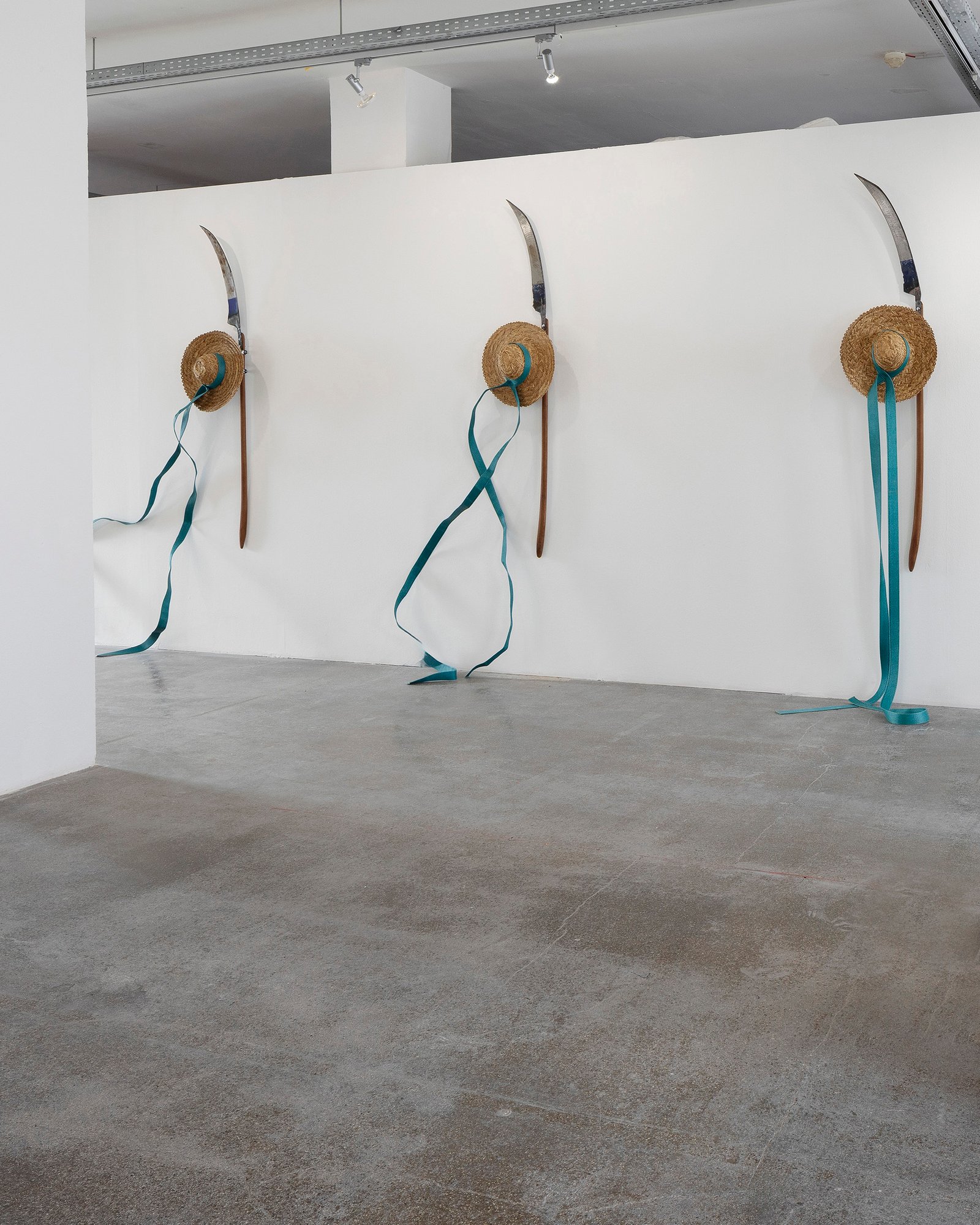
On the end wall of the exhibition space, one finds a series of three works. Uladzimir Hramovich’s objects “Rebellious Things (New Wind)” reference the political situation in Belarus. Not only the title, but also the ribbons on the hats suggest a wind movement that enters from outside into the exhibition space. The circular form of the hats is repeated in the circle of the tires and in the circle of the bench—all elements by other artists in the exhibition. The relationships become even more direct when one understands his work as hats with knives. Hramovich was the artist who stood at the beginning of the anecdote.
Wolfgang Obermair, Ekaterina Shapiro-Obermair