


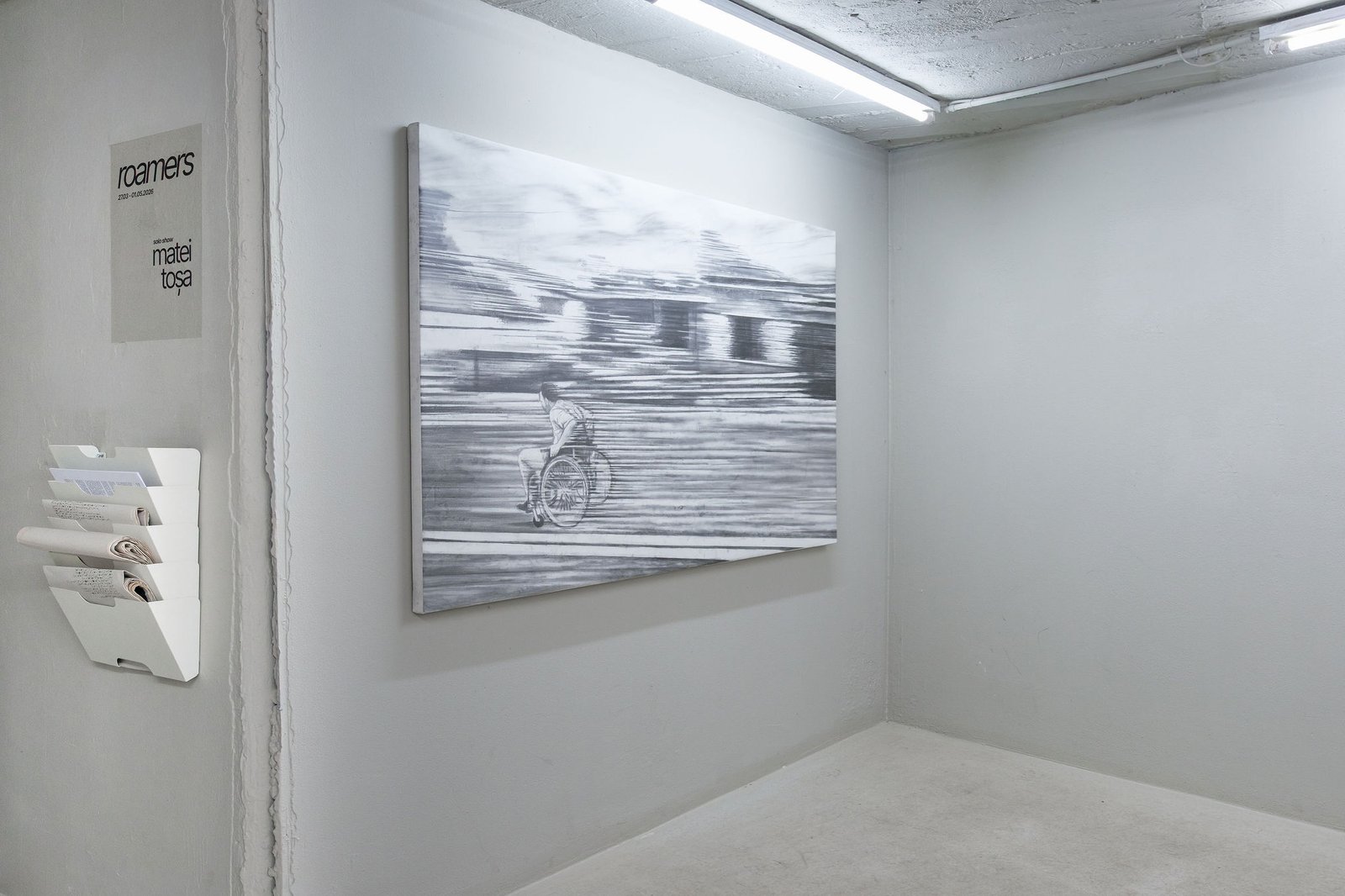
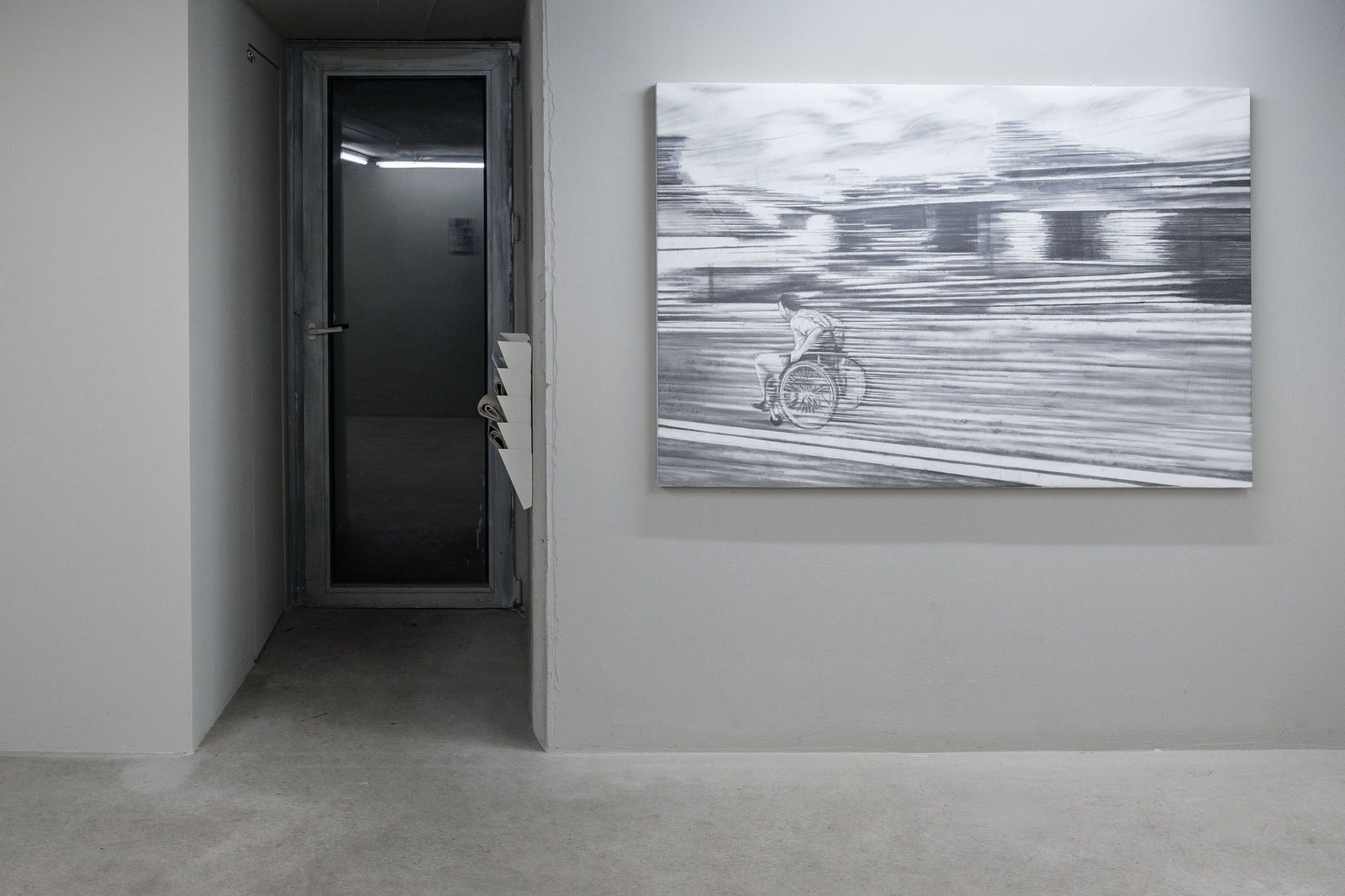
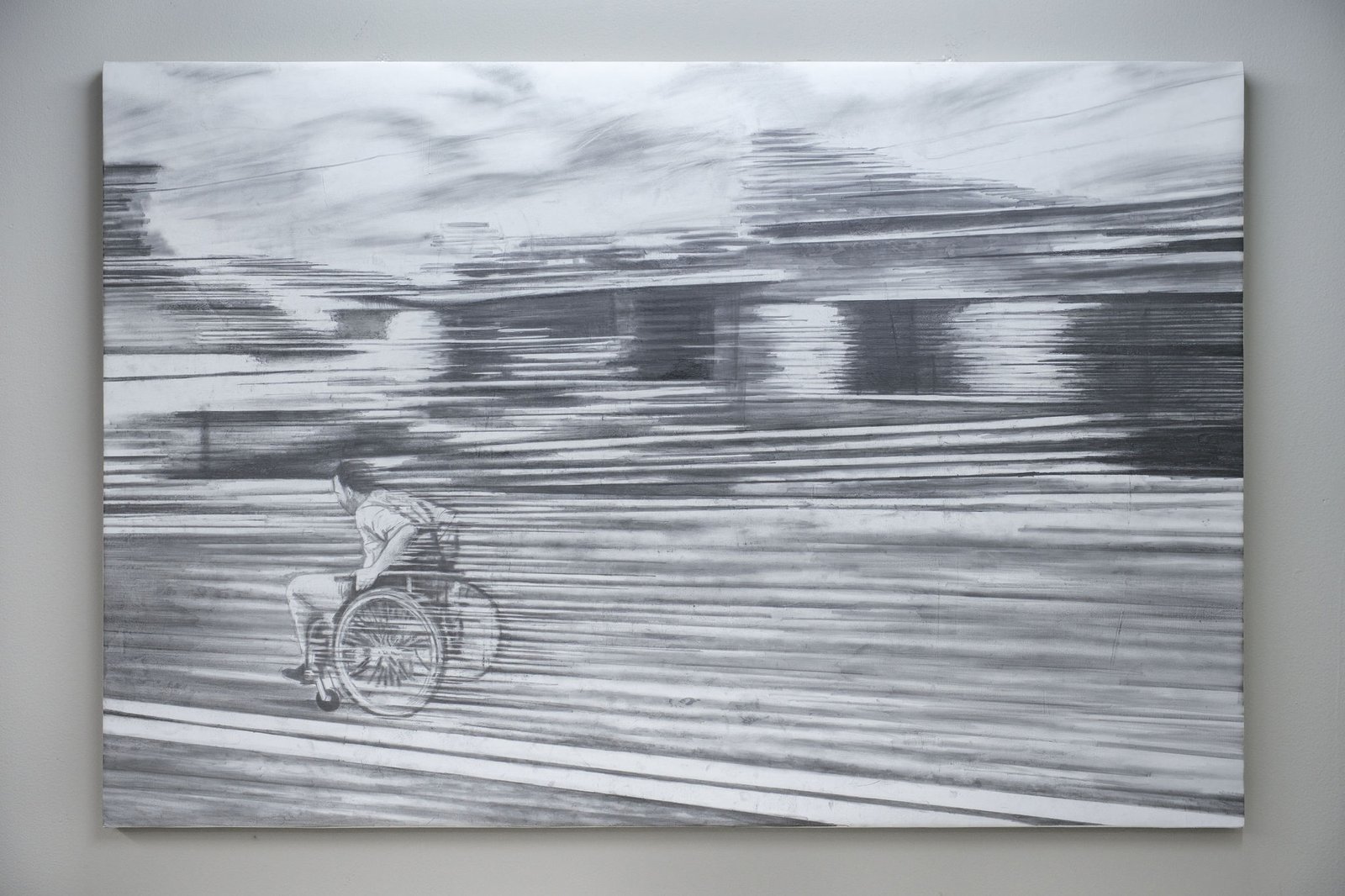
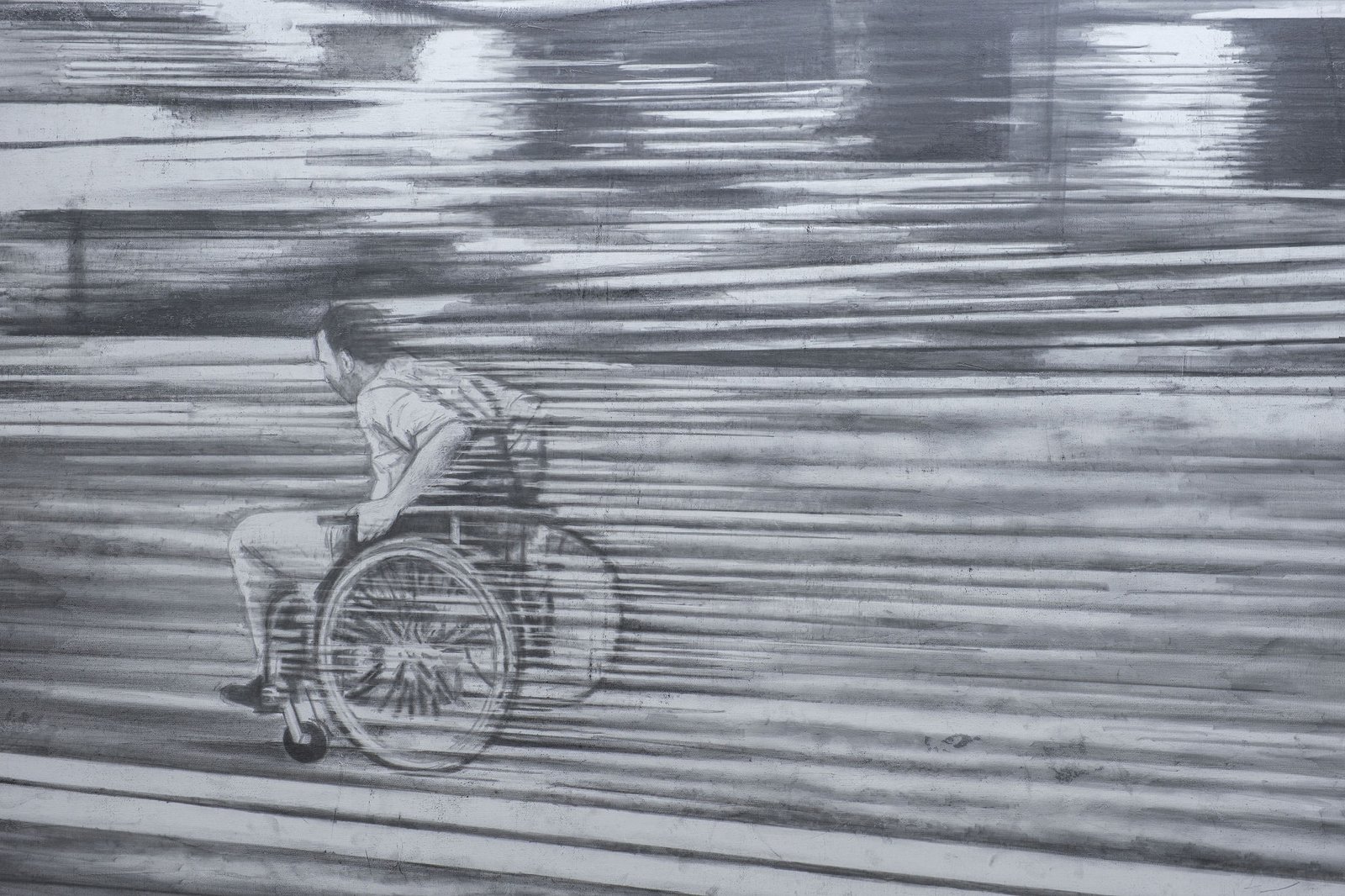
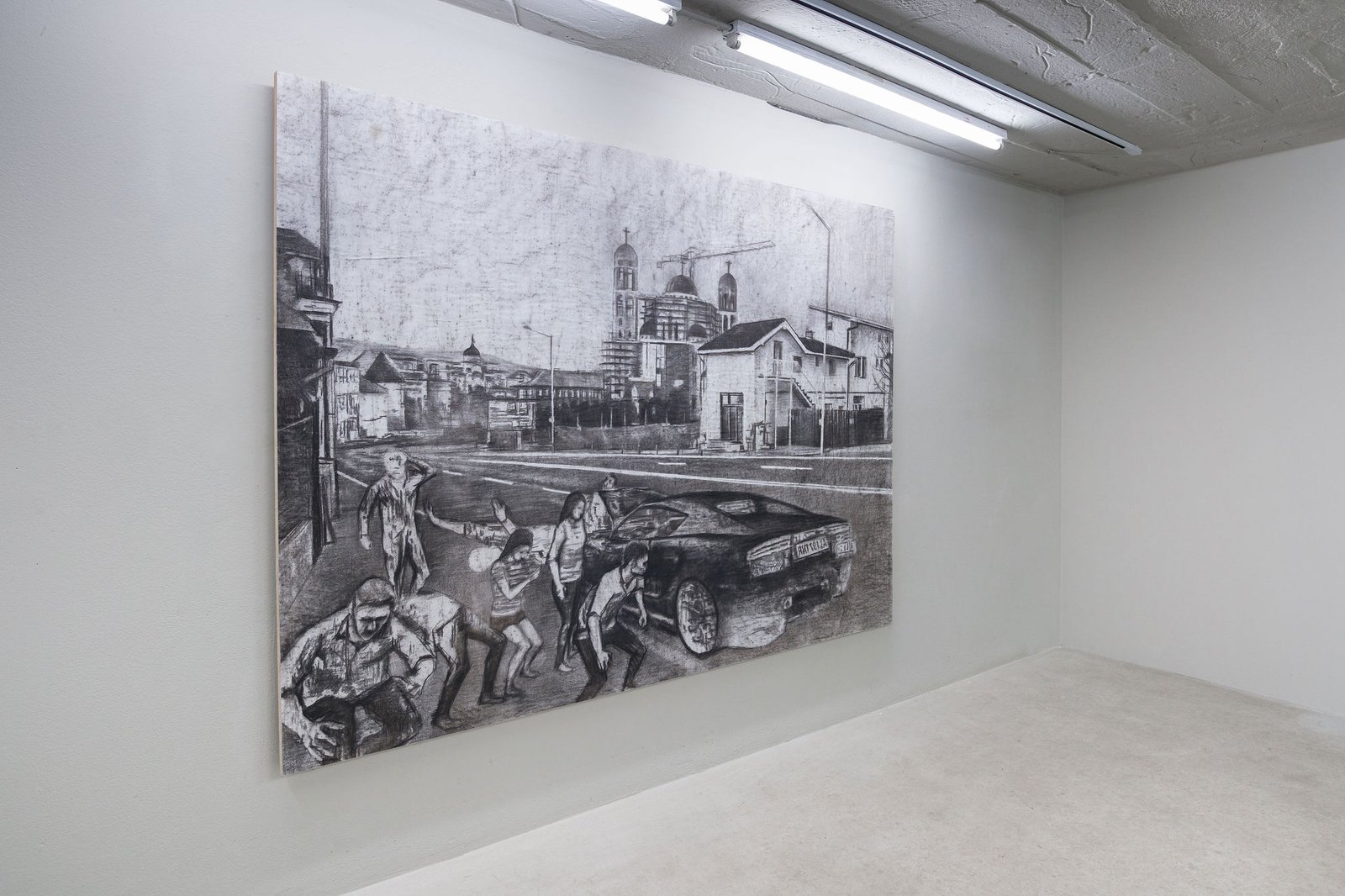
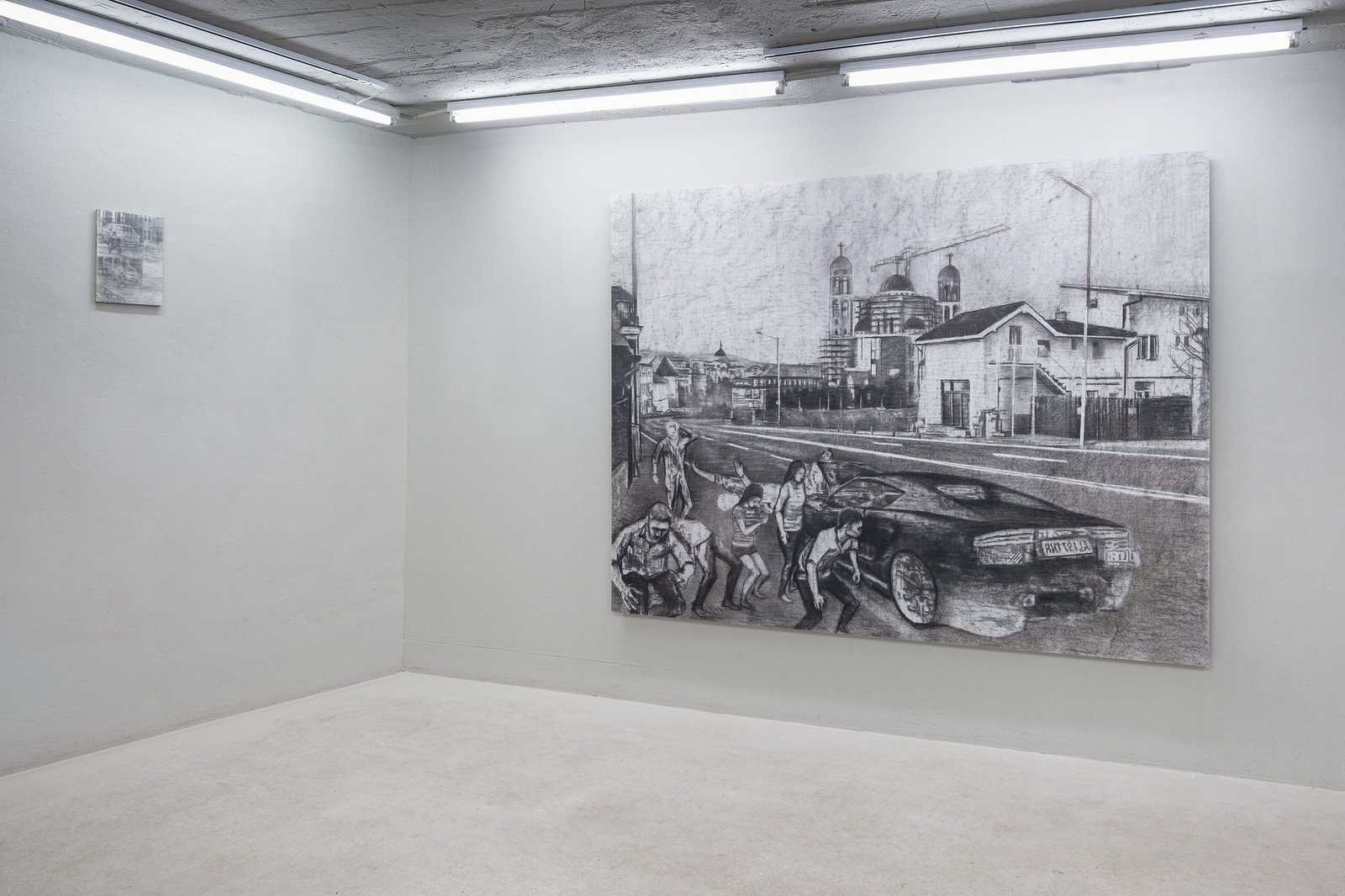
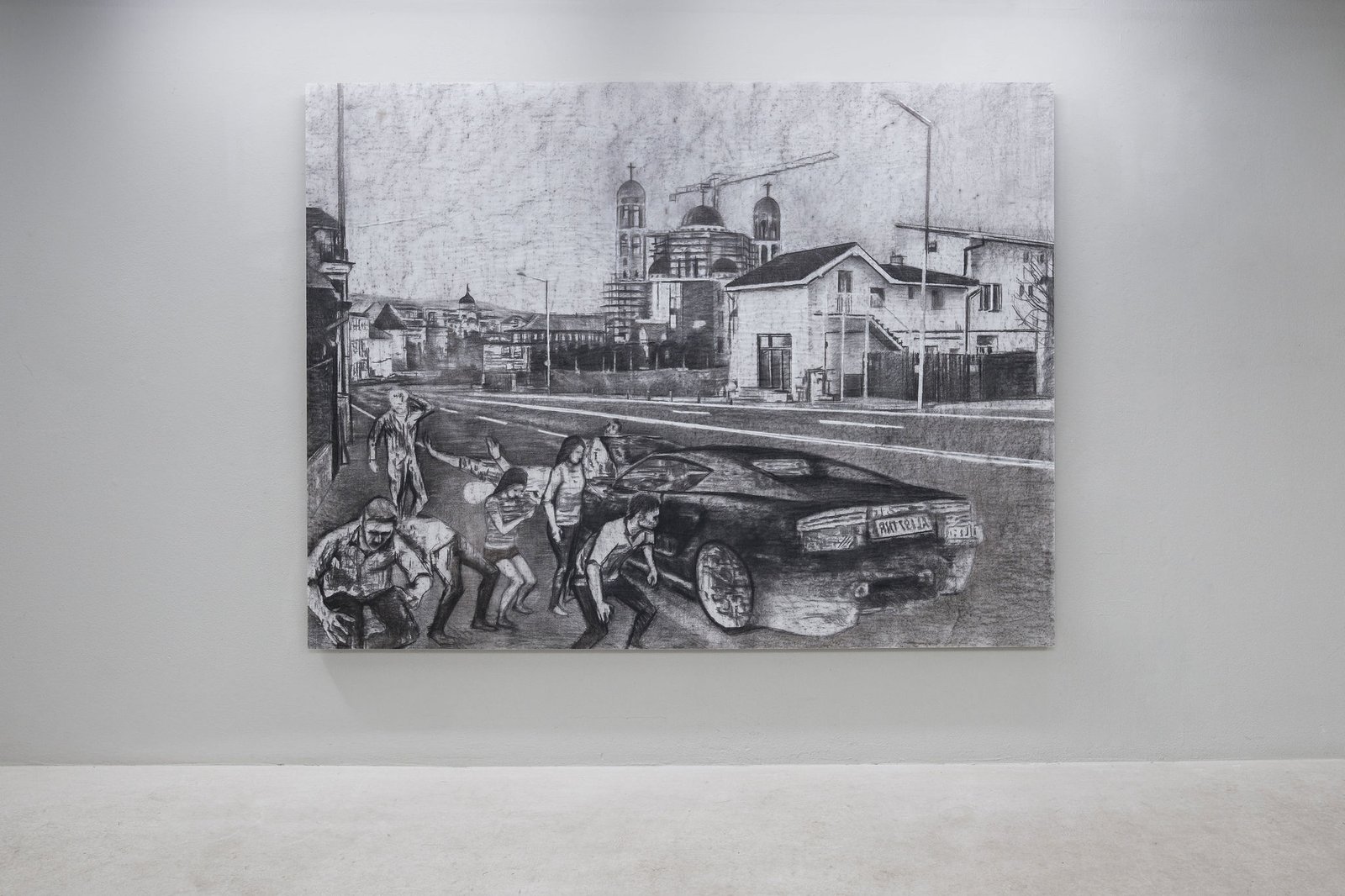
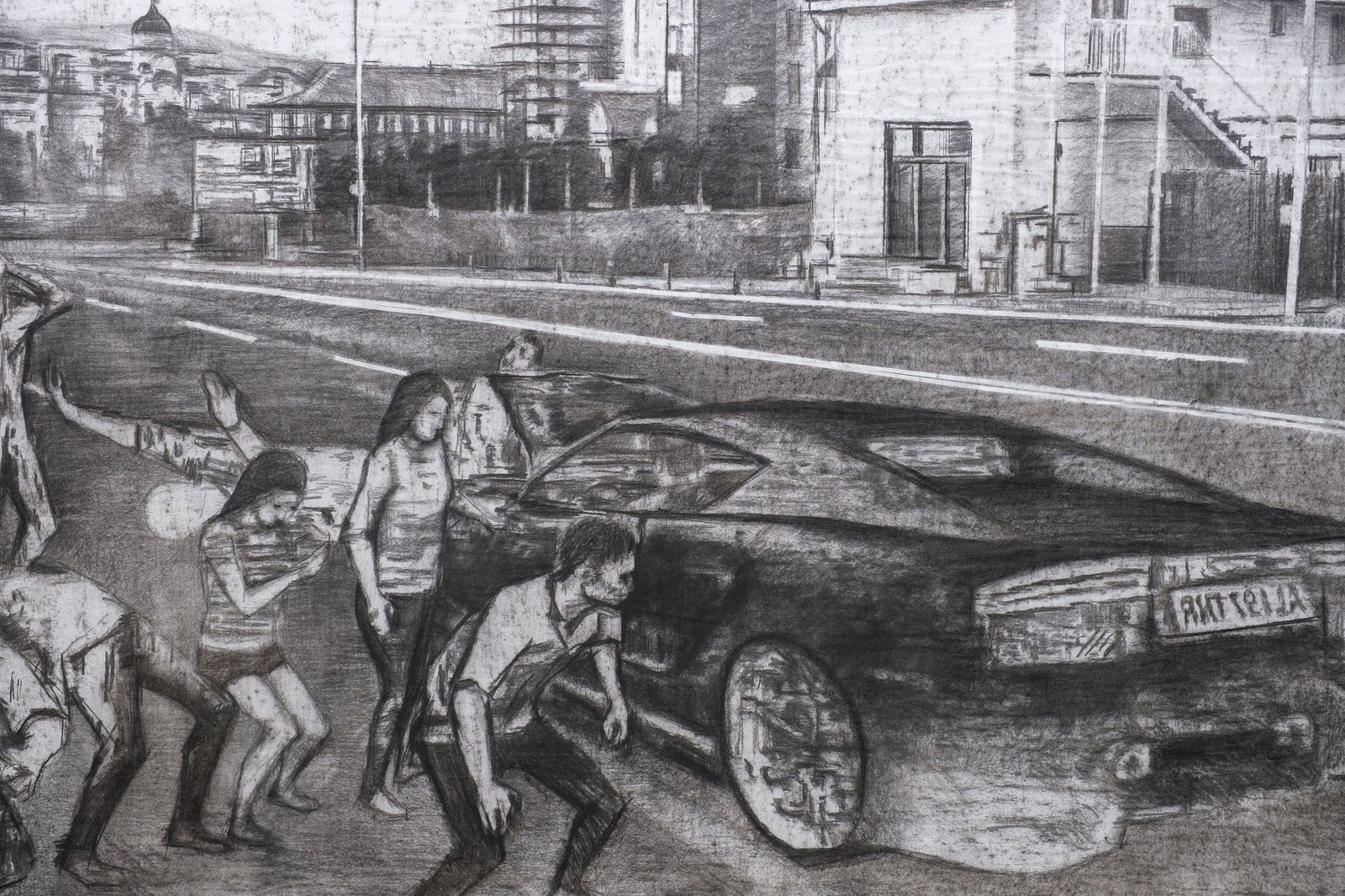
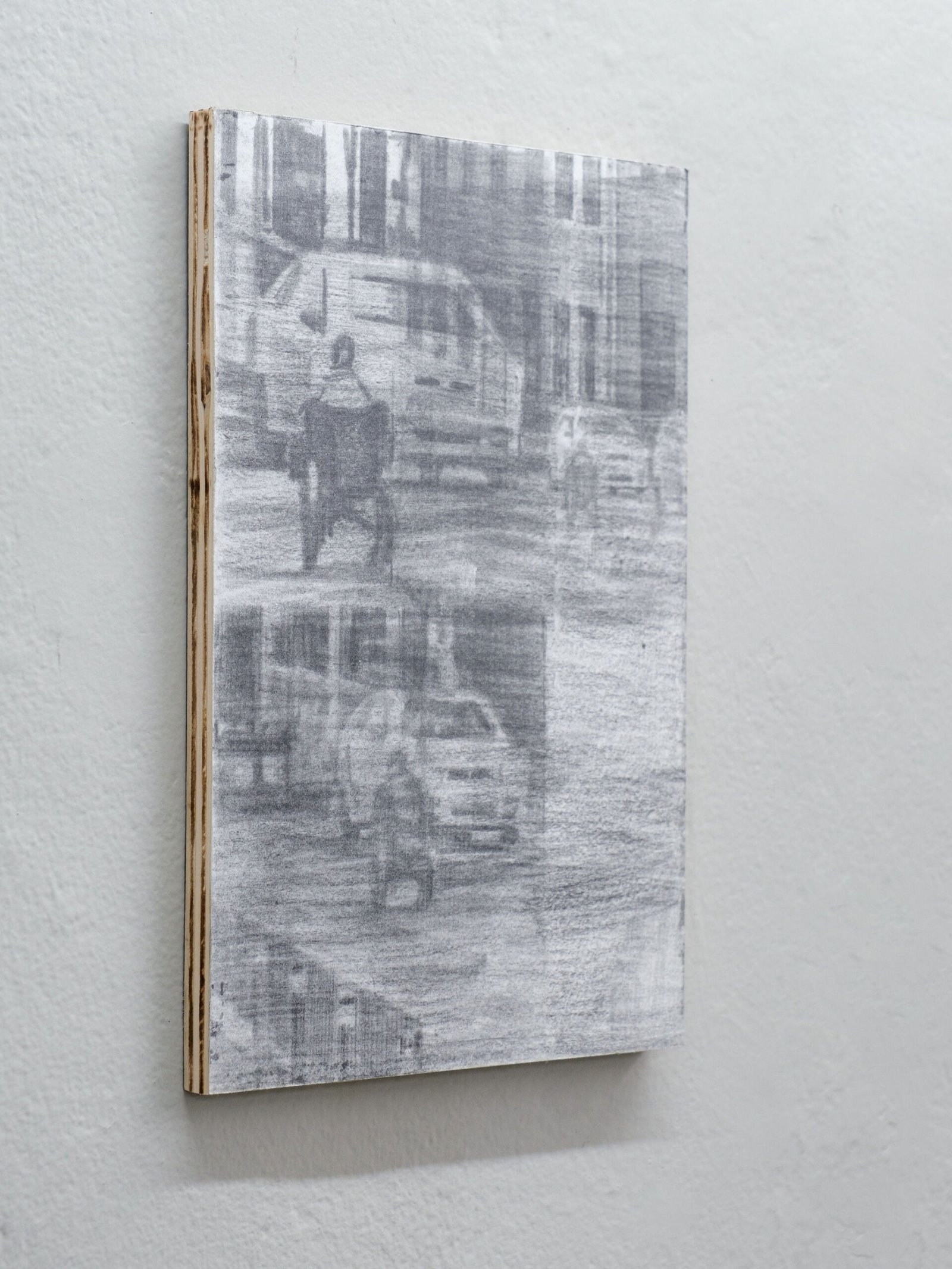
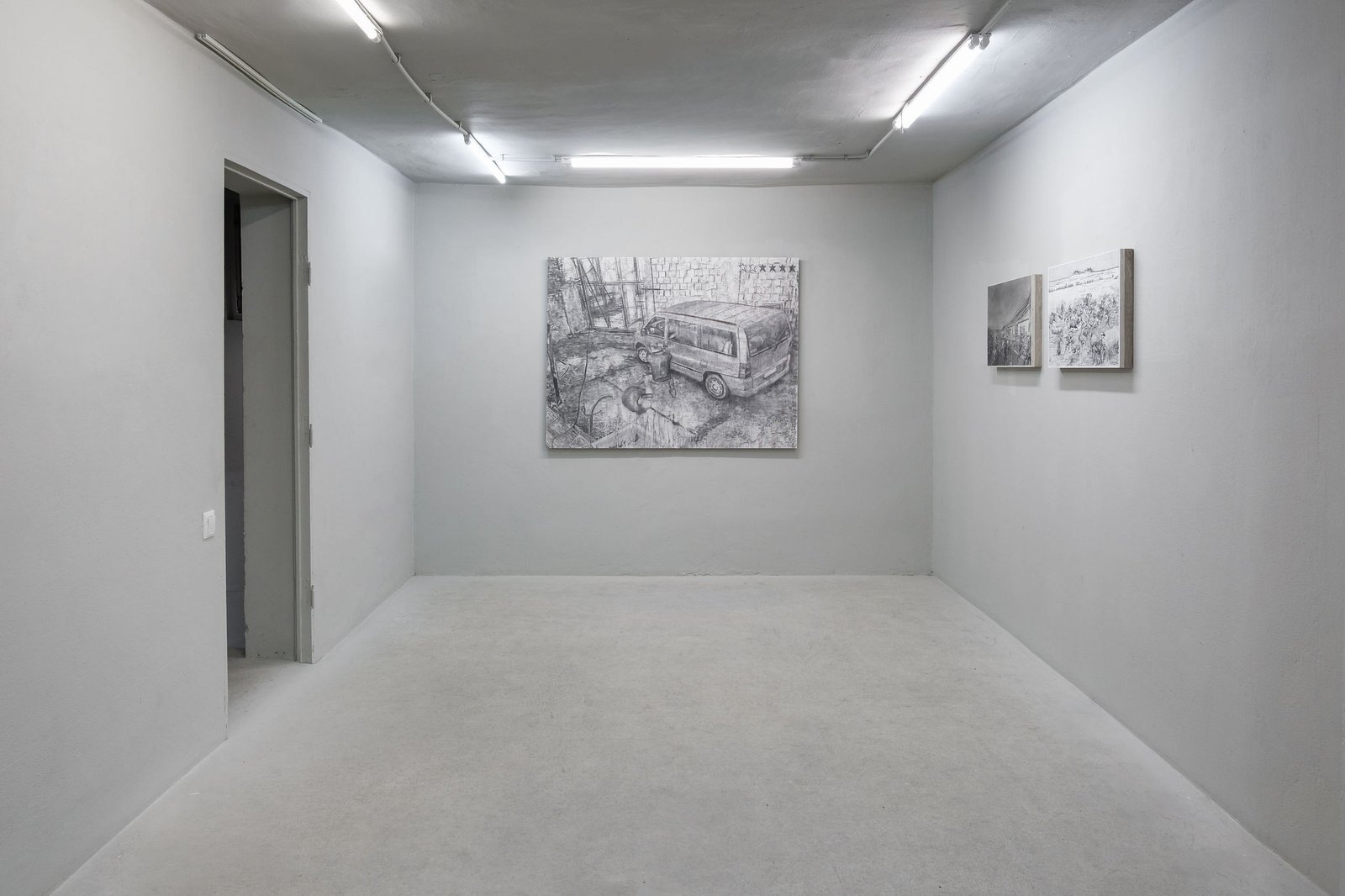
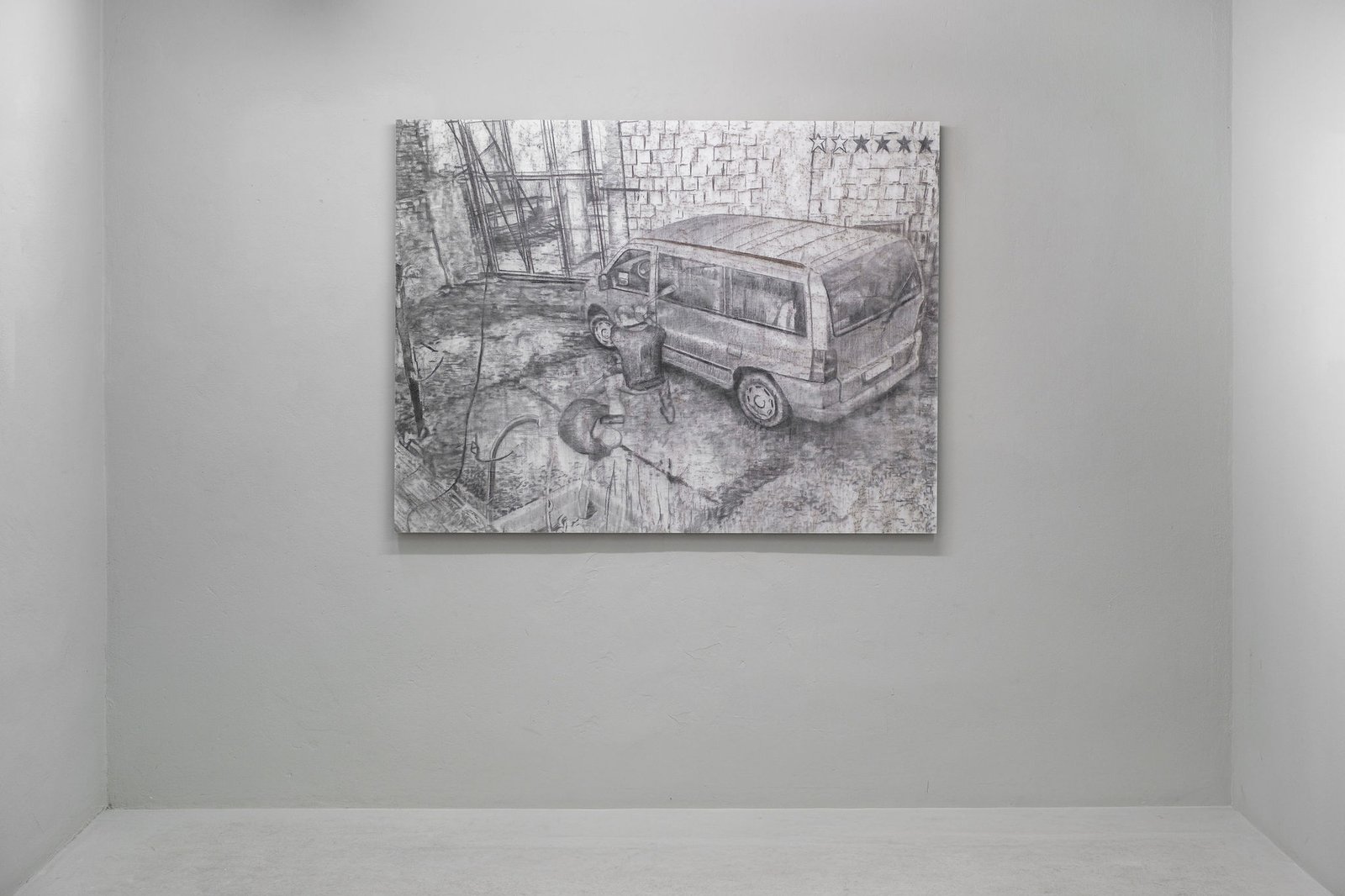
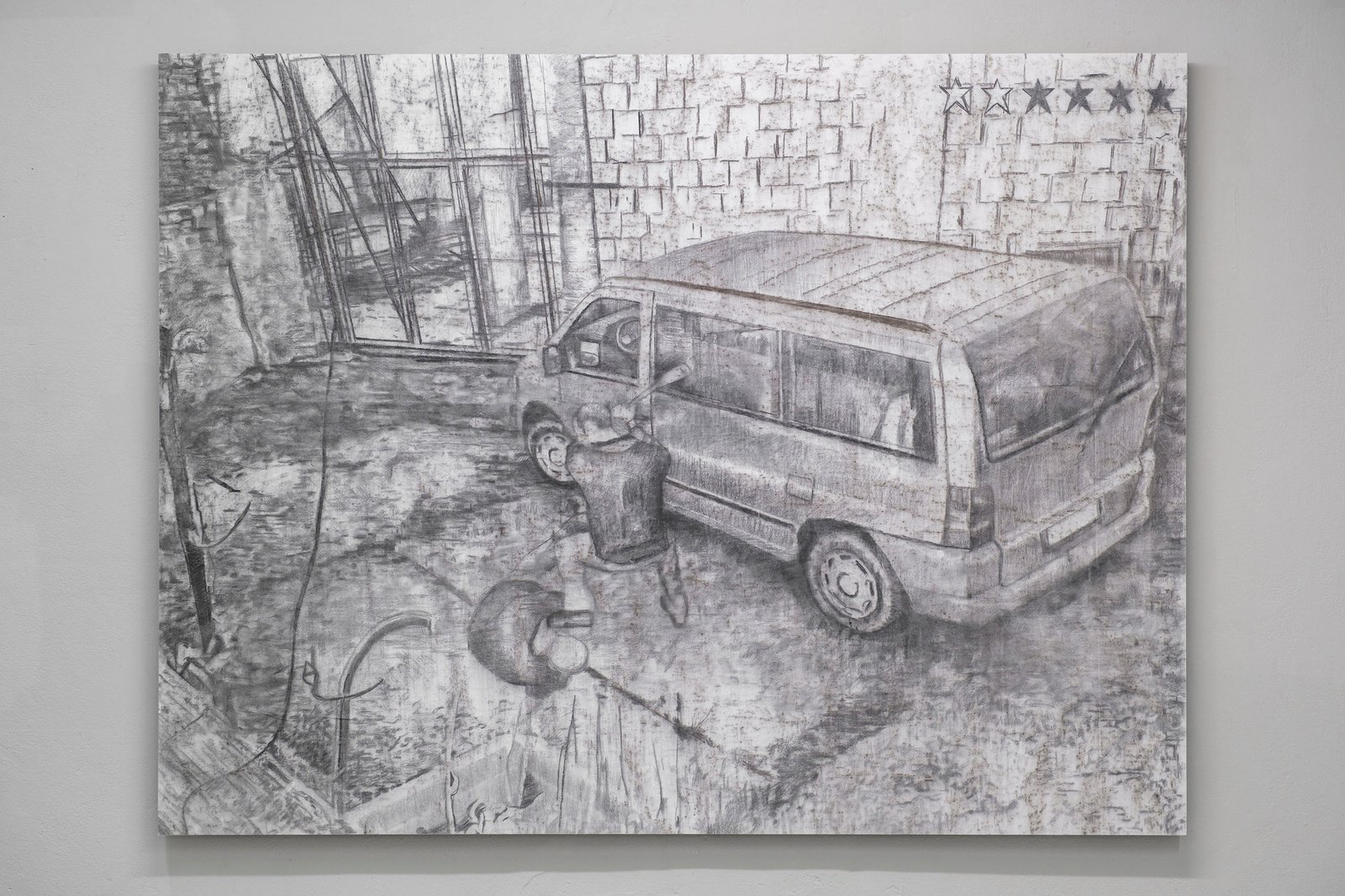
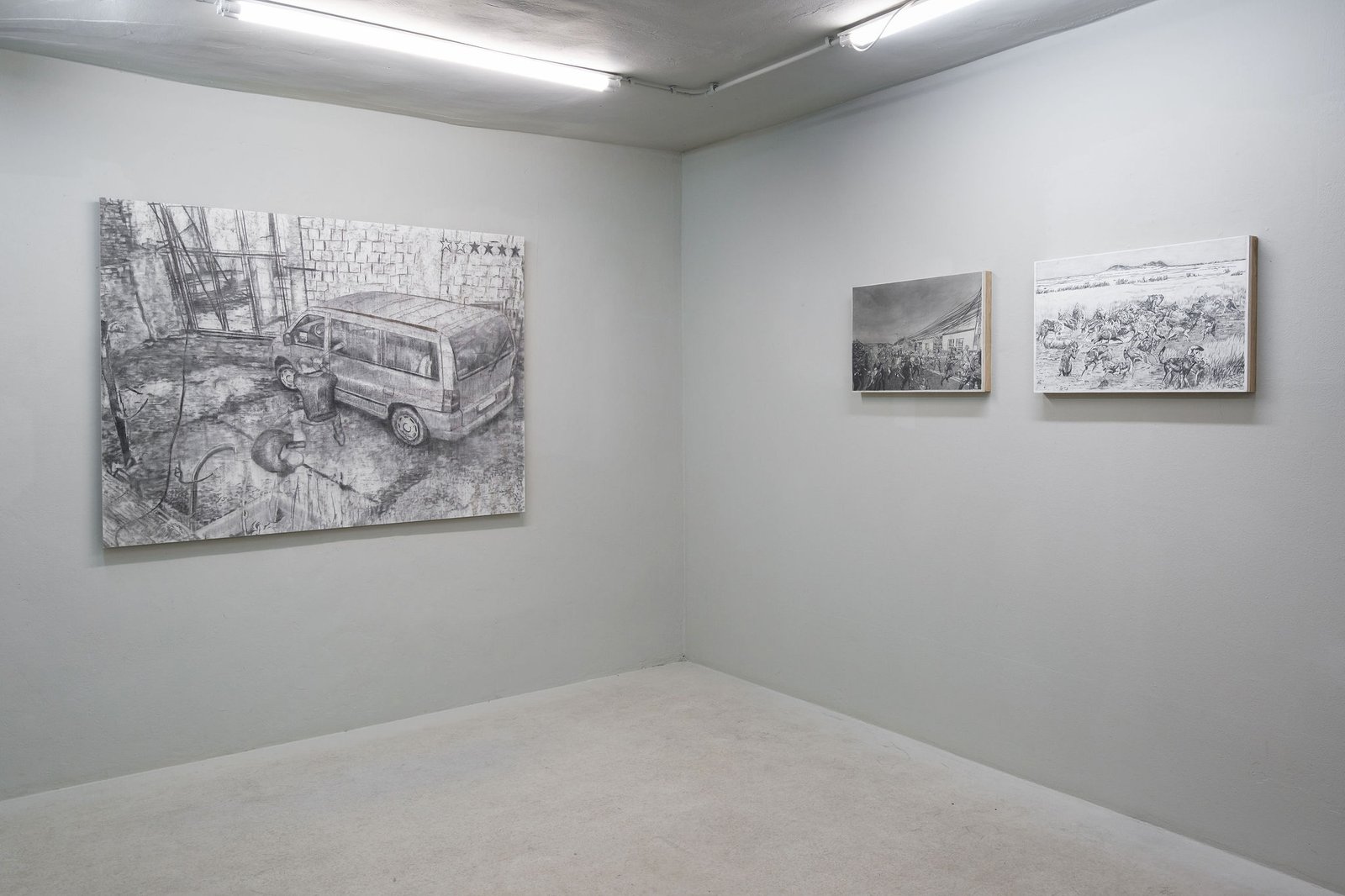
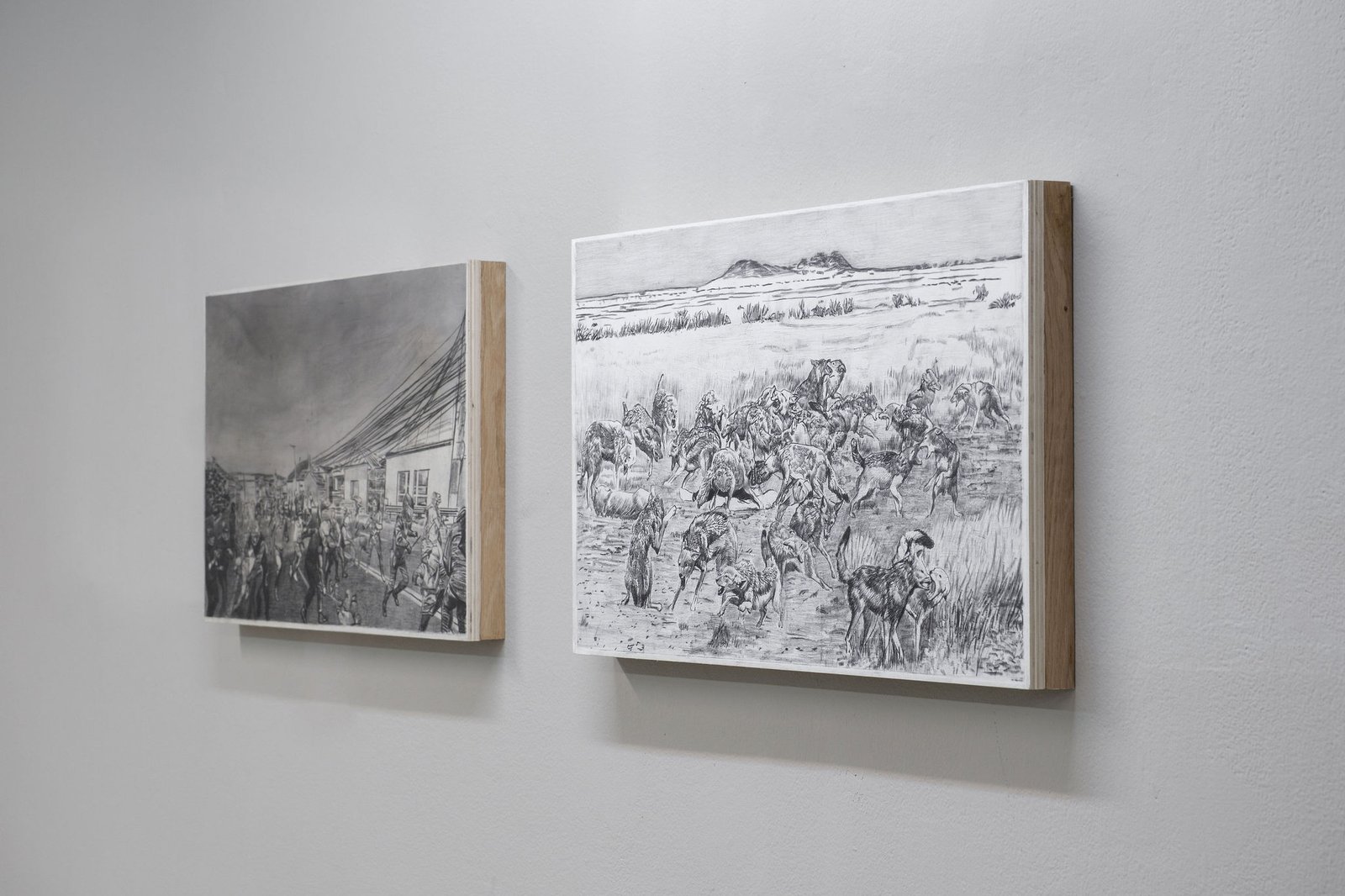
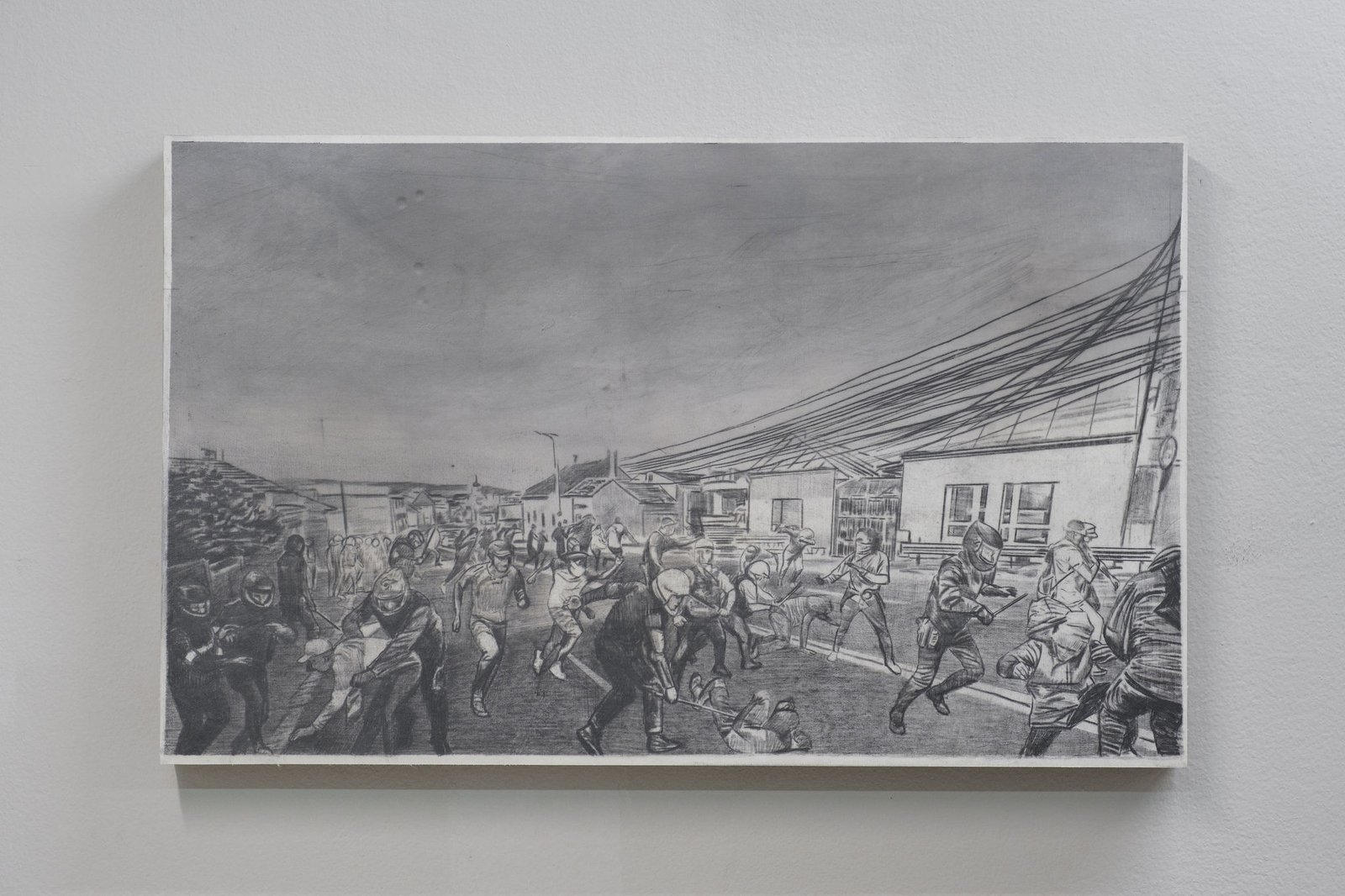
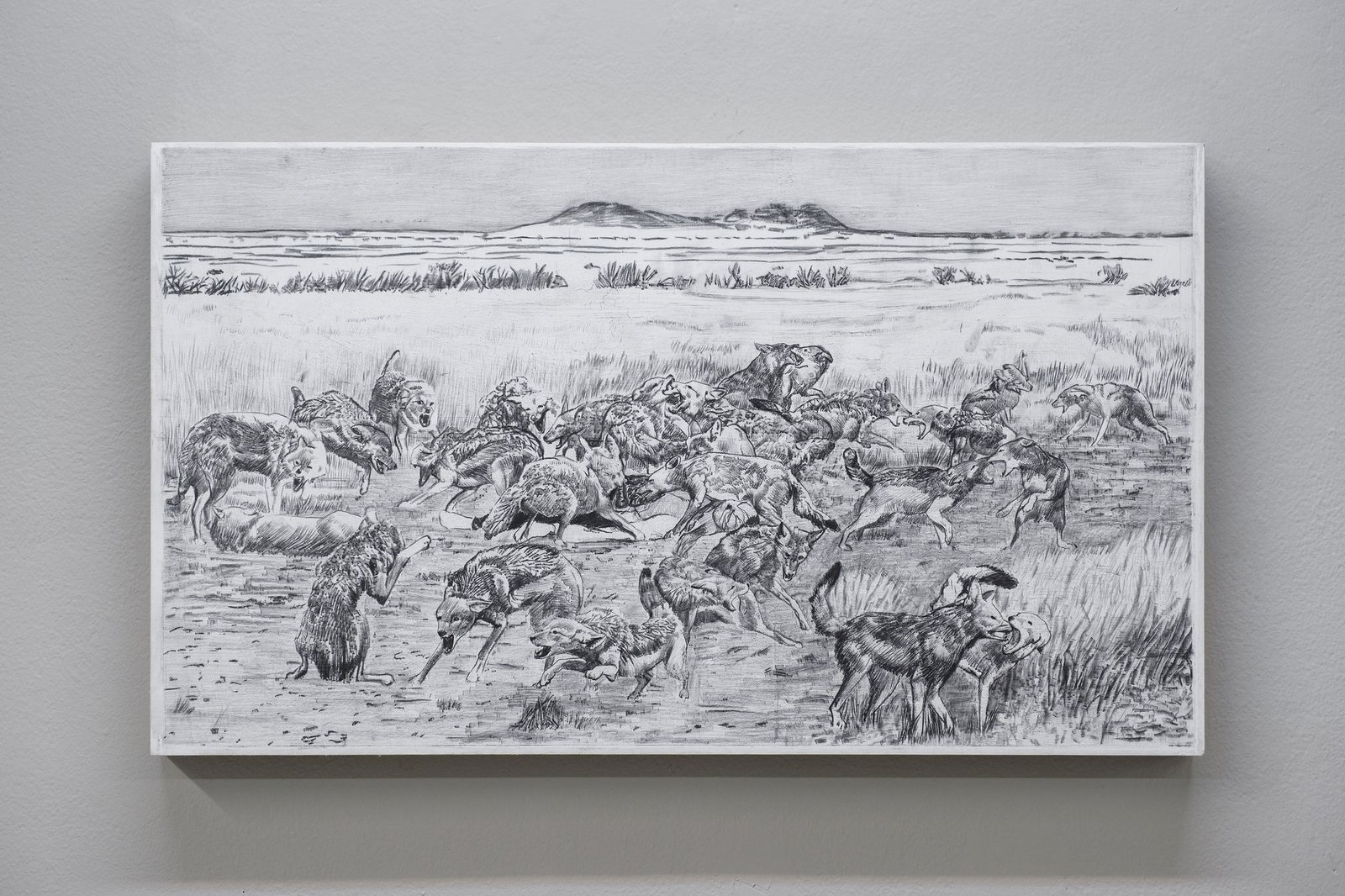
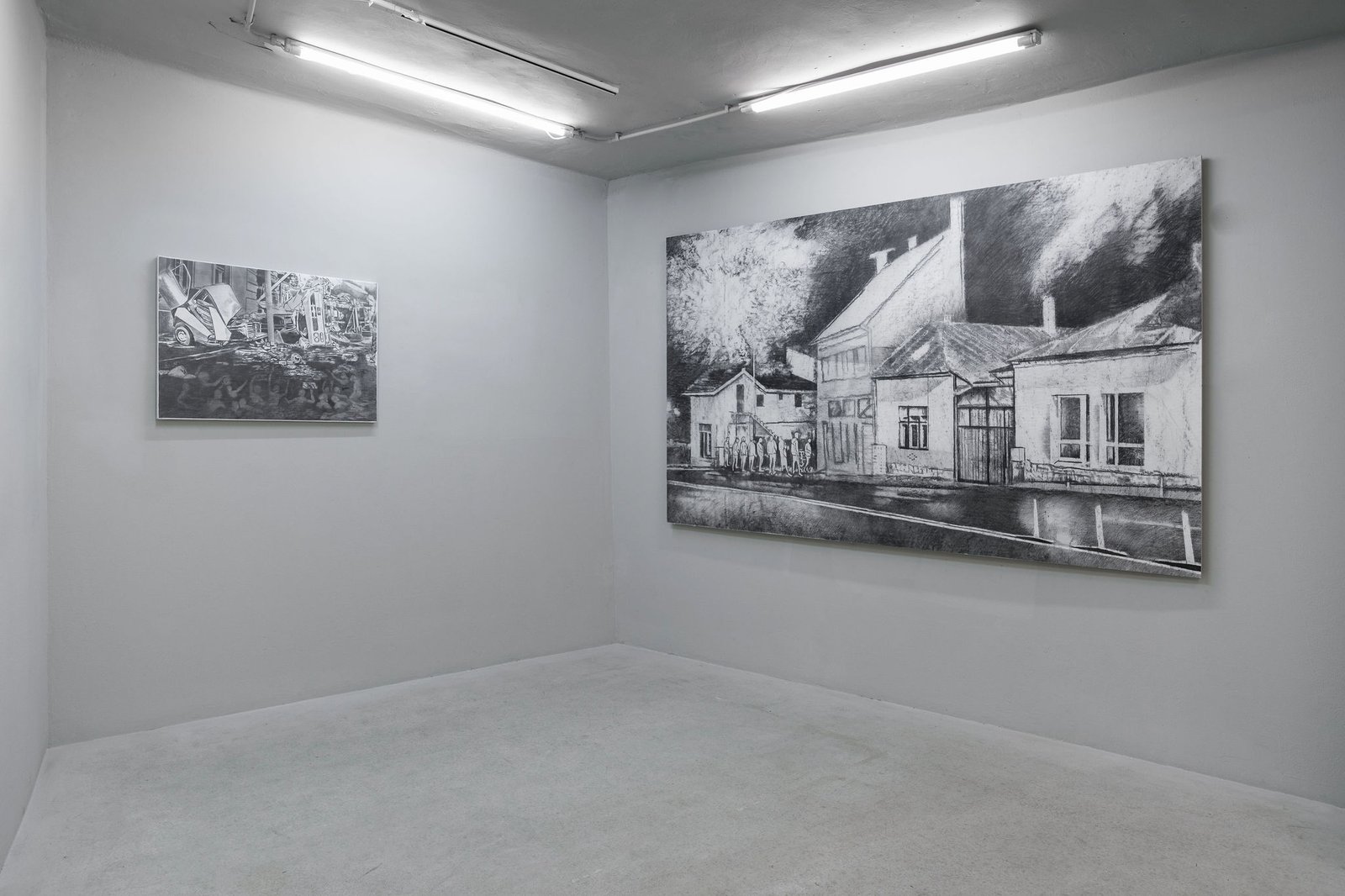
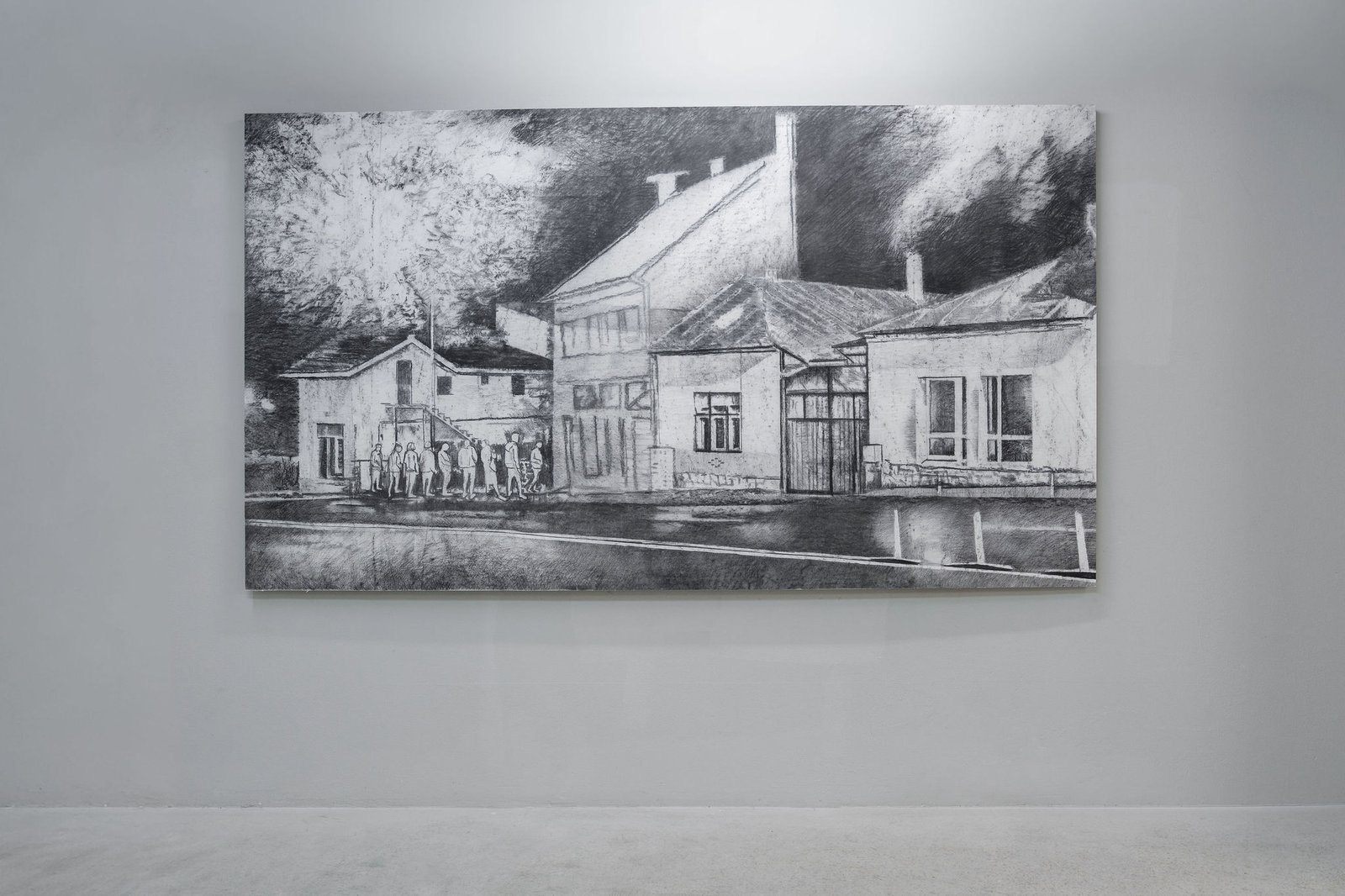
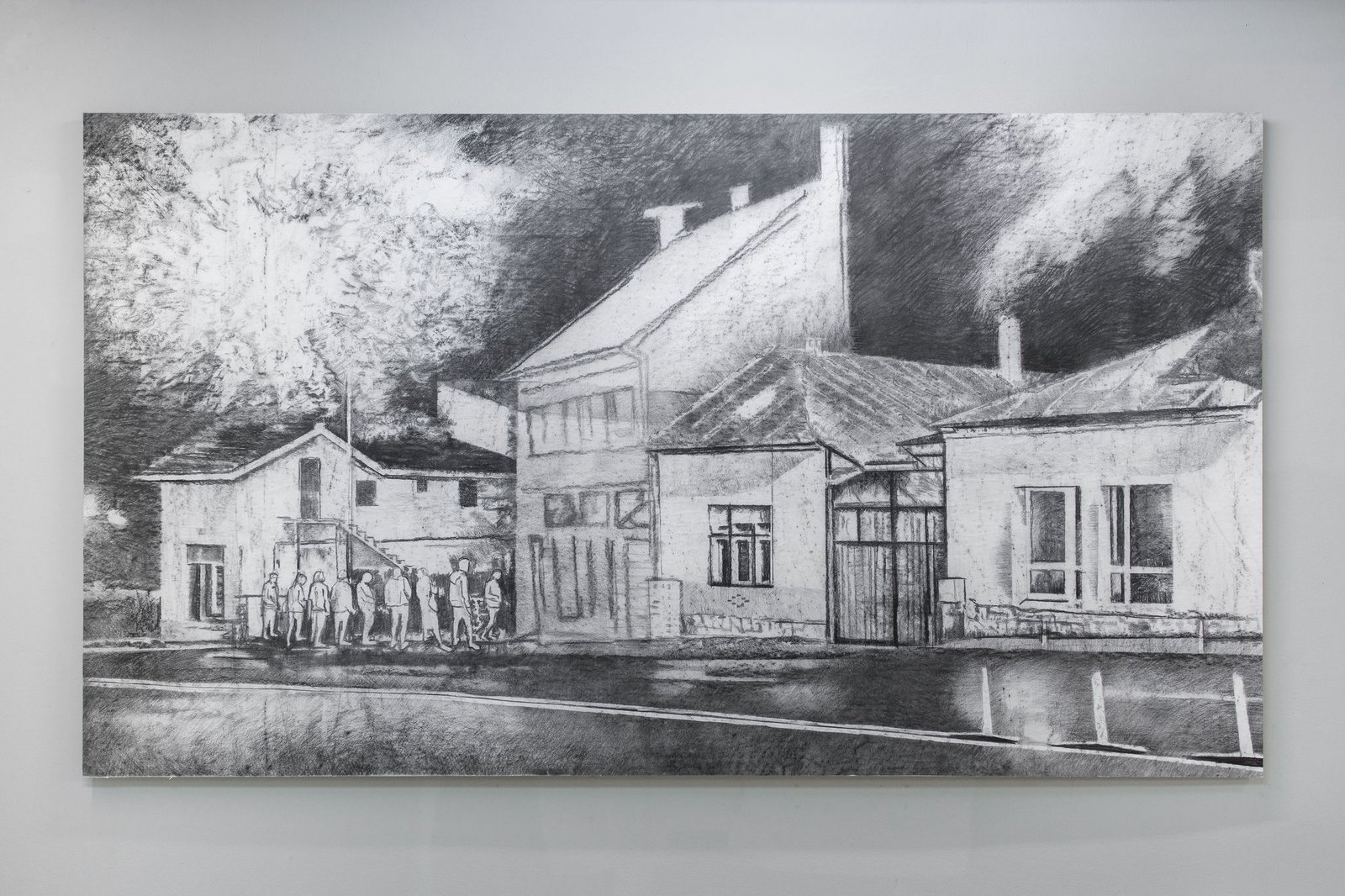
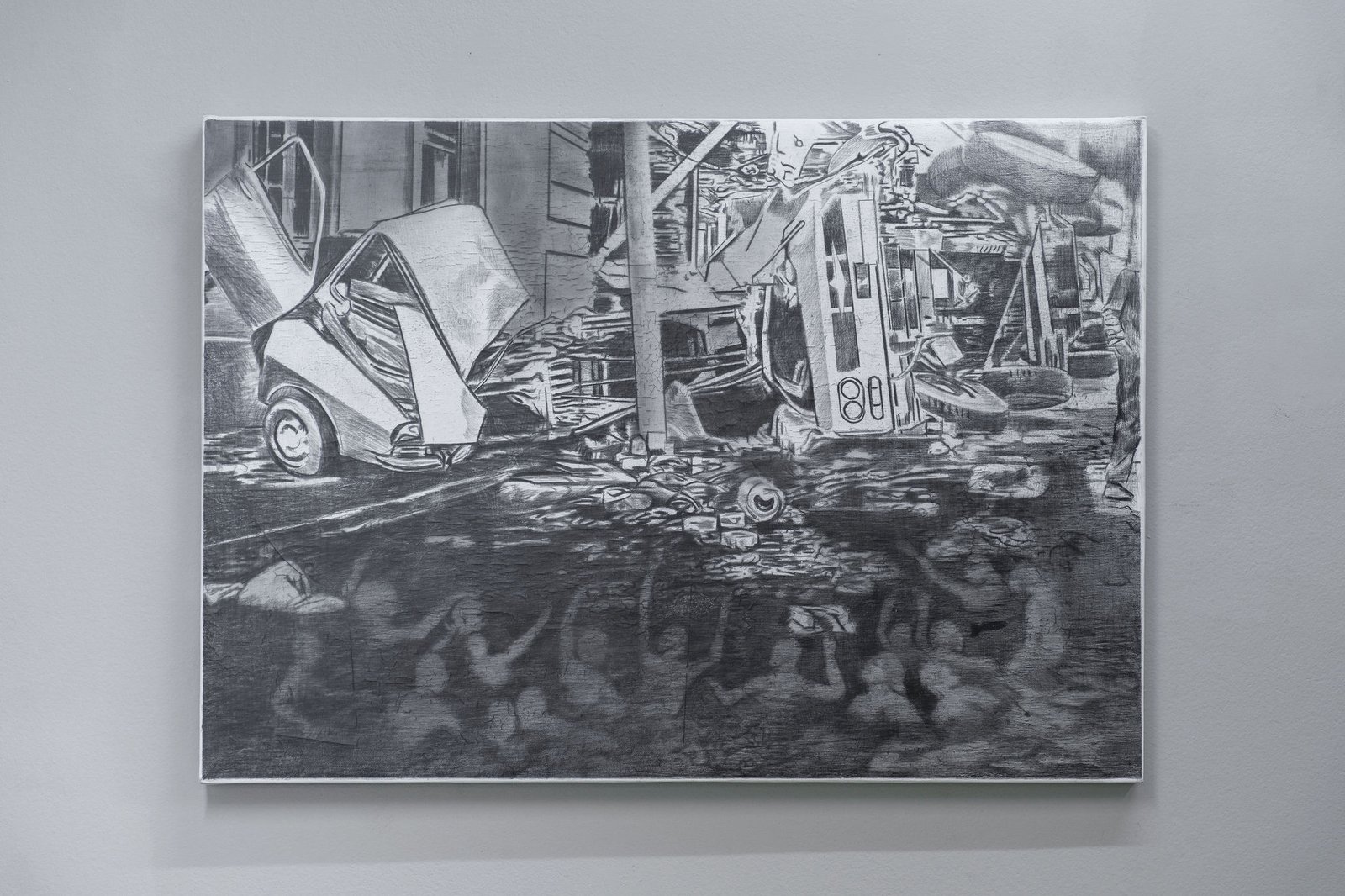
While moving fluidly between reality and speculation, an uncanny atmosphere permeates Matei’s
drawings, where the surrealism depicted feels increasingly immediate and holds the potential to become
plausible within the conditions of the (global ongoing) present. The artist revisits heard or imagined
stories, blending them with surprising twists in an almost tongue-in-cheek manner.
Roamers operates as an analogy for in-betweenness – evoking transitions and crossings between states,
places, and conditions. Deriving from a local story – circulating around the area where Matei lives, known
as “Dead Man’s Curve / Curba Morții”* – the artist develops speculative fictions emerging from its
margins. Here, zombies and remnants of the afterlife resurface, and reality collides with haunting
scenarios, bringing reflection on how irreverent our daily lives have become.
The selection of works calls up for a state of unconditional un-safety: a street corner once marked by
accidents is translated into a space of fear, tension, and latent conflict, where suspicion shapes behavior
and people or nature might set against one another.
Gaming references play an important role in this series of drawings, as they often do in Matei’s practice,
where worlds can be temporarily explored and navigated through interfaces. These imagined systems
create a framework in which the surreal can unfold, allowing characters and rules to shift fluidly.
Vehicles are also particularly present in his work, often functioning as devices that redirect attention,
triggering game-like scenarios reminiscent of the environments Matei usually depicts: wide open streets
where the attention engages on one single action. Some of the drawings are referencing the Grand Theft
Auto series, where humanoid carcasses operate with no law, moving through open streets unbothered.
What is particular in Matei’s drawings is this sense of wandering – of figures drifting through the scenes.
His protagonists often appear haunted or externally guided, as responding to invisible commands or
systems beyond their control. Even when the setting shifts indoors, or when the street finds its
counterpart in natural landscapes, this logic seems to persist.
A parodical form of conflict runs throughout the works: nothing is making sense, and meaning constantly
slips. Human figures appear zombified, manipulated, estranged. Gaming becomes a lens through which
these characters can be understood – not only in how they move or act, but in how they are operated. In
this sense, drawing becomes analogous to playing – a form of navigation through an open space full of
unpredictable scenarios, just like the recent history of the referenced area (Dead Man’s Curve / Curba
Morții).
*The Dead Man’s Curve / Curba Morții is a concrete geographical point on Calea Turzii, where, over the
years, several serious accidents have taken place. In the past, multiple heavy-duty vehicles crashed into
the house located next to MATCA artspace. The memory of the site becomes the starting point for a
broader exploration of how we experience the idea of safety and the anxiety surrounding temporal limits
and finitude. At this location – named as such by locals and those living in the area – several fatal
accidents occurred during the 1980s.
Matei Toșa (b. 1993, Cluj-Napoca) is an artist whose practice centers on drawing. Shaped by a
background in sculpture, his work reflects a strong sensitivity to spatial relationships and fragmentary
environments.
While many of his subjects draw from everyday life – especially the places he depicts – he often clashes
reality with abrupt twists. Influenced by anime, comics, and games, he invokes references from these
cultures into fragments of quotidian reality. His spatial depictions rarely unfold beyond the city, and more
often remain rooted in his immediate surroundings – where he expands between personal space and
urban recognizable landscapes. His works are often infused with irony and translate into raw, sometimes
absurd compositions that explore isolation and introspection.
A graduate of the Master’s program in Graphics at the University of Art and Design in Cluj-Napoca, he is
a co-founder of MATCA artspace, where he contributes to supporting artistic dialogue and the local
creative community.
MATCA artspace is an independent artist-run space in Cluj-Napoca, repurposed from a former furrier workshop. Founded in 2017 by Alexandra Mocan, Alexandru Muraru, and Matei Toșa, the space was initiated to address the need for accessible platforms for local artists. MATCA explores and reflects on the evolution of contemporary art, current trends, recent global events, and the ways artistic discourse develops around them. Through events and exhibitions, the space serves as a medium for discovering local art while facilitating dialogue between emerging and established artists, both local and international. MATCA encourages experimentation with alternative media beyond traditional formats and operates on a non-commercial basis. To date, MATCA has organized 90 exhibitions and collaborated with over 300 artists. Recent projects reflect a focus on cultural and artistic work, as well as an orientation towards research-driven, dialogue-based, and participatory practices. In this context, the space has recently launched residency programs, discussions, and workshops.
Event part of Aproape de Curba Morții / Close to the Dead Man’s Curve project.
Cultural project co-financed by the Administration of the National Cultural Fund. The project does not necessarily represent the position of the Administration of the National Cultural Fund. AFCN is not responsible for the content of the project or for how its results may be used. These are entirely the responsibility of the funding recipient.