


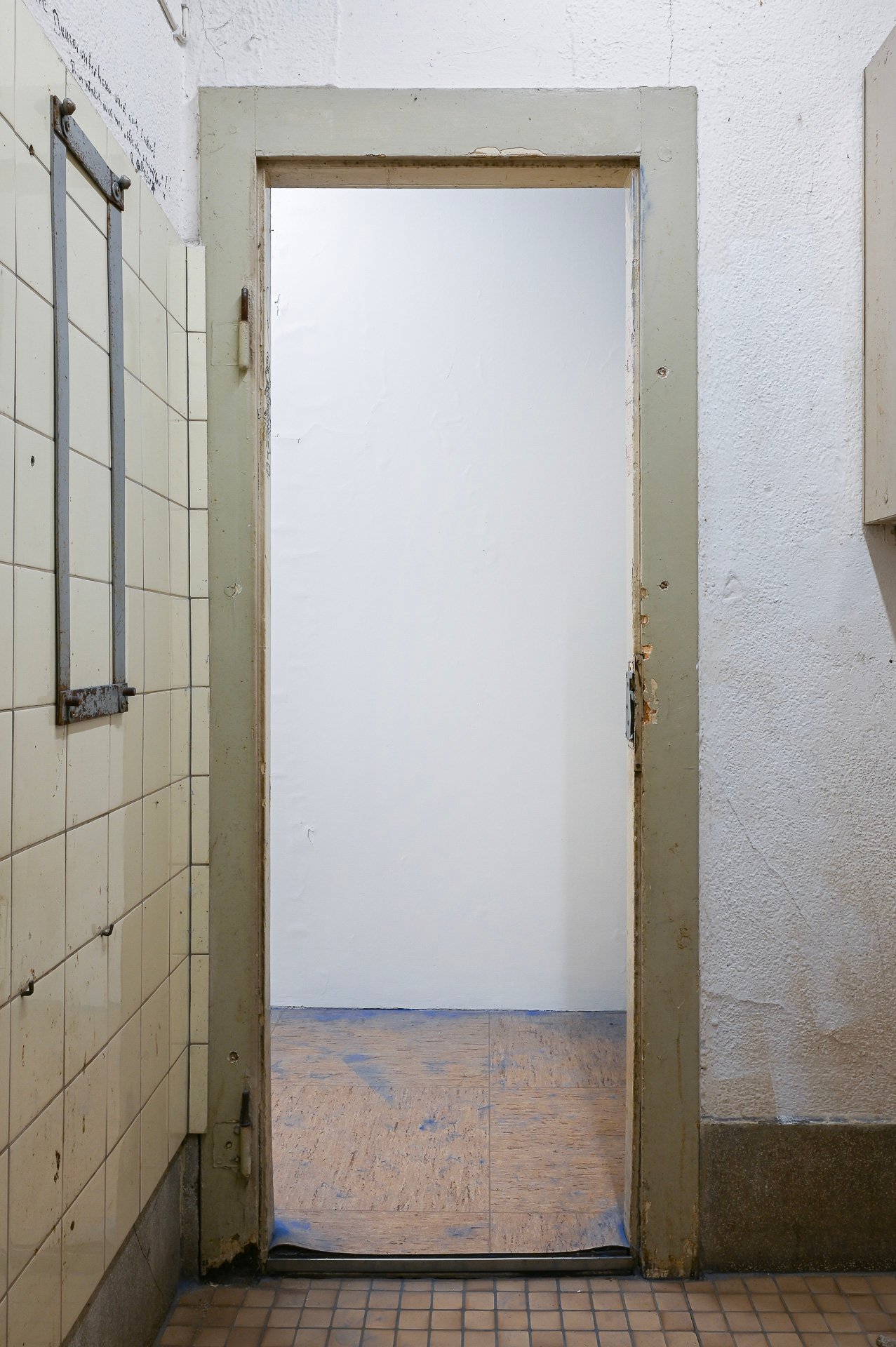
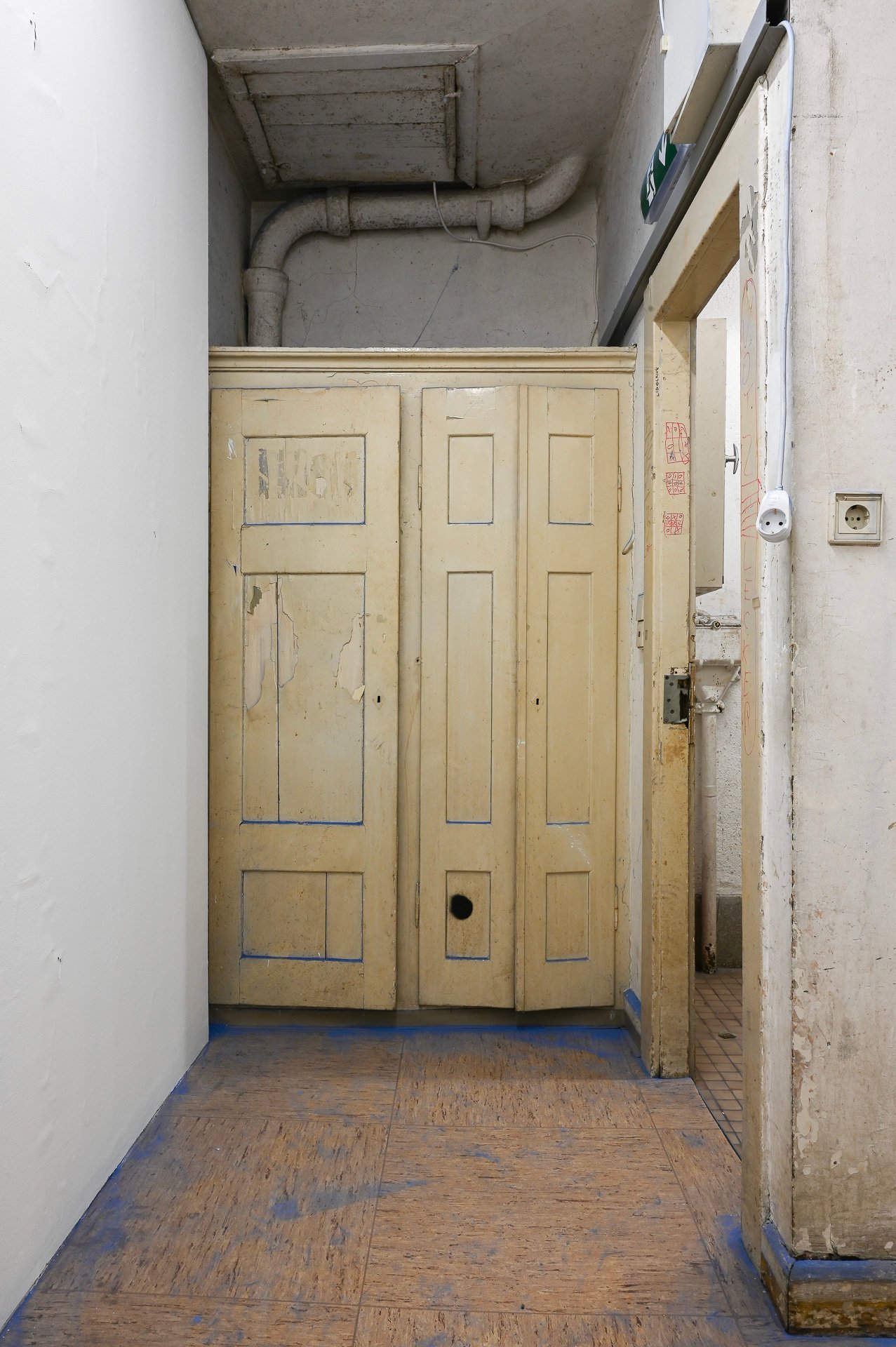
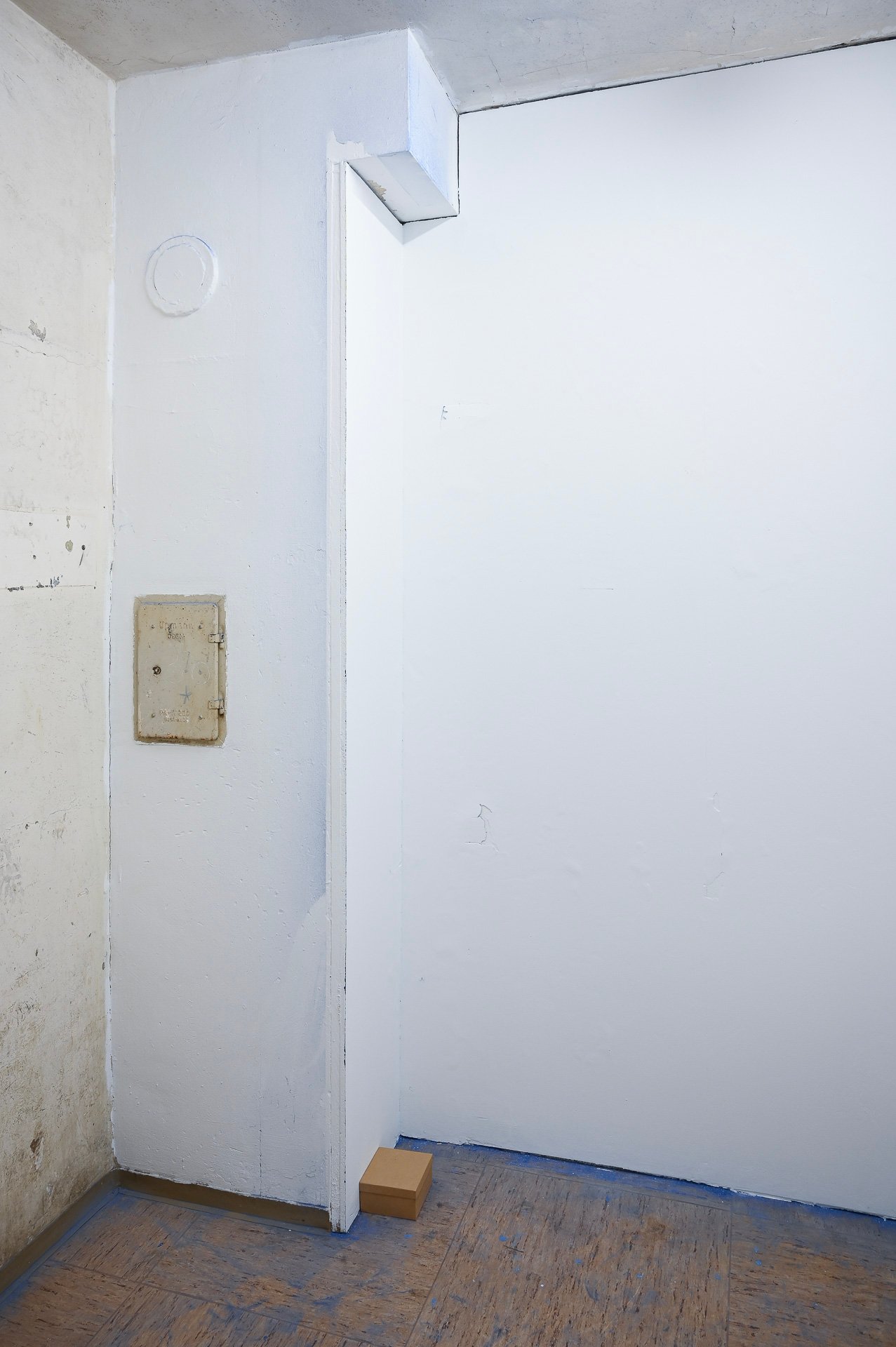
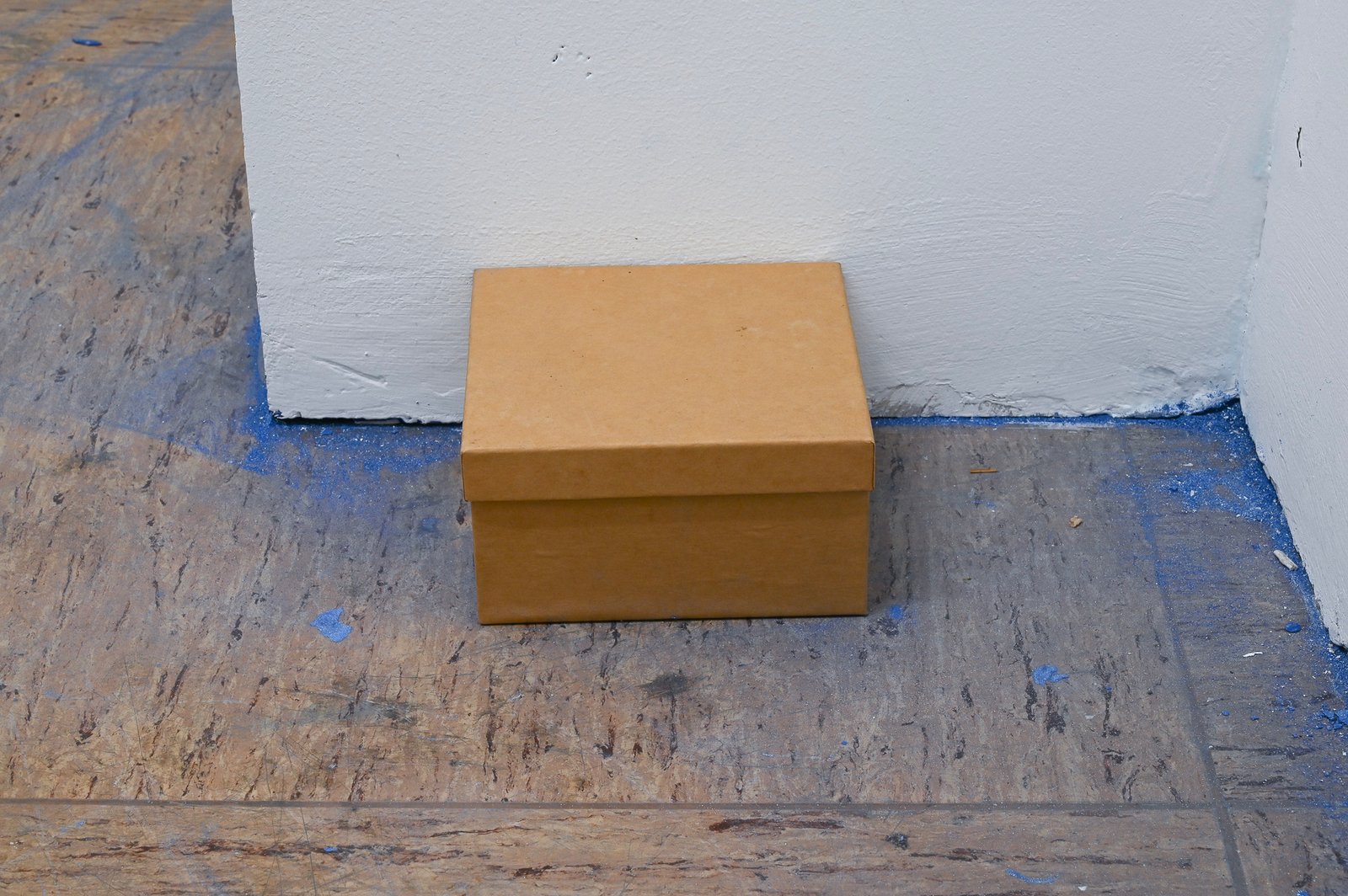
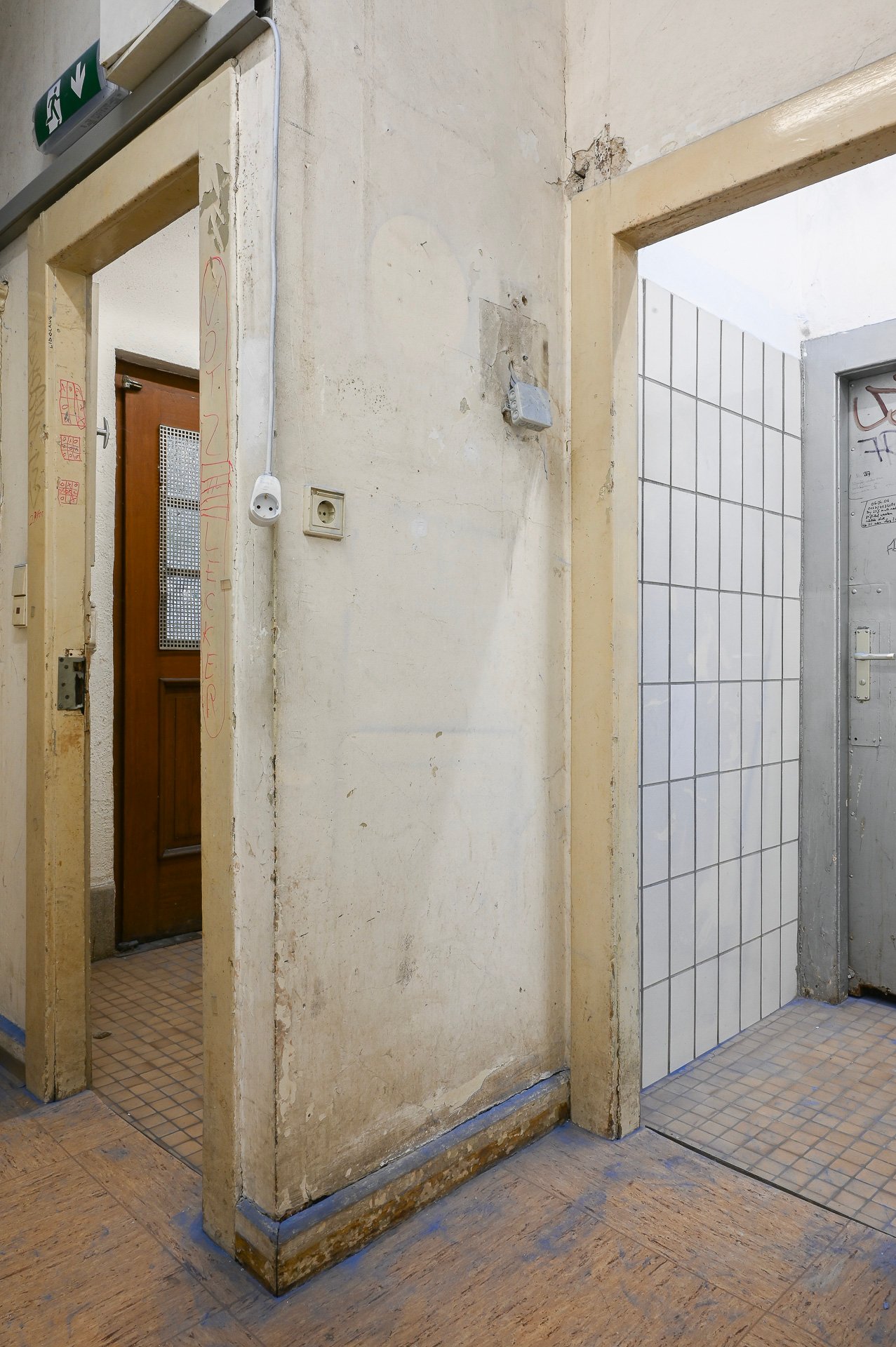
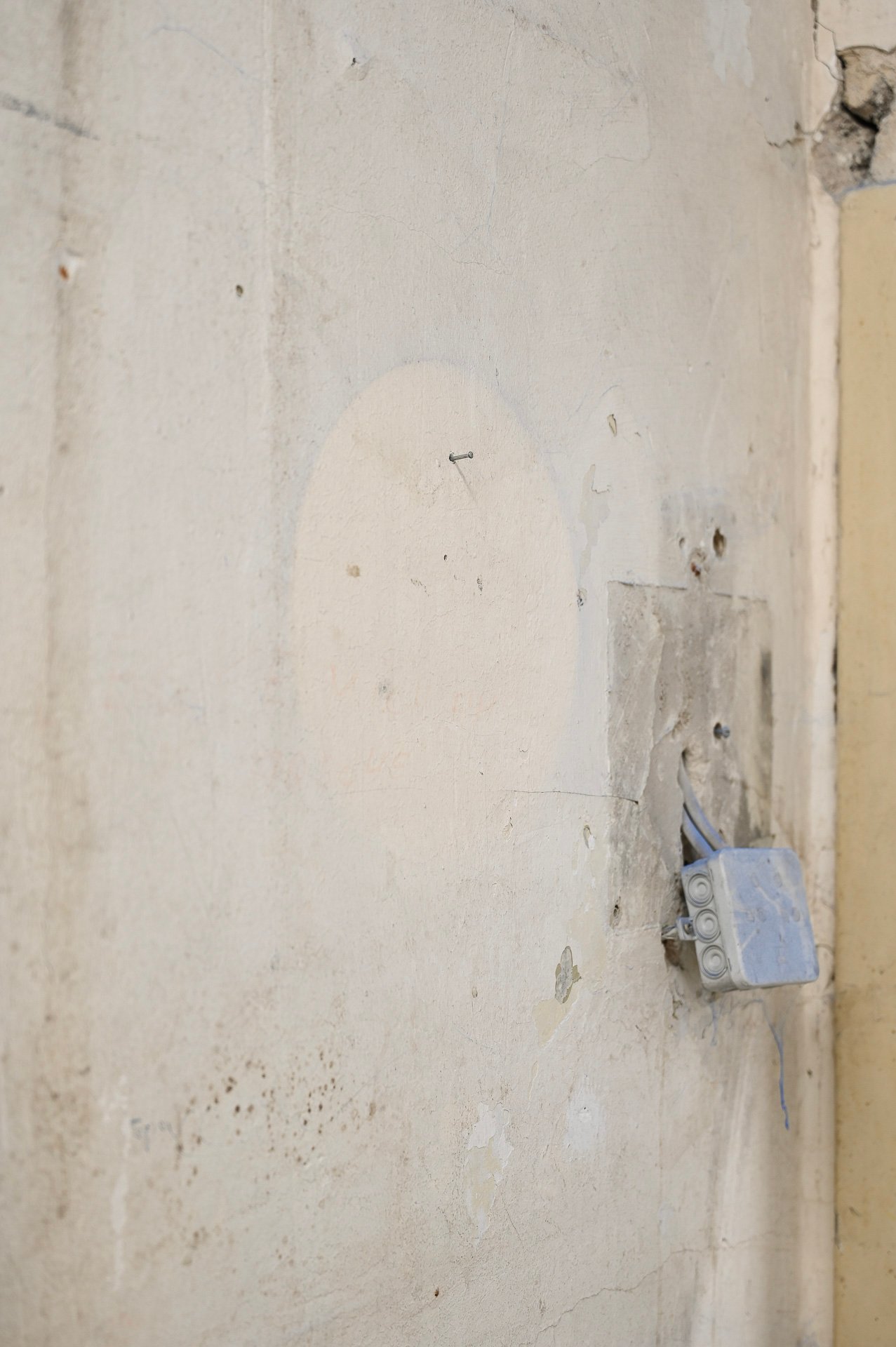
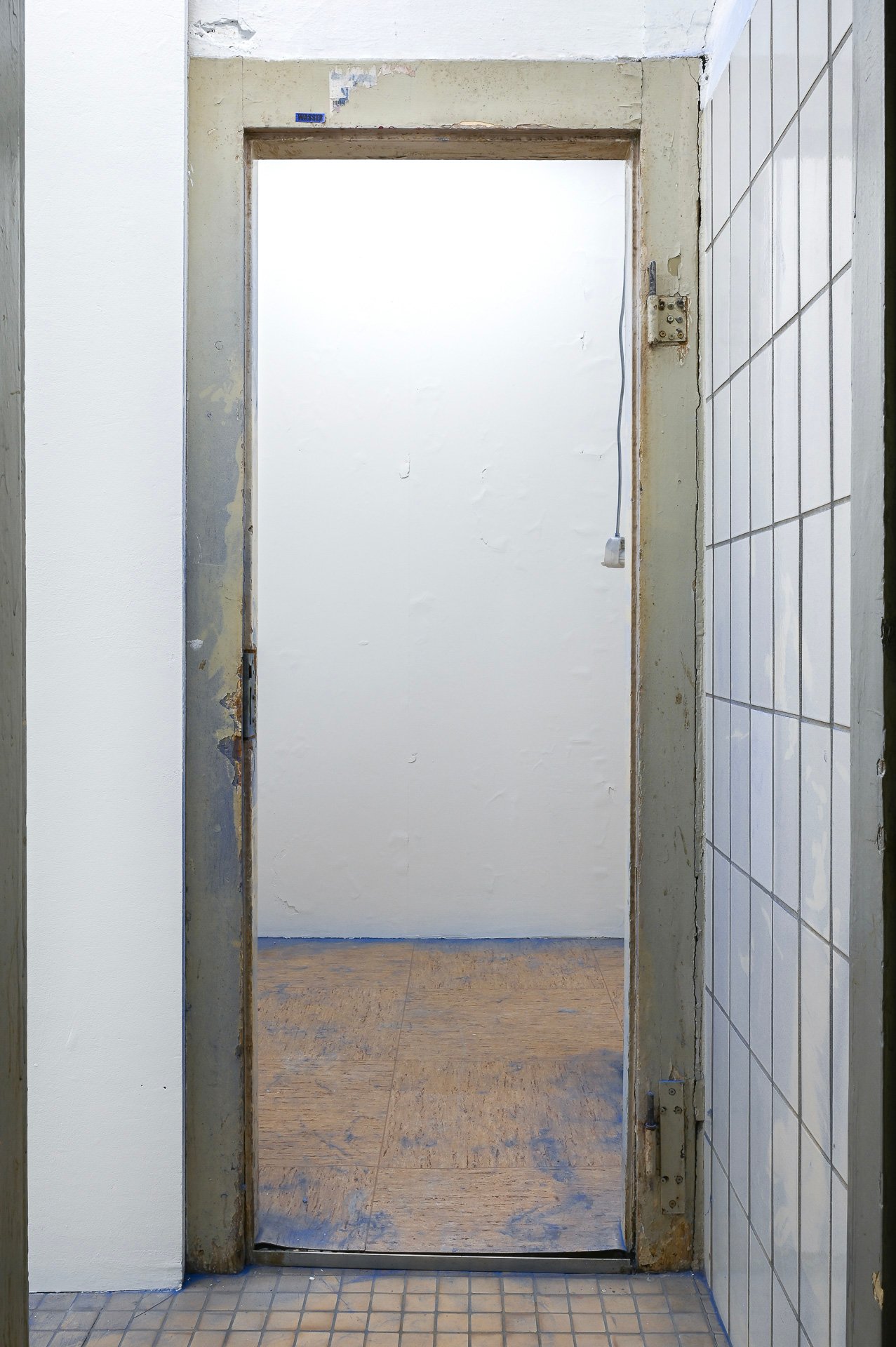
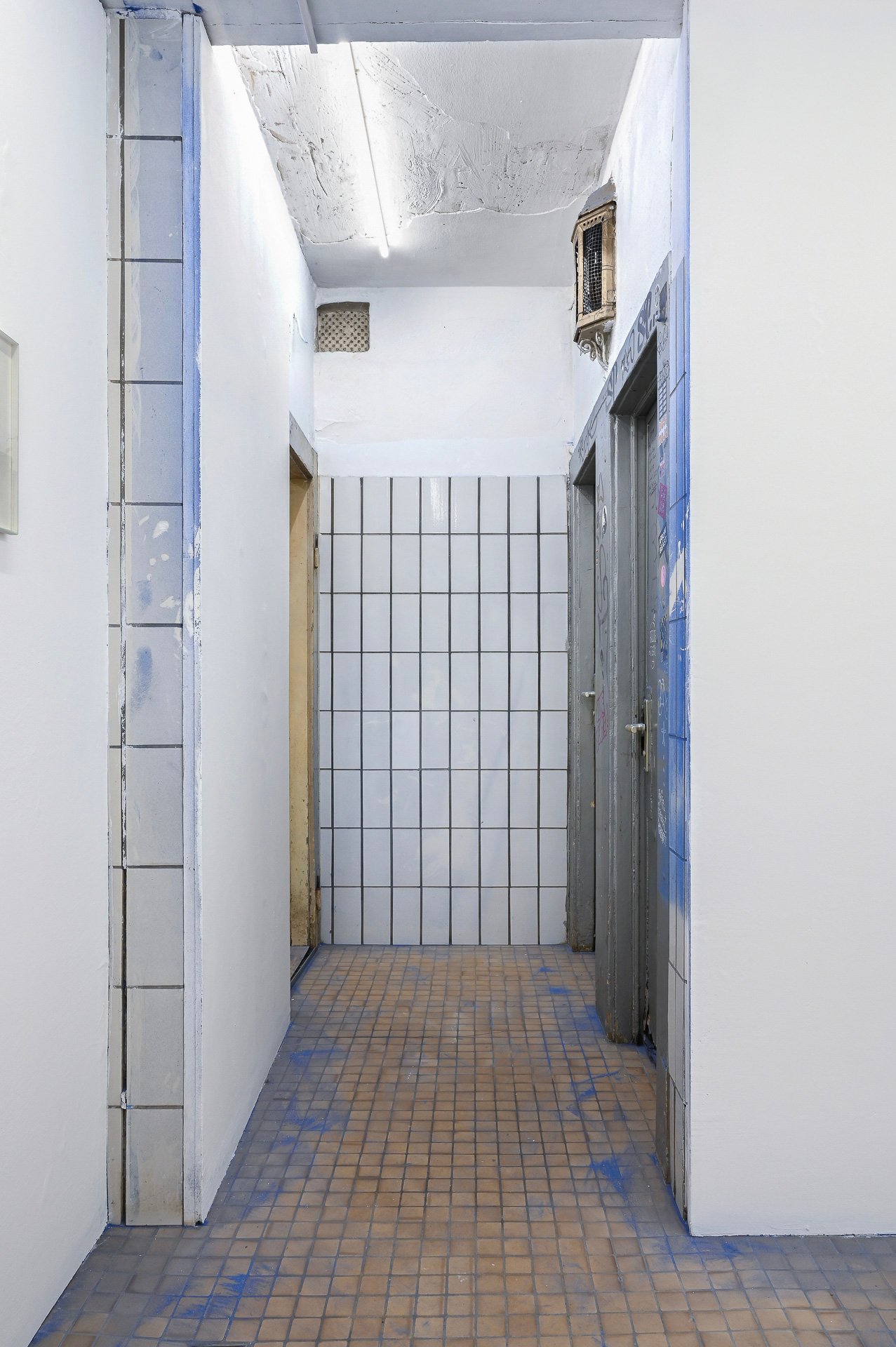
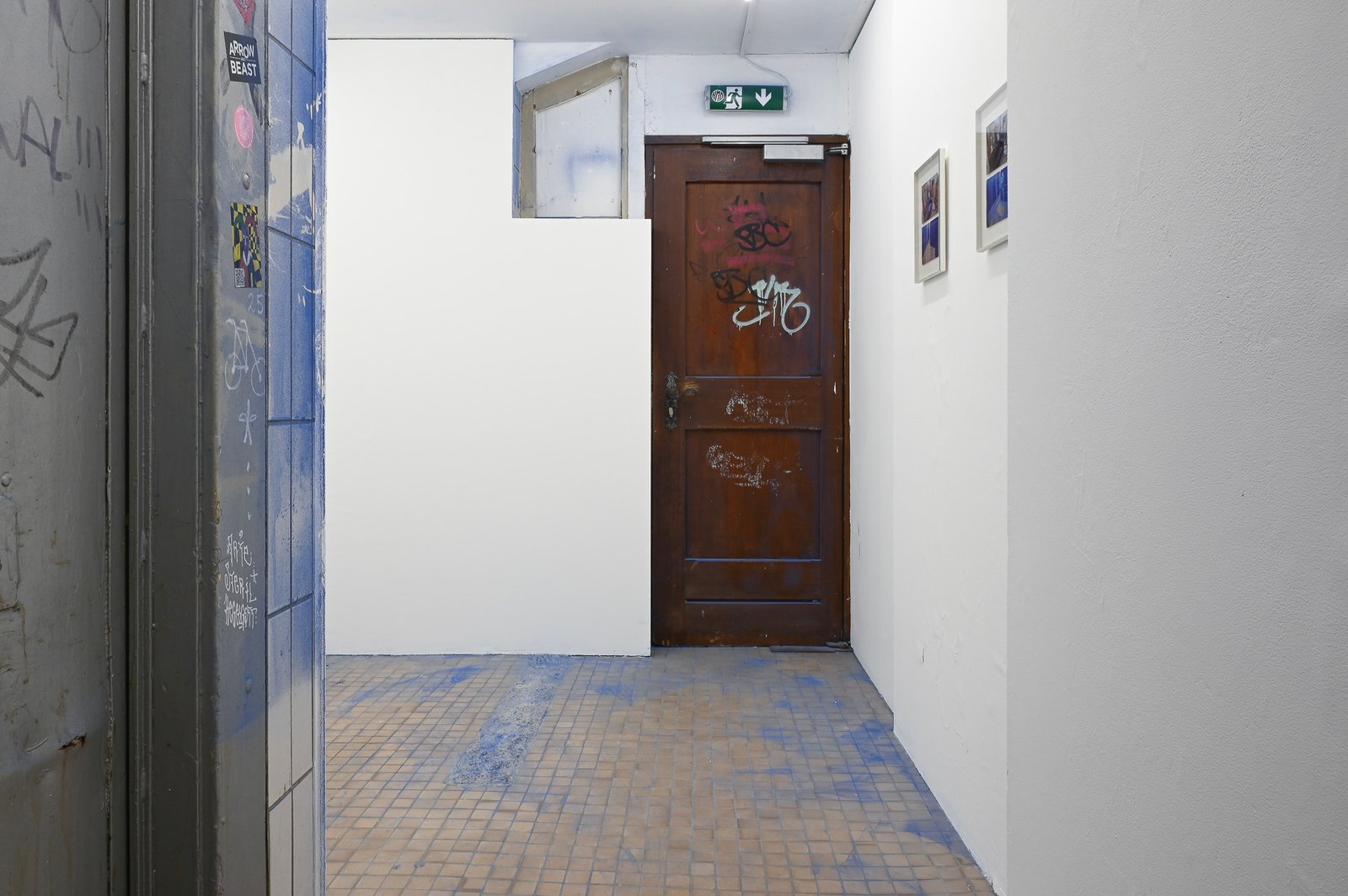
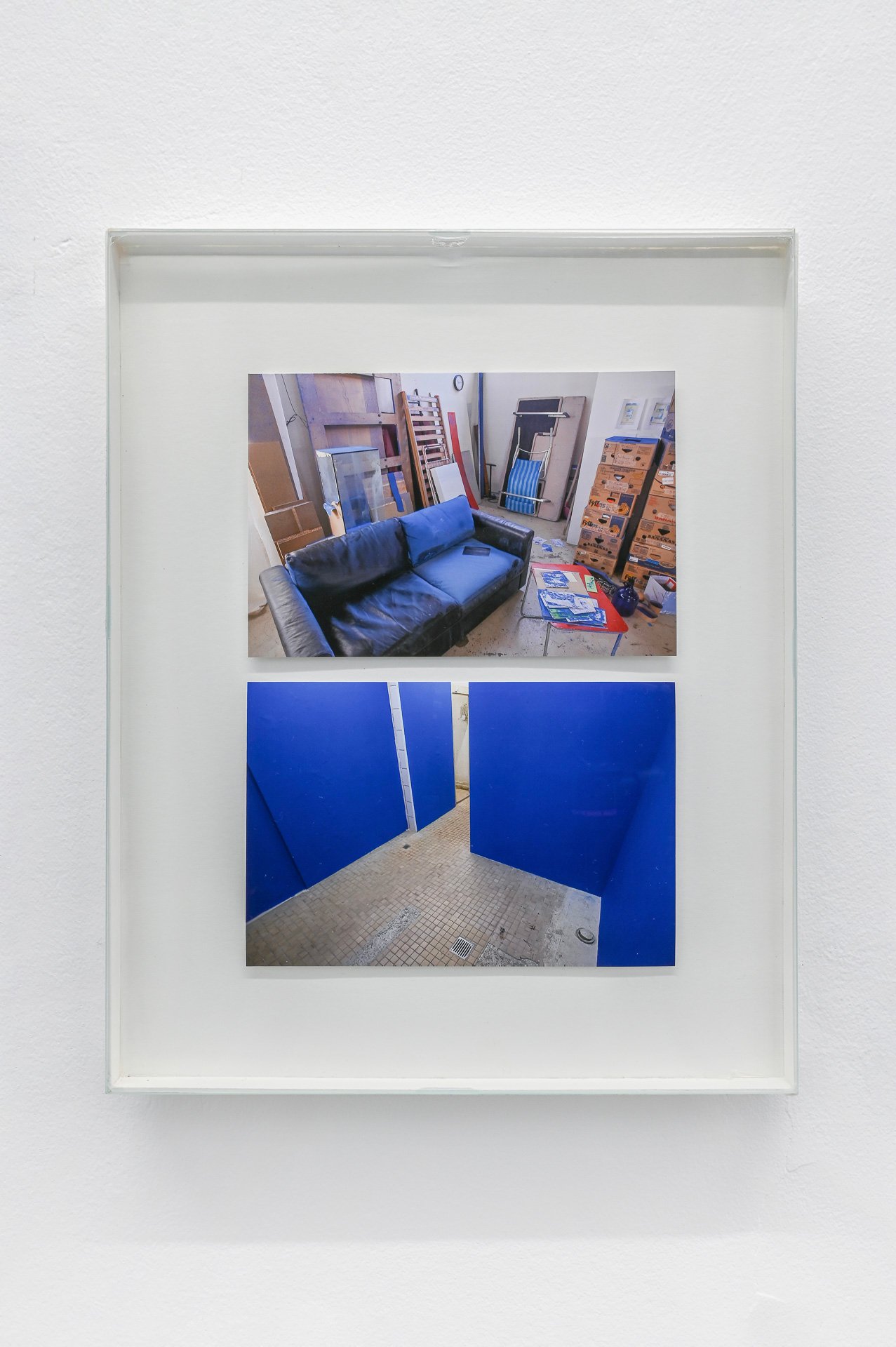
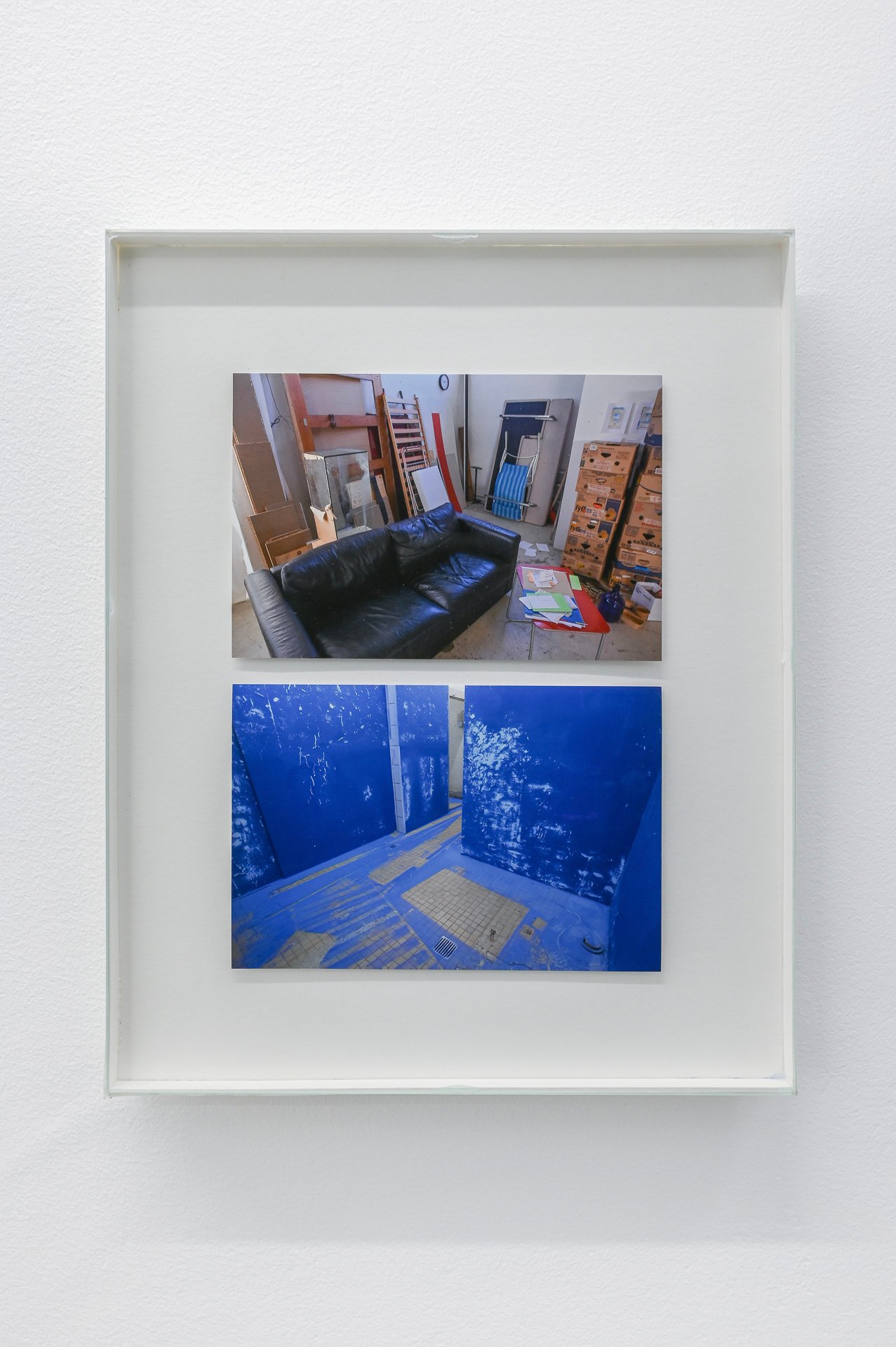
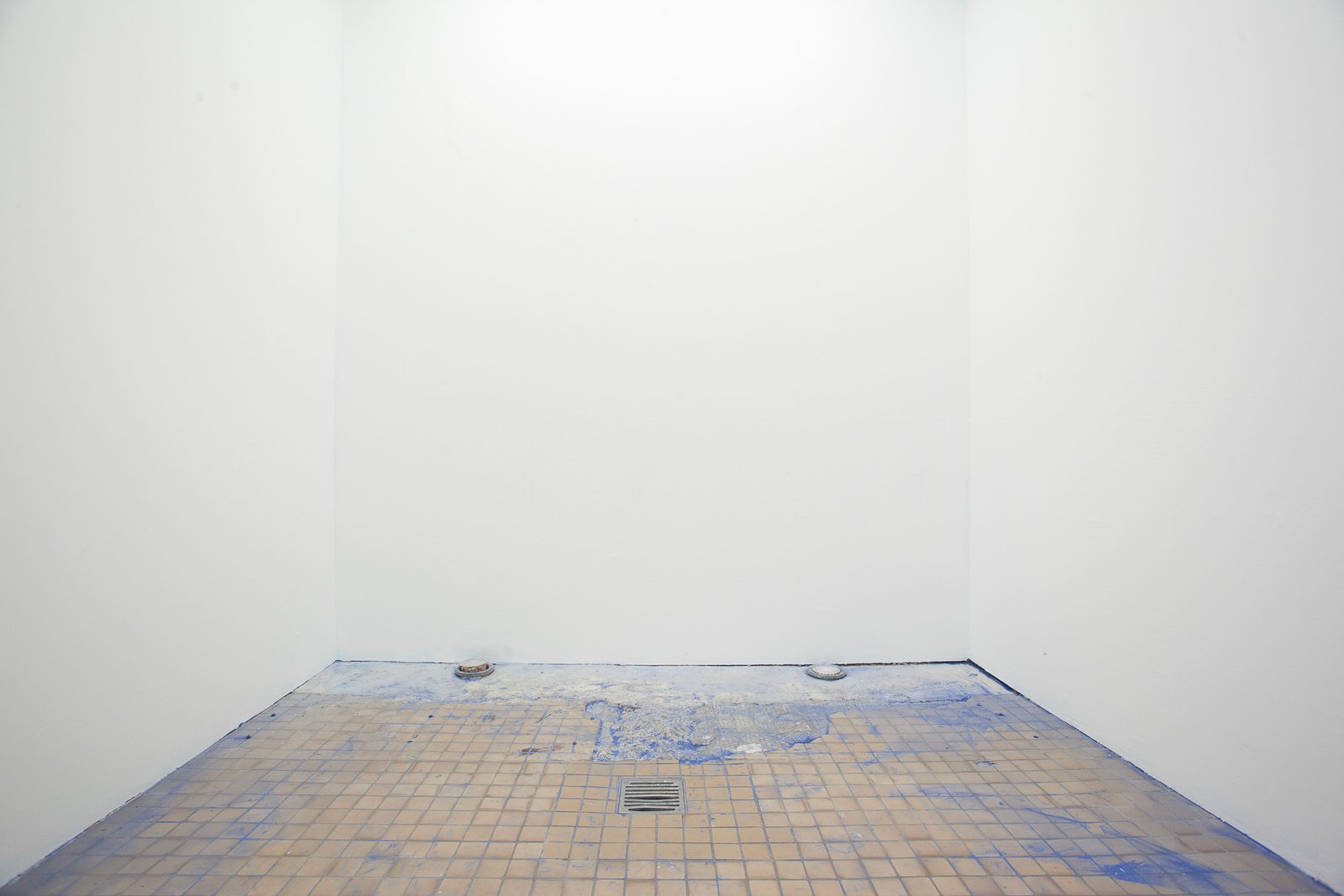
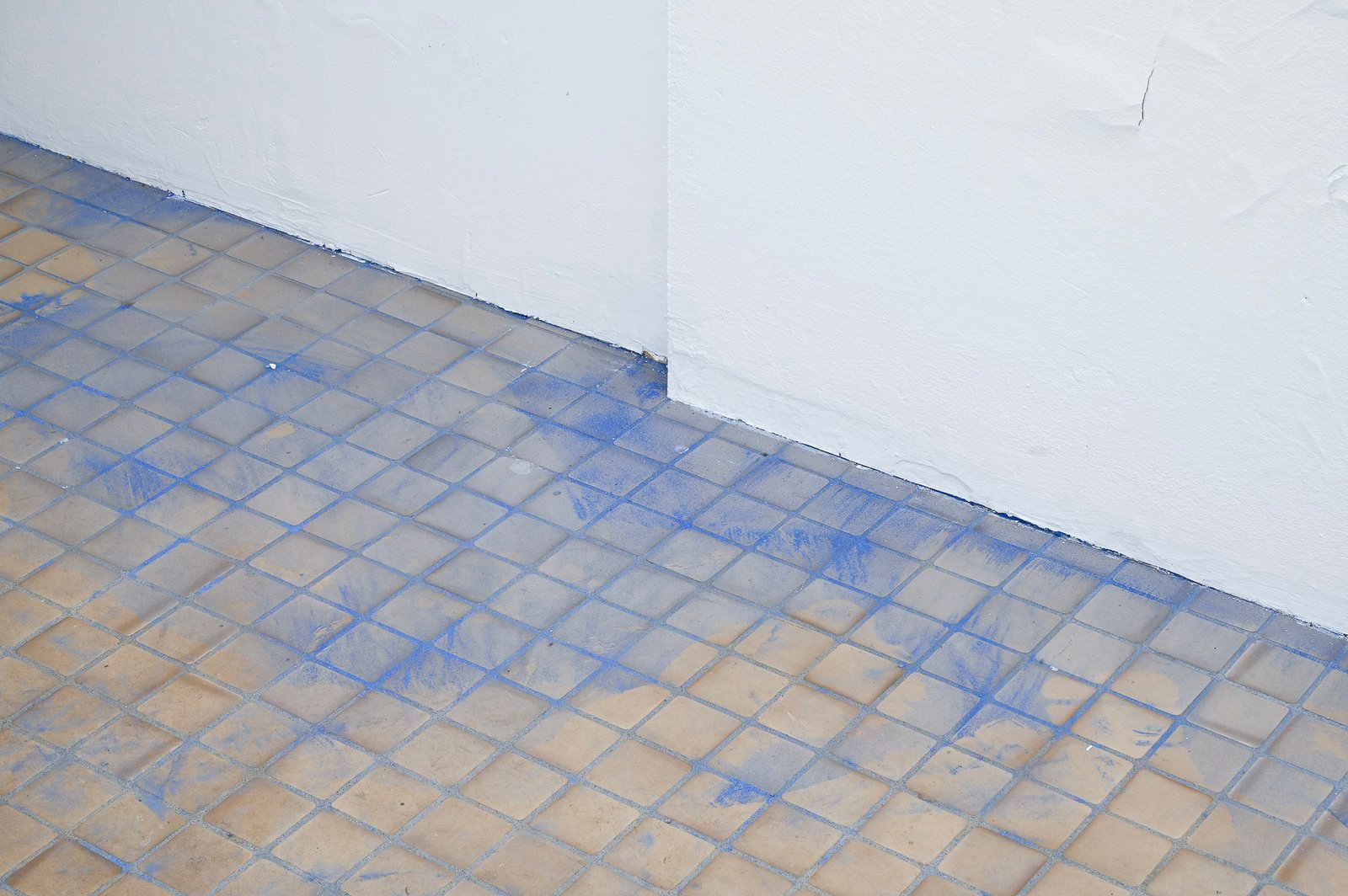
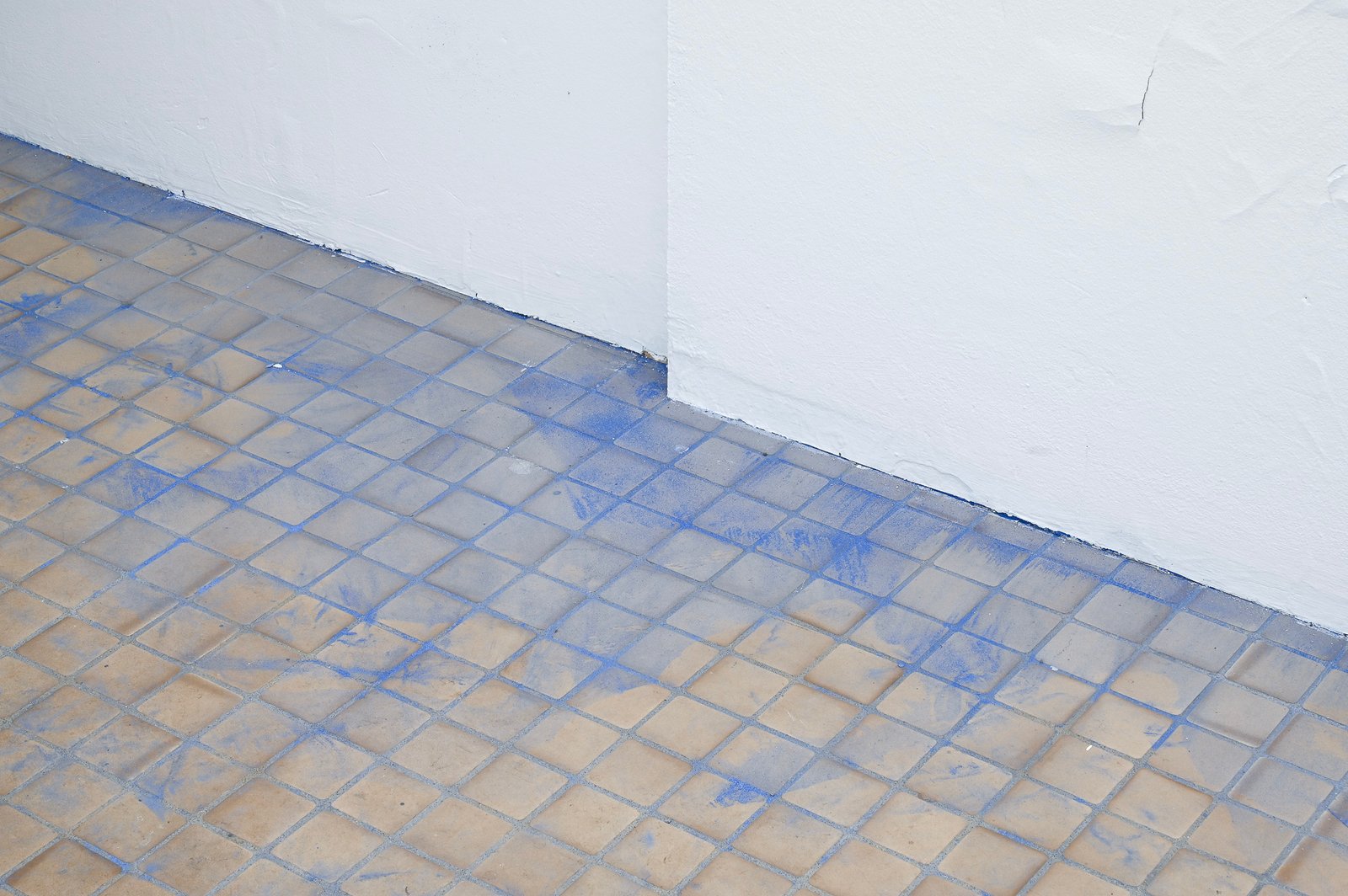
It was only yesterday that, under Sebastian‘s command, step by step, thing by thing, I emptied Kaiserwache of everything that bore his name. The former public restroom had been packed with banana boxes, wooden planks, bed frames, two reclining pieces of furniture, and so on—volumes large and small—arranged in such a way that one could just barely turn around. I lent a hand, especially with those things that could only be persuaded to move by four arms. I had to walk along beams so as not to smudge the dust-shadow image that lay on the floor. His belongings had only recently seen the inside of the extra-large moving van; truly a brief stay, and already they were on their way back.
Since my last visit to his studio, Sebastian had declared all of his worldly possessions to be material for his artistic work. The imaginary wall separating the living room from the studio had thus been torn down. From then on, every object was prefigured as a potential element of an artistic gesture, and accordingly the move felt strangely unusual. It became a matter of debate what, exactly, was being transported here. I also found myself wondering whether one could already speak of a pre-emptive dismantling of the exhibition. Perhaps that very question was itself getting ahead of things.
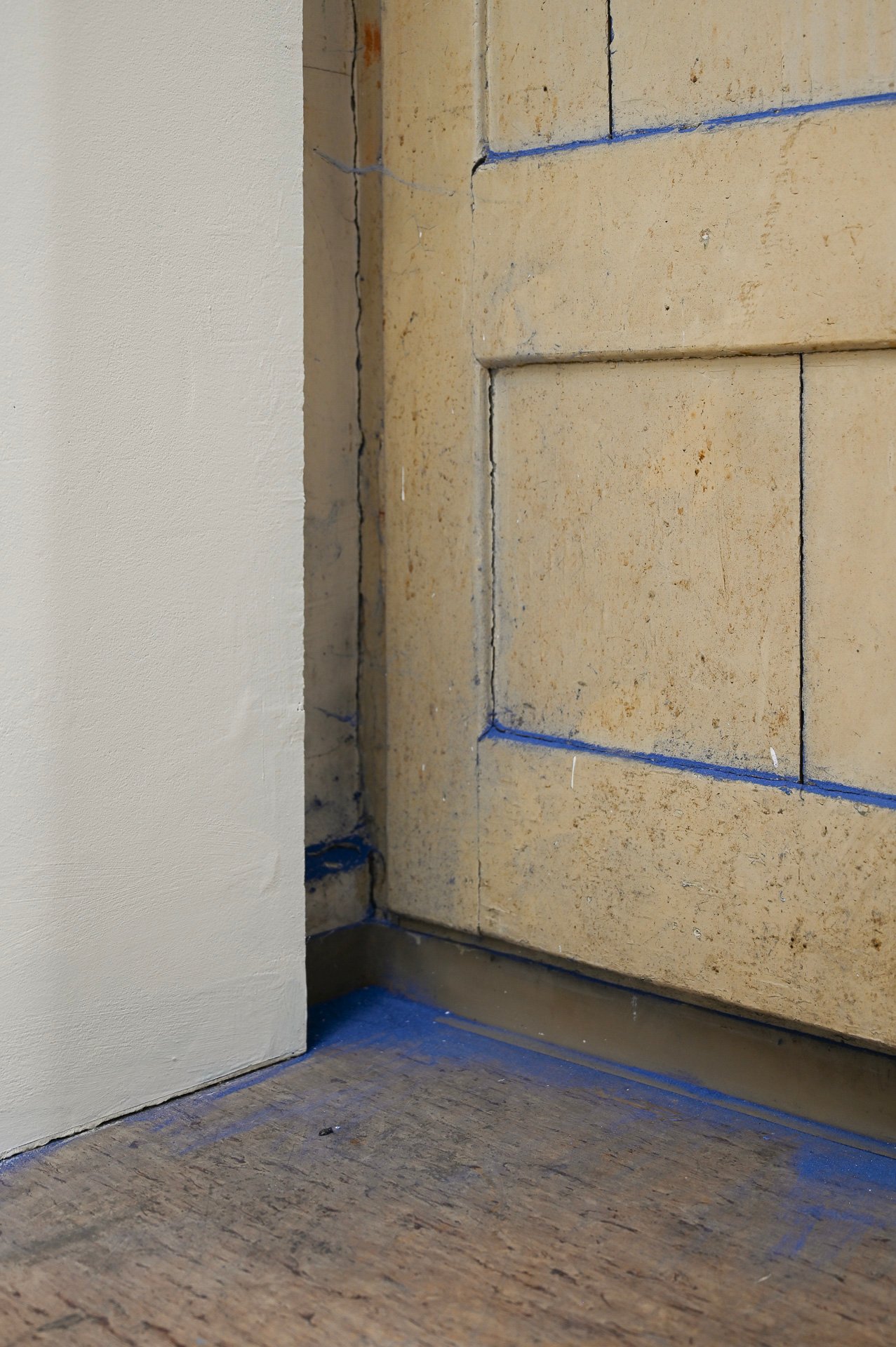
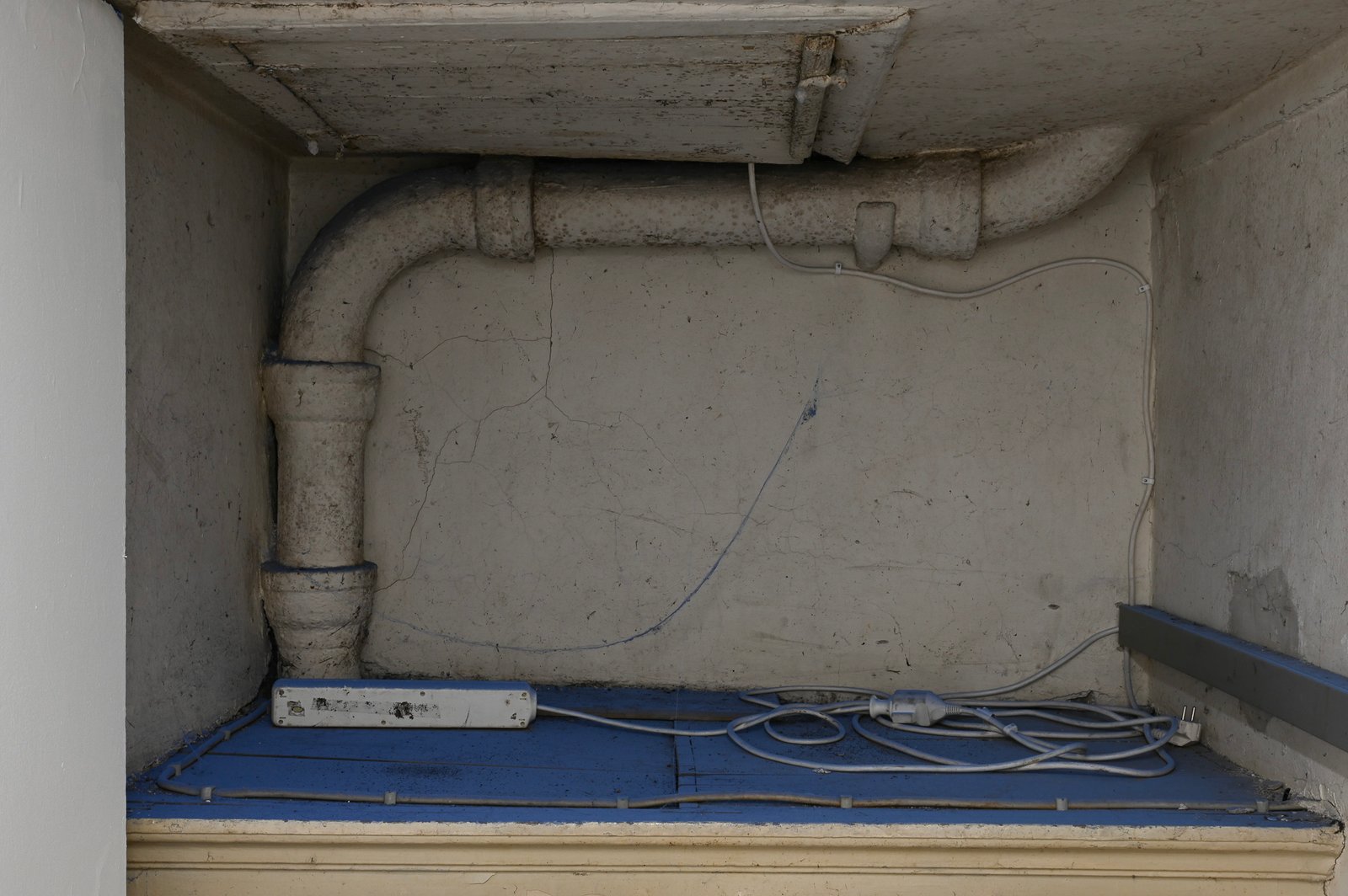
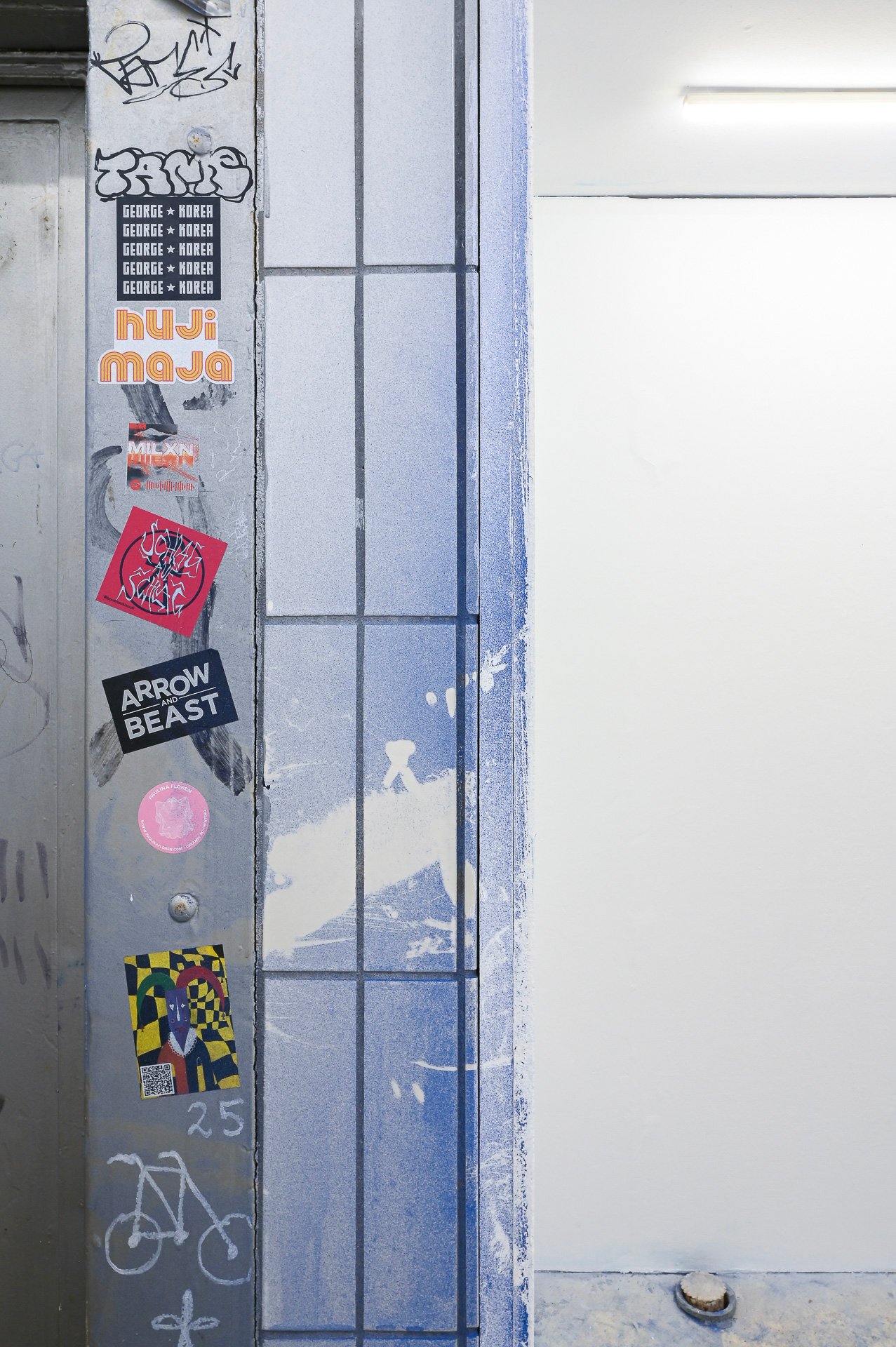
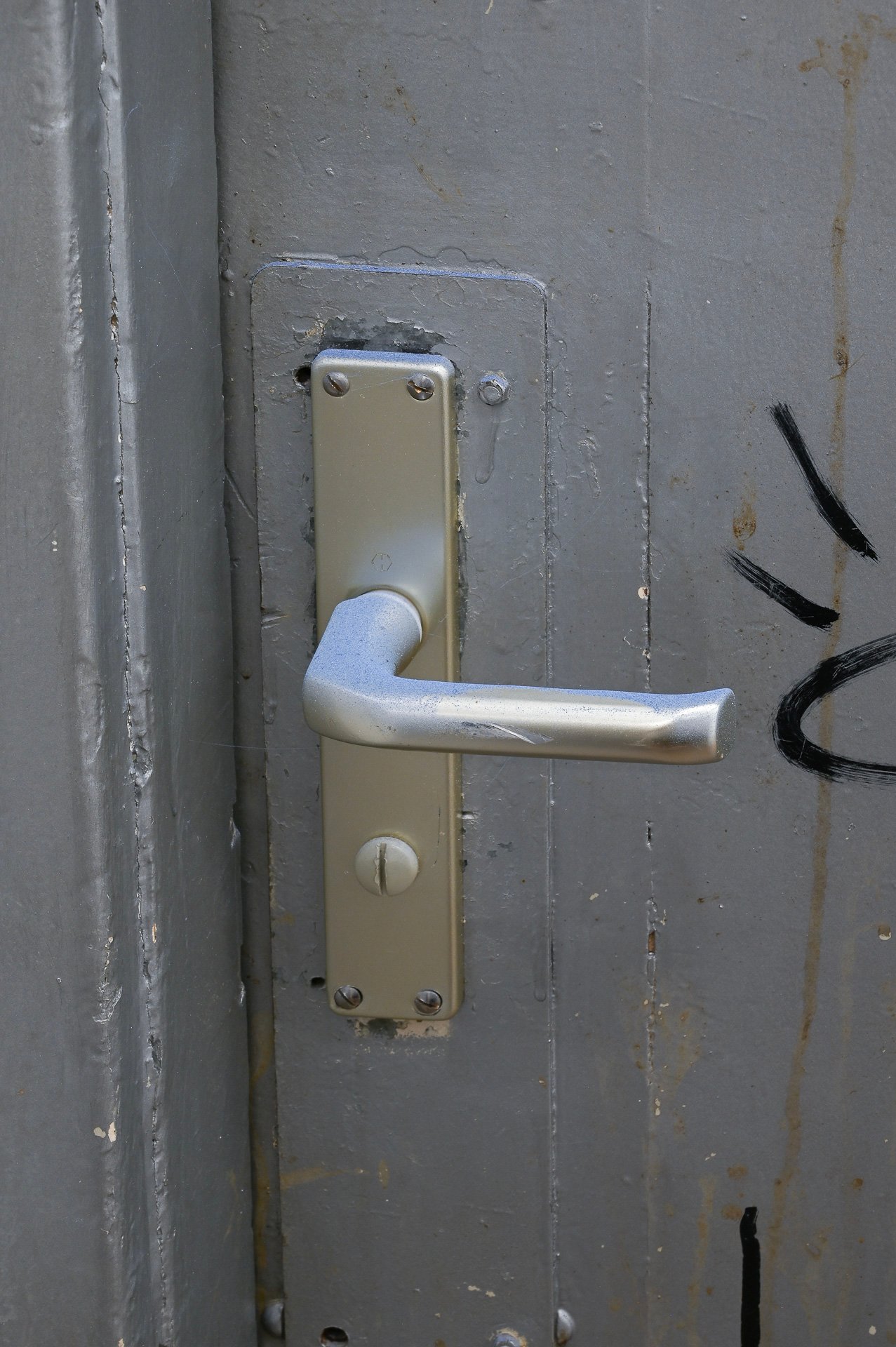
The blue-washed walls likewise bore his name, or at least his handwriting in the form of sanding marks. They were the objectification of labour already carried out, a reference surely not only to the work itself, but to what exactly? I found myself thinking of the blue plaque-disclosing dye used at the dental clinic. However hard I tried, eerie blue patches kept appearing, which the dentist pointed out to me, places the toothbrush had apparently overlooked. This exhibition, too, was evidently concerned with residues and deposits that cannot simply be avoided. Sebastian seemed interested in bringing precisely these remnants into view. I thought about what the dust might signify, what it might stand for as a metaphor. Yet, as could hardly have been otherwise, its symbolism paradoxically had to blur before I could think more clearly about the work.
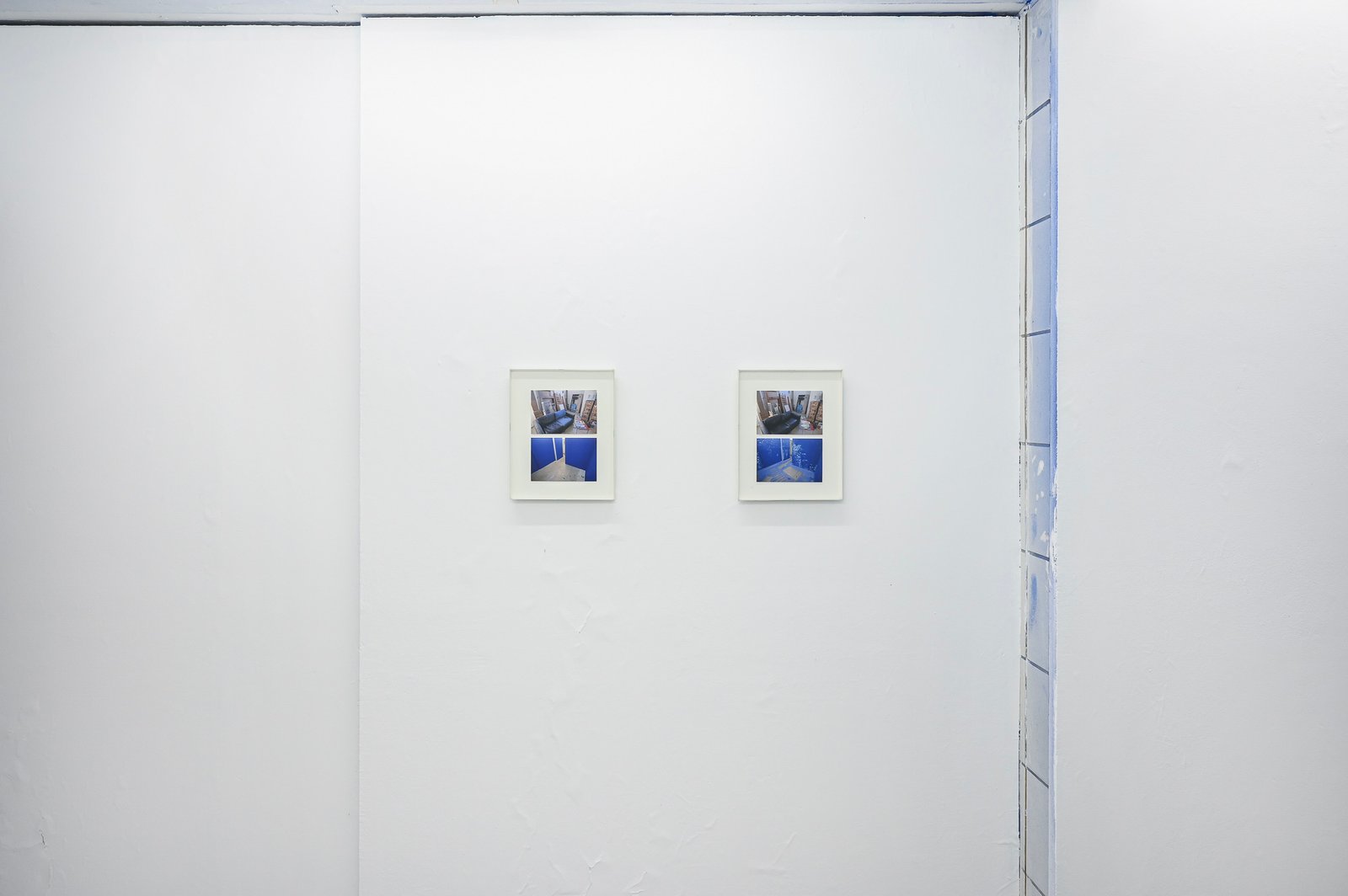
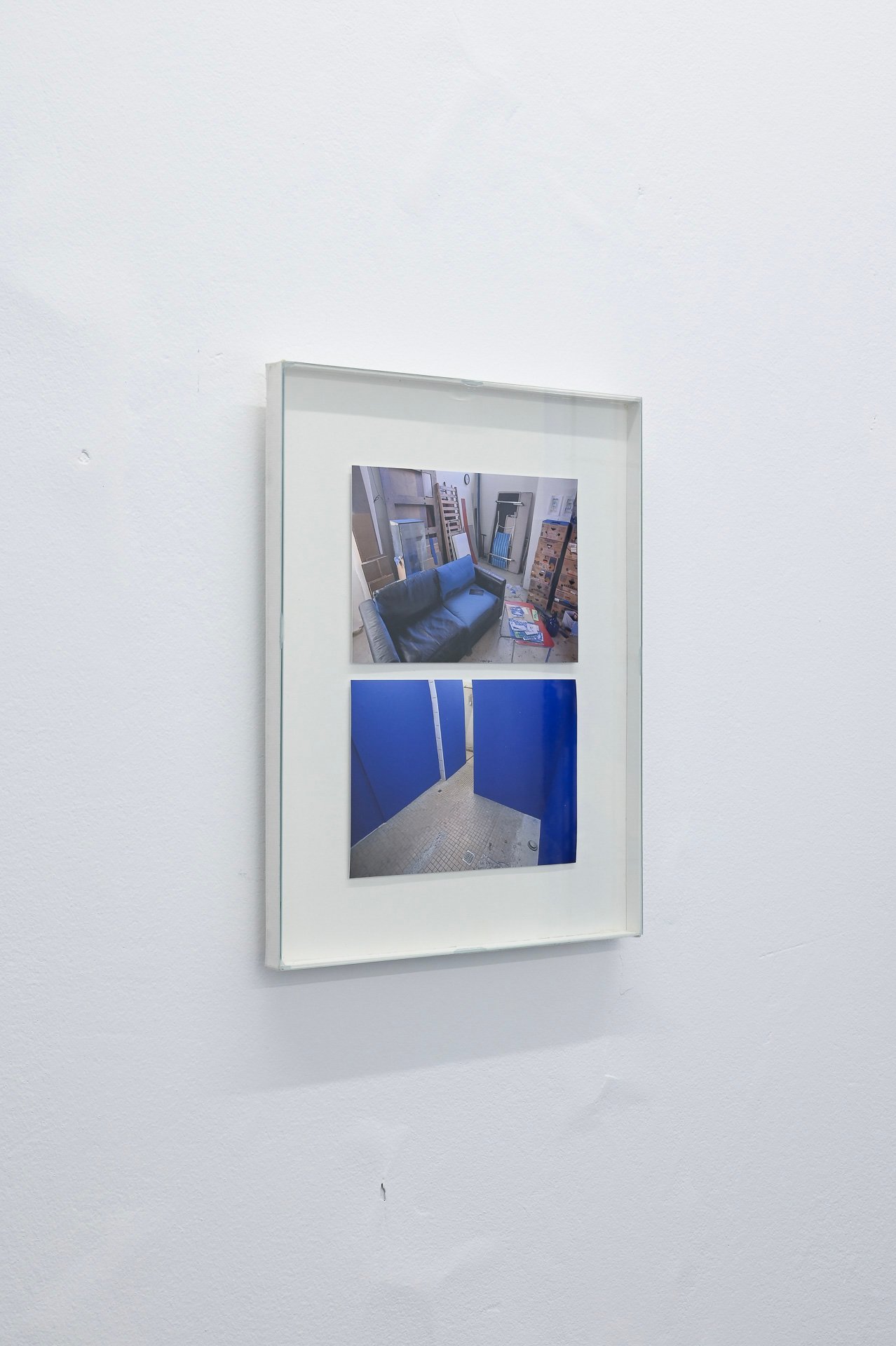
Carefully I carried the blue-powdered sofa cushions to the van. One of the cushions was particularly thickly coated in wall dust and reminded me of the pigmented surface of an Umberg monochrome, of colour as colour, defined through its materiality, as the painter insisted. Was this exhibition—or at least in its state at the time—a painting exhibition? I wondered. Charles, however, had earlier remarked that it was essentially a photography exhibition; one need only think of the photogram-like image on the floor or, more obviously still, of the presentation of the photographs of Kaiserwache and the studio that were to provide the crowning conclusion. (The final two photographs, however, still had to be made.) At the same time, the work was also an expansive installation or, considered temporally and as a process, an action or a performance. Was that even relevant? I asked myself. Categories are probably beside the point here anyway, I answered myself. My sense of the space told me as much: certainly associations, but nothing one hundred percent unequivocal.
Above all, the room felt unfamiliar. I had never experienced it like this before. It seemed furnished, lived in, but not in the conventional sense that presupposes the ordinary use of objects. I could not have said this furnishedness of any other exhibition in these rooms. Here, instead, the furnishings seemed to lead a life of their own. The wall dust in particular, settling over the roomscape like royal-blue snow, left no doubt that the objects had to stand exactly where they stood.
Yet, like every snowy landscape, this one could not last forever, and I found myself wondering how long the thaw would take once we had transplanted the landscape back into Sebastian‘s studio. How would he live with this landscape from the exhibition space? Would it become part of him and of his work? It is precisely there that the black box of the studio (and of his private life) begins, even though he granted us a carefully controlled glimpse through the camera. One thing was certain: even if he were to wipe and vacuum everything clean again, a fine residue would remain for a long time—in the creases between the sofa cushions, inside the boxes, between the pages of books, on the floor and in the corners, and not only at Sebastian‘s workplace but also at my own. After all, every exhibition here has left behind its own particulate traces. They had simply never before stood so explicitly at the center as they did in this one.
The blue snow had settled inside the moving van. The vehicle was loaded, Kaiserwache was “empty” at this point, while I, meanwhile, was drenched in sweat. The salt in my sweat crystallized on my T-shirt. Before we set off, I took one last look around in the space. Walls are vertical islands, projection surfaces for dreamers. Even with the exhibition title hovering before me, I found it difficult to see a child‘s room (Kinderzimmer) in Kaiserwache. Rather, walls as walls. And yet a child‘s room, too, is supposed to correspond to the needs of a child, just as an exhibition space corresponds to those of an artist. Strong colors are said to be capable of triggering memories. It hardly seemed accidental that I felt I had seen this kind of wall before. My thoughts carried me back to adolescence during the summer holidays, to Soviet buildings in a post-Soviet city. The interiors were run-down, renovations forever left unfinished, and the louder the color, the greater the chance that it would remain that way. What memories, I wondered, did Sebastian project onto these walls?
Sebastian had a childhood bedroom only a few kilometers from Kaiserwache, which he initially left every other weekend for his other childhood bedroom at his mother‘s home in Basel. Later, after moving in with his mother, the movement was reversed, and from then on Sebastian travelled to his father‘s home in Freiburg, although only on special occasions. A constant back and forth: the child between mother and father, between two houses, between wave and particle. The child suspended between the houses of its parents, yet compelled to manifest itself in a single reality the moment it arrives, simultaneously has one life and two. Sebastian told me about a banal yet striking moment. It must have been years after he had moved in with his mother when he returned to his father‘s house. He found his childhood bedroom almost exactly as he had left it what felt like a youthful eternity earlier, as though frozen in time.
Sebastian washed the blue layer of dust from his arms and legs in the Dreisam-river before we climbed into the van. It was already the nth day in a row that he had undertaken this journey. Later he explained to me his conviction that these two poles—the studio and Kaiserwache—operate at different speeds. It was as though the places possessed different gravitational fields, different atmospheres, charged not only by those separately compartmentalized stays with Mom and Dad, two memories (which nevertheless are one), that “double life” of childhood, but also, on a more fundamental level, by the different conventions and expectations brought to bear upon the artist. Conventionally, after all, movement proceeds from the site of production to the exhibition space. Each of these spaces is defined by its own particular mode. Here, however, the studio is temporarily transported into the exhibition space, while the exhibition space, through the symbolic act of sanding down the walls, comes to settle over the studio. The resulting installation disappears again in the very same movement, returning to the actual studio. This movement—which simultaneously echoes the yo-yo rhythm of his childhood—is ultimately mediated through photographs presented at Kaiserwache. The more one had oneself become part of this process, it seemed to me, the more difficult it became to locate the work. It gradually dawned on me that I had not yet seen the exhibition at all. The situation at Kaiserwache had developed rapidly over the previous days, and Sebastian made decisions regarding its final state directly in response to every individual step. Tomorrow it might already look different.
We set off, the artist at the wheel. I found myself thinking how this exhibition confirmed my sense that Kaiserwache is a preserve of memory, an ellipse of the past that has unfolded within it, a place where stories tumble over one another and become entangled. Sebastian had configured the site in such a way that, in a peculiar manner, it housed both his adulthood as an artist and his childhood, together with that origin story so deeply impressed upon him. For in 1984 his grandparents and his father had immigrated to Germany. They were permitted to bring only the possessions that would fit into a specially constructed wooden crate of prescribed dimensions. They found accommodation in the caretaker‘s apartment of St. Paul‘s Church, just around the corner from here, where his grandfather worked as the church‘s caretaker. All of these connections formed themselves into a kind of acrobatics of loose knots: places, journeys, different temporalities, and memories brushing against one another. Everything, of course, drawn in dust, only to be scattered again by the next wind (or the next exhibition). I imagined Sebastian sweeping the floor at Kaiserwache with a twig broom, slowly fraying into a silhouette within the blue fog.
-Ilja Zaharov