

Published 11.08.2026
LGP: Today we are speaking to Anna Wolna, co-founder of HUMAVE.
HUMAVE offers a human-made verified label to anyone who wants to show to the world that their work is genuinely humanmade. Hello Anna!
Anna Wolna: Hello, thank you for inviting me.
LGP: When we first met you said something that made me feel we are on the same wavelength. You said you are not here to argue that AI is bad, but rather to learn how to navigate a changing world alongside artists and galleries. Could you elaborate on that?
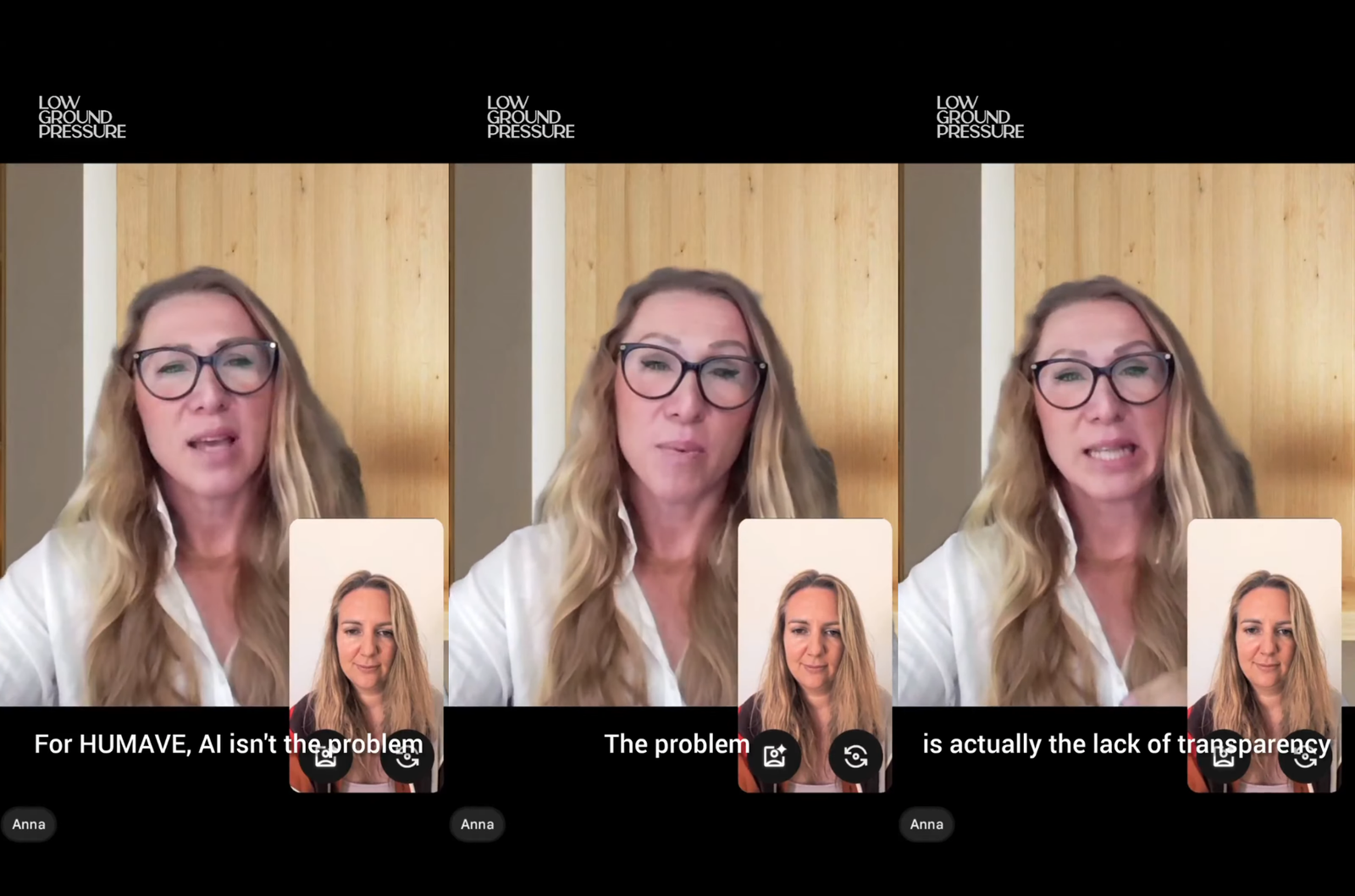
Anna Wolna: Yes, for HUMAVE, AI isn’t the problem. The problem is actually the lack of transparency that AI is creating today. We are very well aware that AI-generated content becomes harder to distinguish from human work, and that’s exactly where HUMAVE comes in. So, with our label, we simply provide transparency, in the sense that we help artists, galleries, collectors and many more people to communicate clearly and instantly that what they are offering or acquiring is human-made. So, that’s all we are protecting.
LGP: What opportunities do you see for artists, galleries and perhaps even collectors in labeling artworks as human-made? Do we actually need this kind of certification?
Anna Wolna: We don’t need certification simply because AI exists. We need it because we want to know what people are looking at or paying for. So, imagine someone who is scrolling through hundreds of images online and your work appears next to an AI-generated piece that looks almost as good, but costs a fraction of the price. And to most people it is very hard to tell what is the difference. Think, if buyers can’t tell the difference, they most likely won’t pay the difference. So, the label communicates what’s the origin of the work is and the buyer can decide really what it is worth to them.
So, when it comes to galleries, the label helps to make the trust visible. Galleries have always built a reputation on expertise, but now they can also offer to visitors a clear, independent proof about the origin of the work. And in that way, they can help buyers feel more confident about the piece they are acquiring.
For art collectors, I think it’s more about preserving the story. Today you remember why you bought that piece and who created it, but think in 10 or 20 years after that artwork changes many hands. That context maybe won’t be that easy to provide.
So, the human-made label verified keeps that provenance and the story connected to the artwork over time. At the end of the day, the label is not there to create exclusivity. It is only to provide clarity.
LGP: Do you believe work made with AI can still be authentic art?
AW: Absolutely. Authenticity isn’t determined by the software someone uses. It is determined by the honesty. So, if you create art and if you use AI, please say so. And if you don’t, also say so.
The art world has always embraced new tools. Let’s look at photography, for example, how that has evolved over time or the digital printing. What matters here is not the tool. It’s actually that the creator is transparent about the creative process. And also the person who is experiencing that creation is aware about the origin of the artwork in question.
LGP: Does your label unintentionally suggest that AI- assisted work is somehow less valuable?
AW: No. Let’s be very clear on that. HUMAVE label isn’t about assigning value. It’s about adding context and clarity. Just to give you an example, organic food labels don’t say non-organic food is bad. And Fairtrade doesn’t say that other coffee has no value or has a bad taste.
Museums today already tell us when a work is an origin, is a print, restoration or reproduction. And obviously, none of those labels tell you what you should like or how much it should cost. So, this information simply helps us understand what we are experiencing. And HUMAVE label does the same. Labels aren’t rankings. They are clearly, purely informational.
LGP: I personally have seen many thoughtful, in-depth artworks created with AI by artists. How do you see these works being received if human-made labeling becomes more widespread? Is there a risk that AI-assisted works could be unfairly discriminated against?
AW: Transparency shouldn’t divide artists. Our label doesn’t create discrimination. In fact, I believe AI artists also benefit from honest labeling. The HUMAVE label allows people experiencing art to appreciate artists’ work for what it is. Trust grows when expectations match reality. And I believe that’s good for everyone.
LGP: Does emphasizing human authorship risk overshadowing what ultimately matters most? The quality and impact of the artwork itself?
AW: Human authorship isn’t competing with artistic quality. If you go to see Francis Bacon’s work, for example, you will experience the quality and the impact of his artwork. But the process of creation is only an element of the finished work. So, whether human made or AI-made, it’s just a part of the creative process.
LGP: For now, this kind of certification is not essential. Do you think it will become so in the future? What are your predictions?
AW: I think it will become increasingly important as AI becomes capable of creating almost anything. I think it will be when people will naturally become more interested in understanding and learning about the origin of the piece or the creative journey. So, I think transparency here will become an expectation. Soon, the question like, is this AI-generated, will be a very normal question. Imagine you or a gallery will be asked that question and not having an answer. The artists who get human-made verified labels today aren’t really early adopters of a trend. They’re the ones who are actually thinking ahead of time.
LGP: Is this a temporary response to the uncertainty surrounding AI or do you see it as a part of a more permanent cultural shift?
AW: It is permanent. It’s not temporary. AI isn’t going anywhere. So, the question “Is this AI?” isn’t going anywhere either. And honestly, I think as the technology gets better, the question will become even more important, louder. So, trust becomes more valuable here, not less.
Summing up, this isn’t a temporary response to uncertainty surrounding AI. I think we are at the start of a real cultural shift.
LGP: Let’s turn to the practical side of what you do. How do you certify an artwork? Does your certificate actually prove human authorship or does it primarily document a declaration made by an artist?
AW: The process starts with the artist declaring how the work was made. We then review the declaration according to our standard. We ask for supporting evidence, review the evidence and only award the label when it holds up. You can ask whether we can stand behind someone’s shoulders for the entire creative process. Of course not. And no certification on this planet actually does that or can do that. But what we give is an independent verification and accountability. And honestly, that’s how most certifications work. Just to give you an example, organic label doesn’t follow every tomato from seed to shelf. It assesses evidence against a defined standard and that’s where the trust comes from. We are doing exactly the same thing, just for human authorship. We are giving buyers and collectors something much more useful than blind trust. We are giving them confidence that the declaration has been reviewed and it’s just not taken at face value.
LGP: Do you expect a human-made certificate to increase an artwork’s market value? If so, why?
AW: The labels are not to increase an artwork’s value. That’s for the market to decide what value it should have. The label increases the clarity. If human authorship matters to a buyer or collector, then the information should be visible. And whether that leads to a higher price or greater trust or simply more informed purchasing decisions, it is up to a buyer, not us.
LGP: Thank you so much for this conversation. It was a very inspiring set of points we discussed here.
AW: Thank you so much. It was a pleasure.
LGP: Get in touch with HUMAVE via the this link, get your free non-binding consultation
and mention LGP to get a special referral offer.