


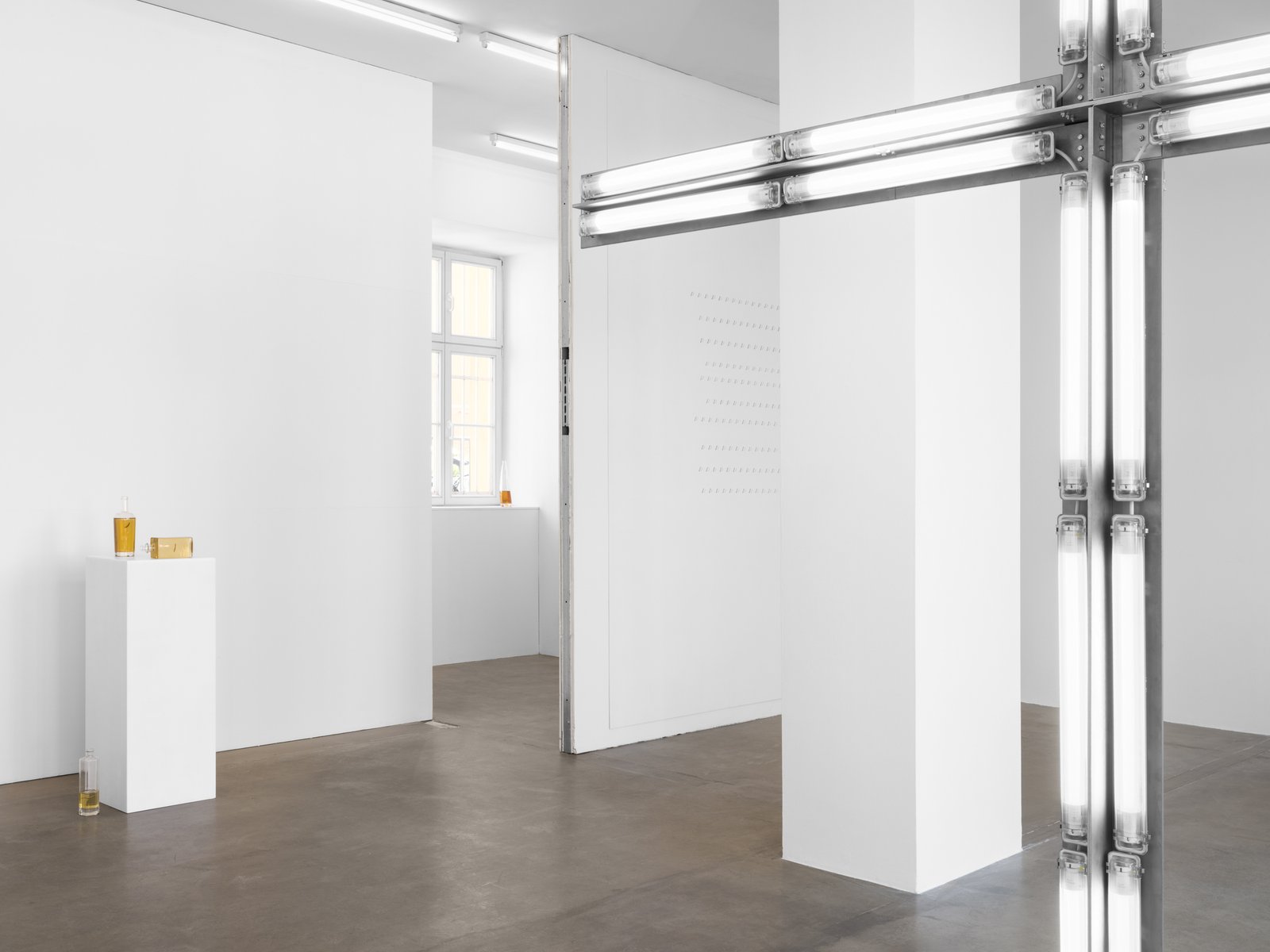
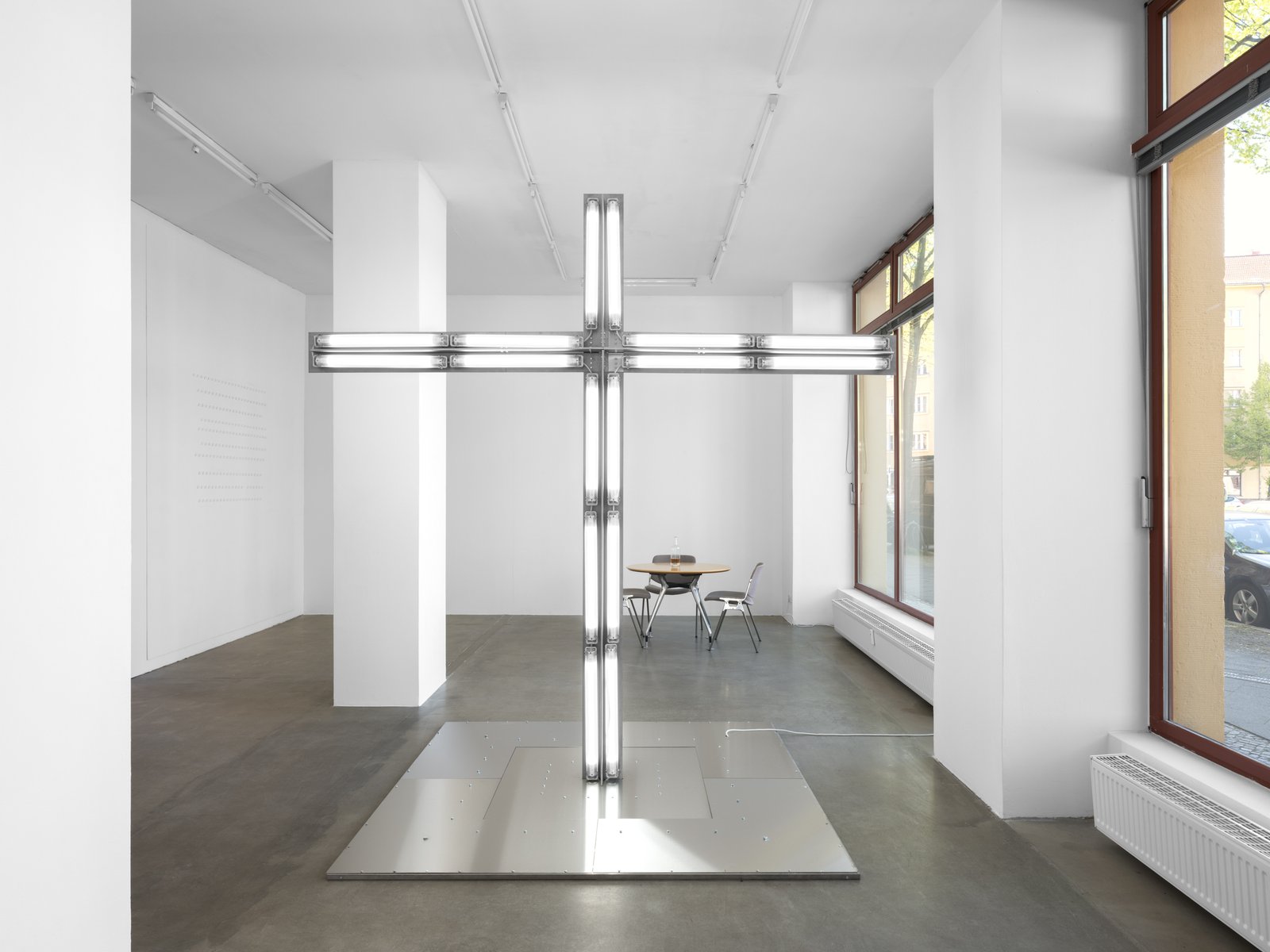
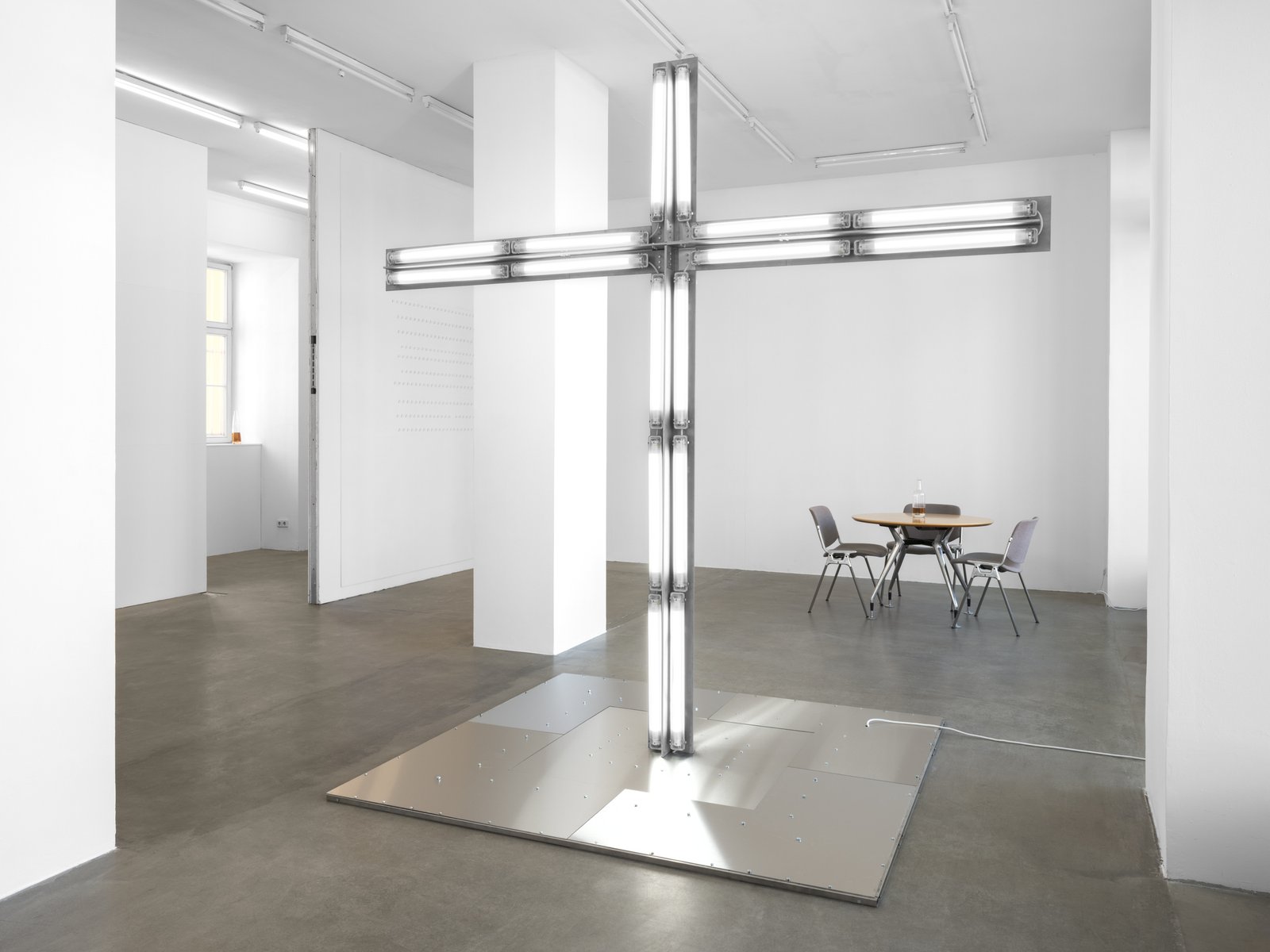
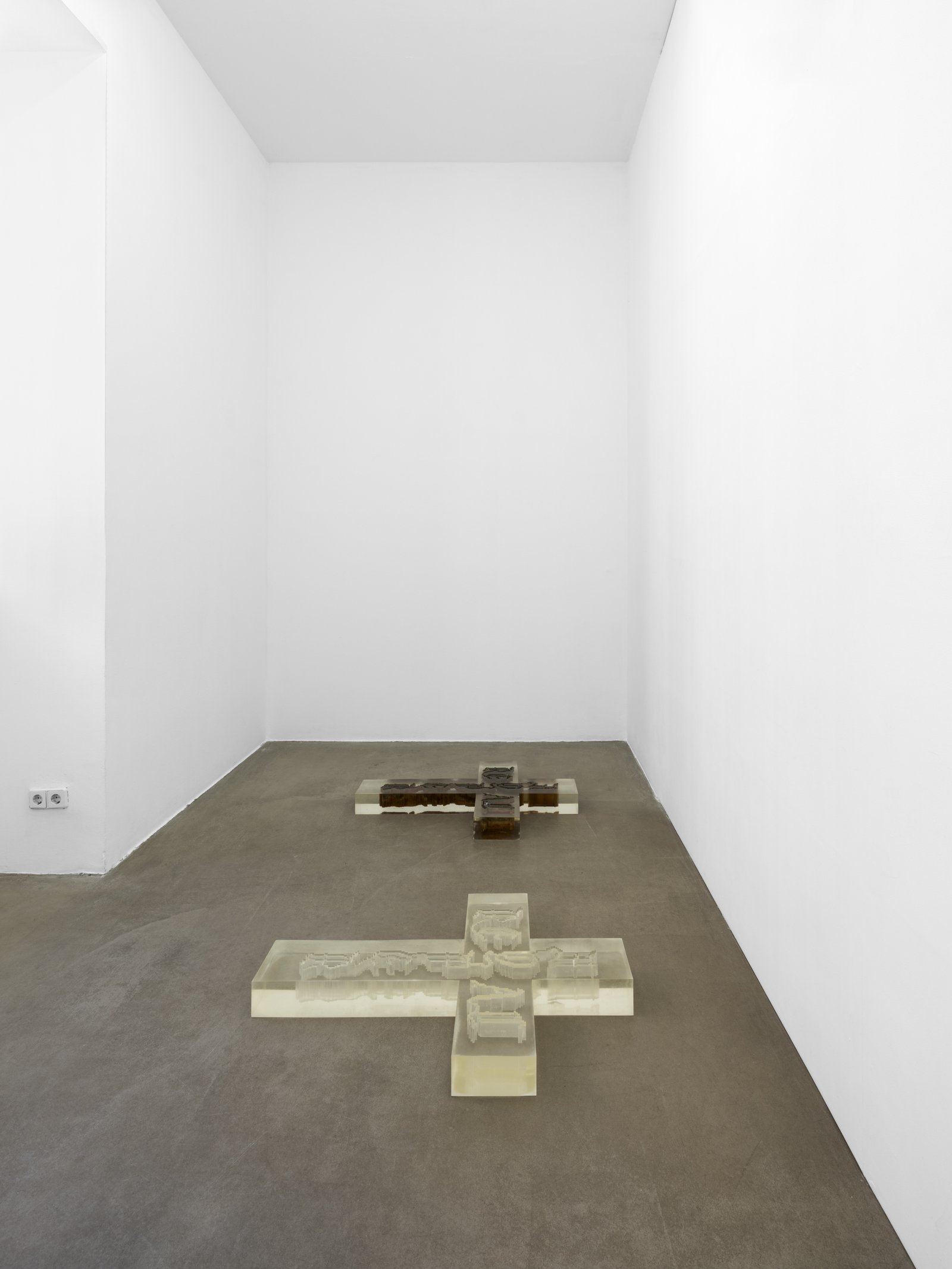
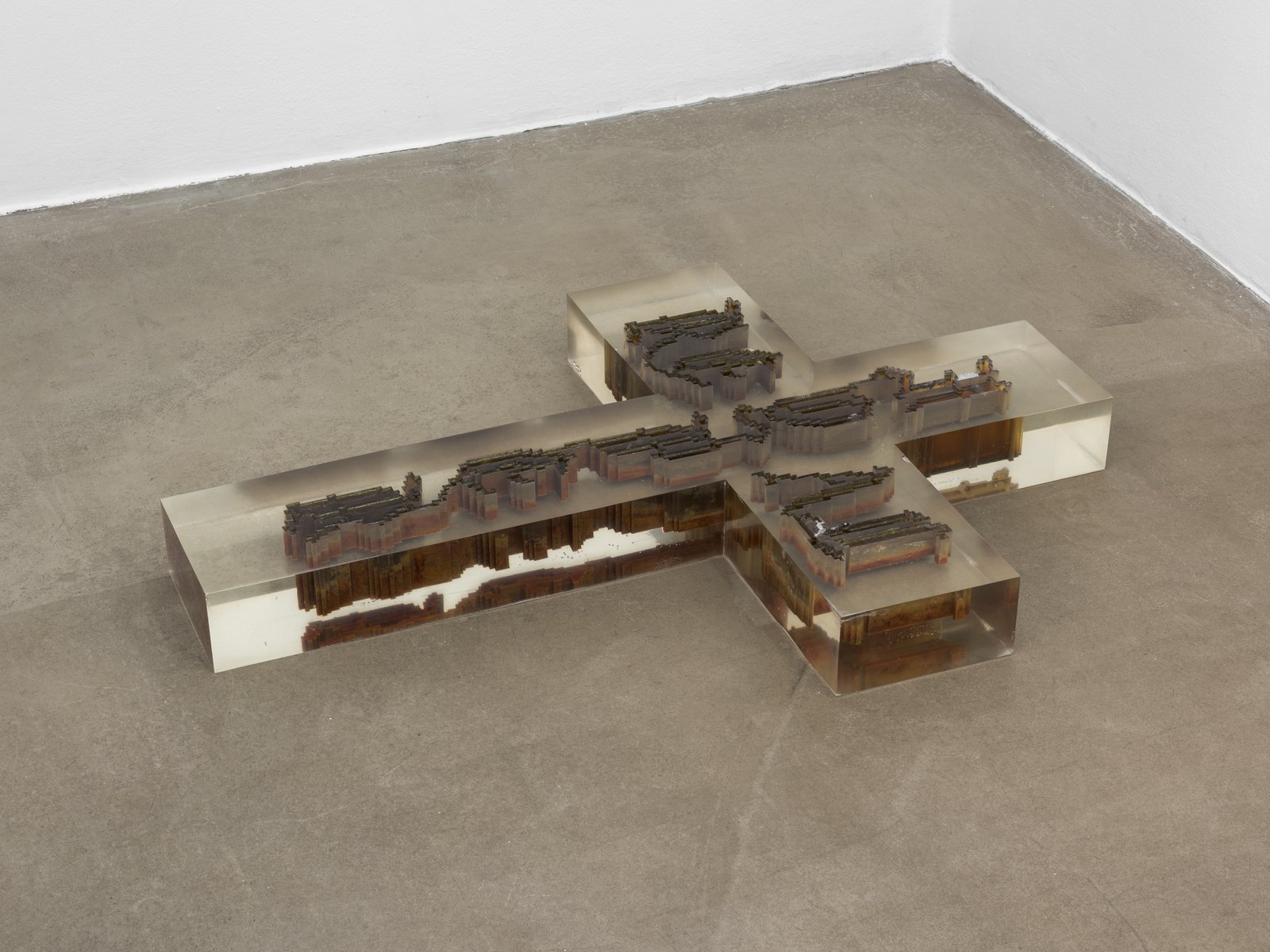
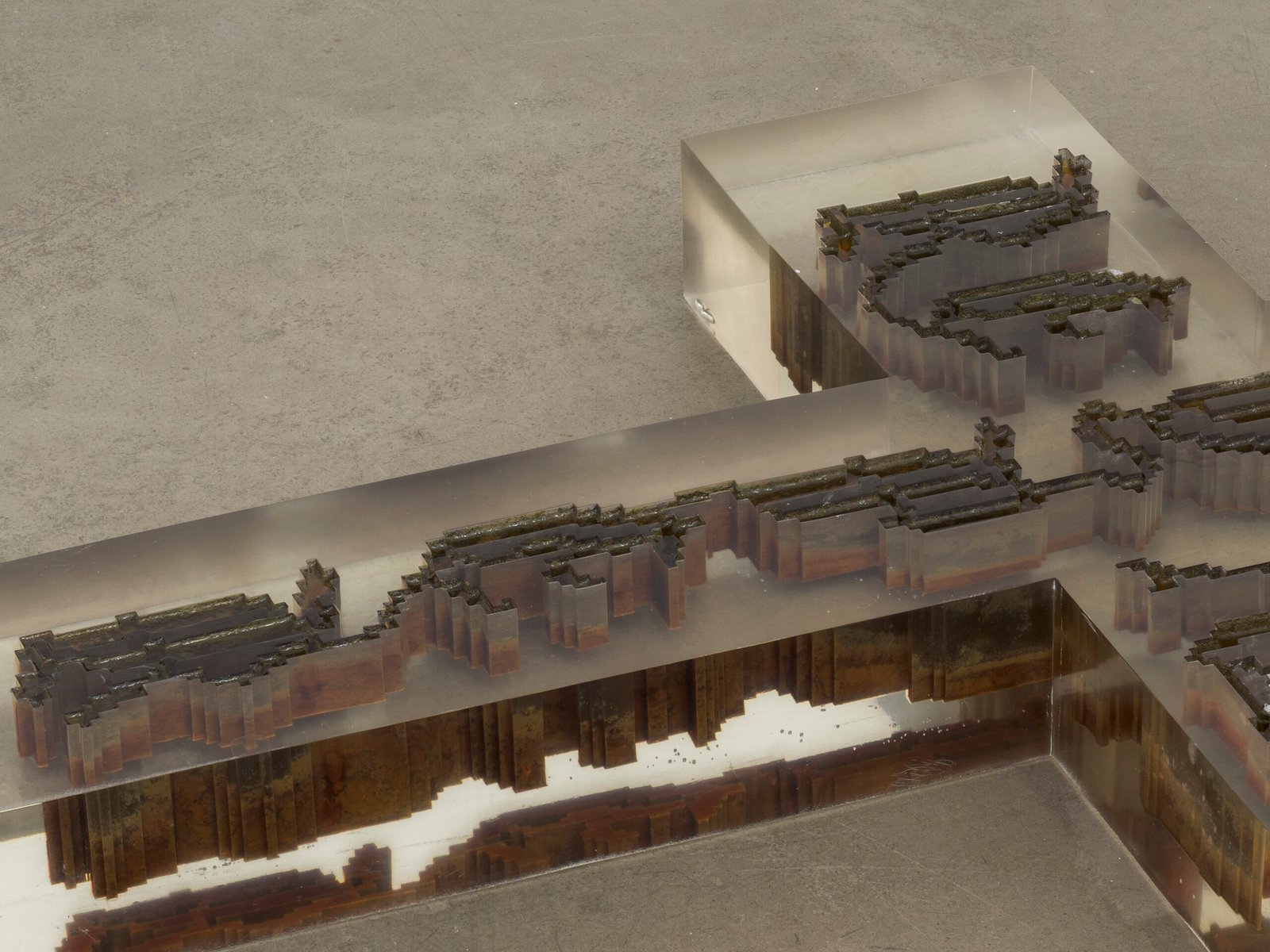
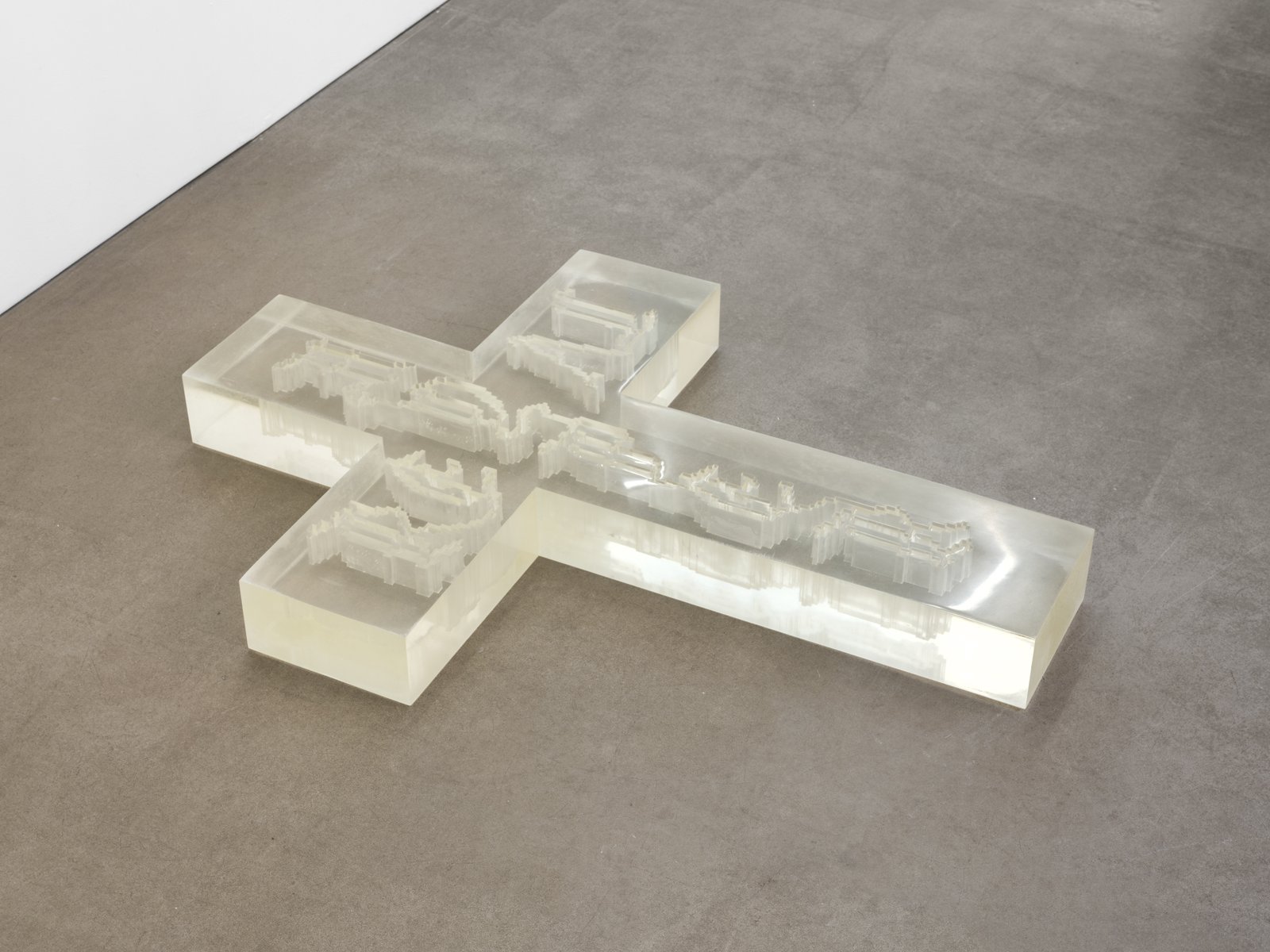
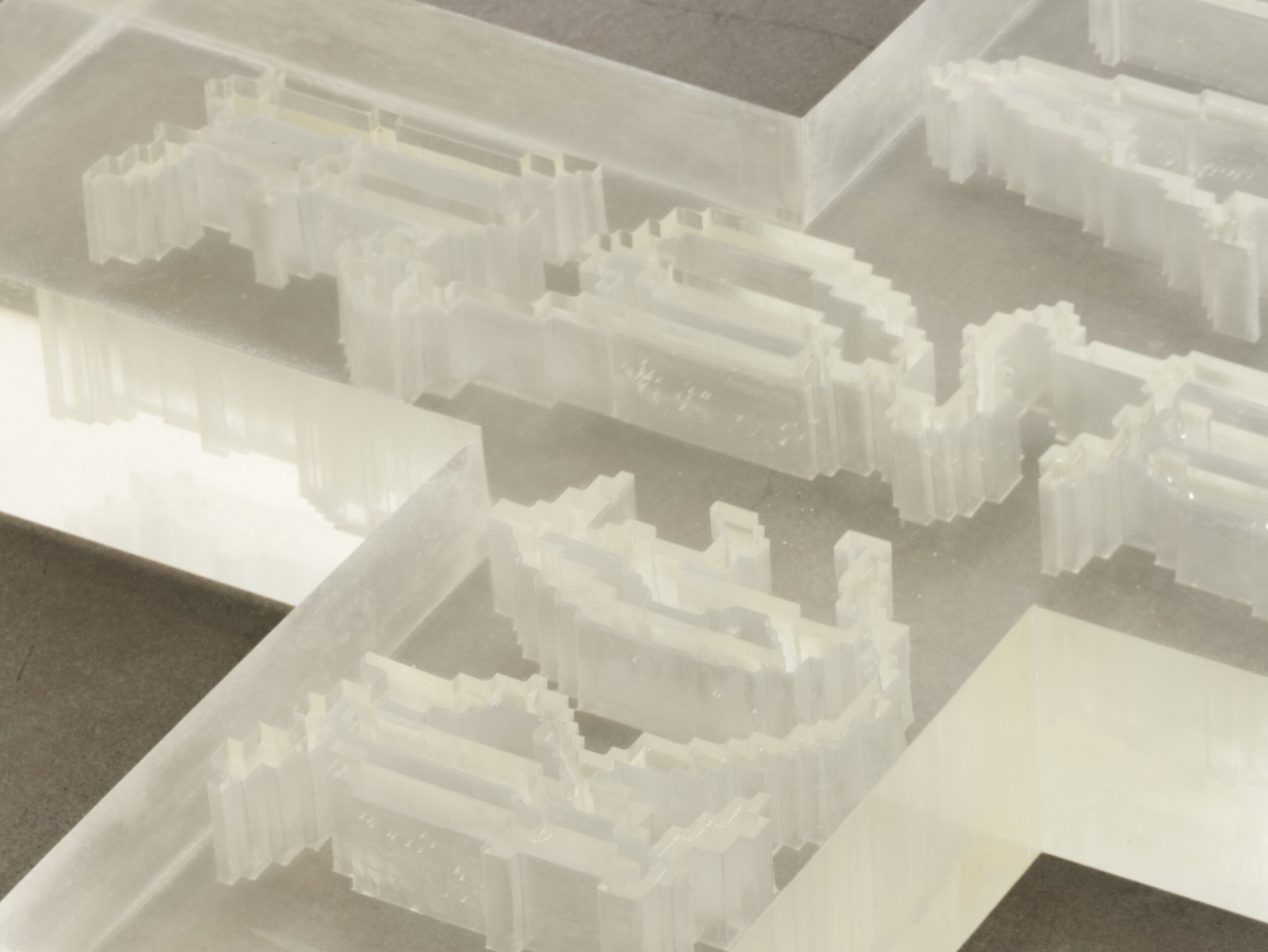
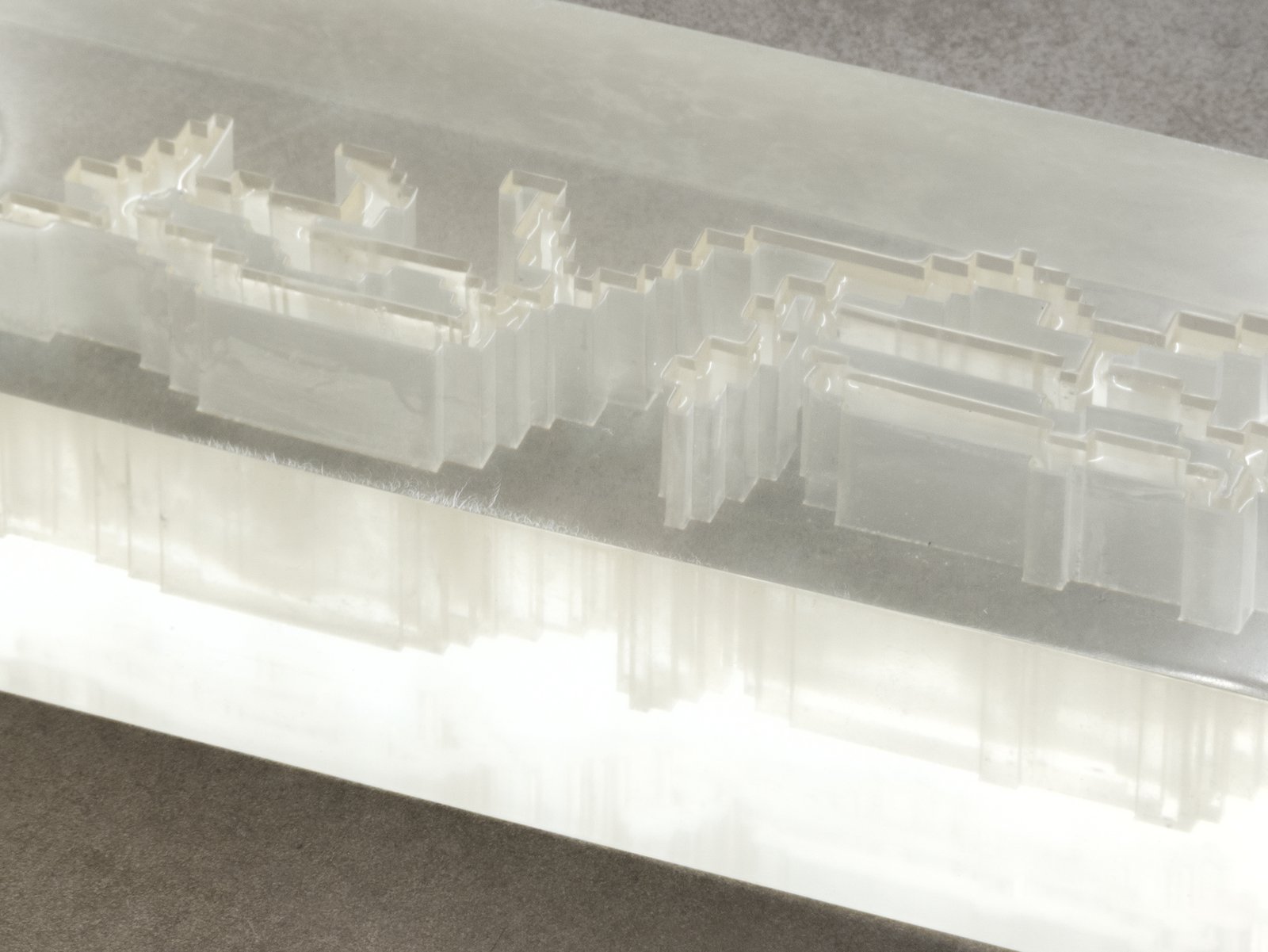
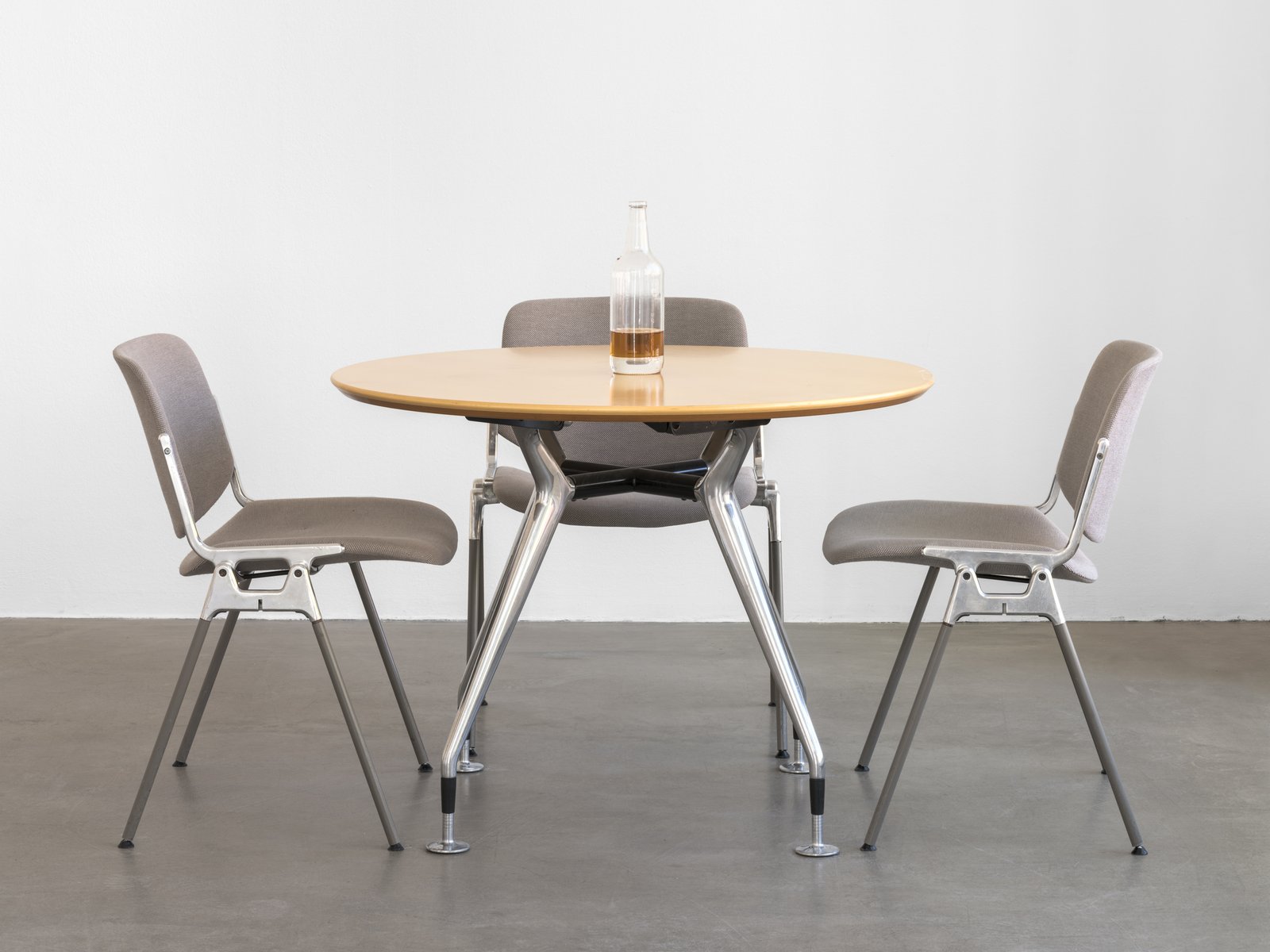
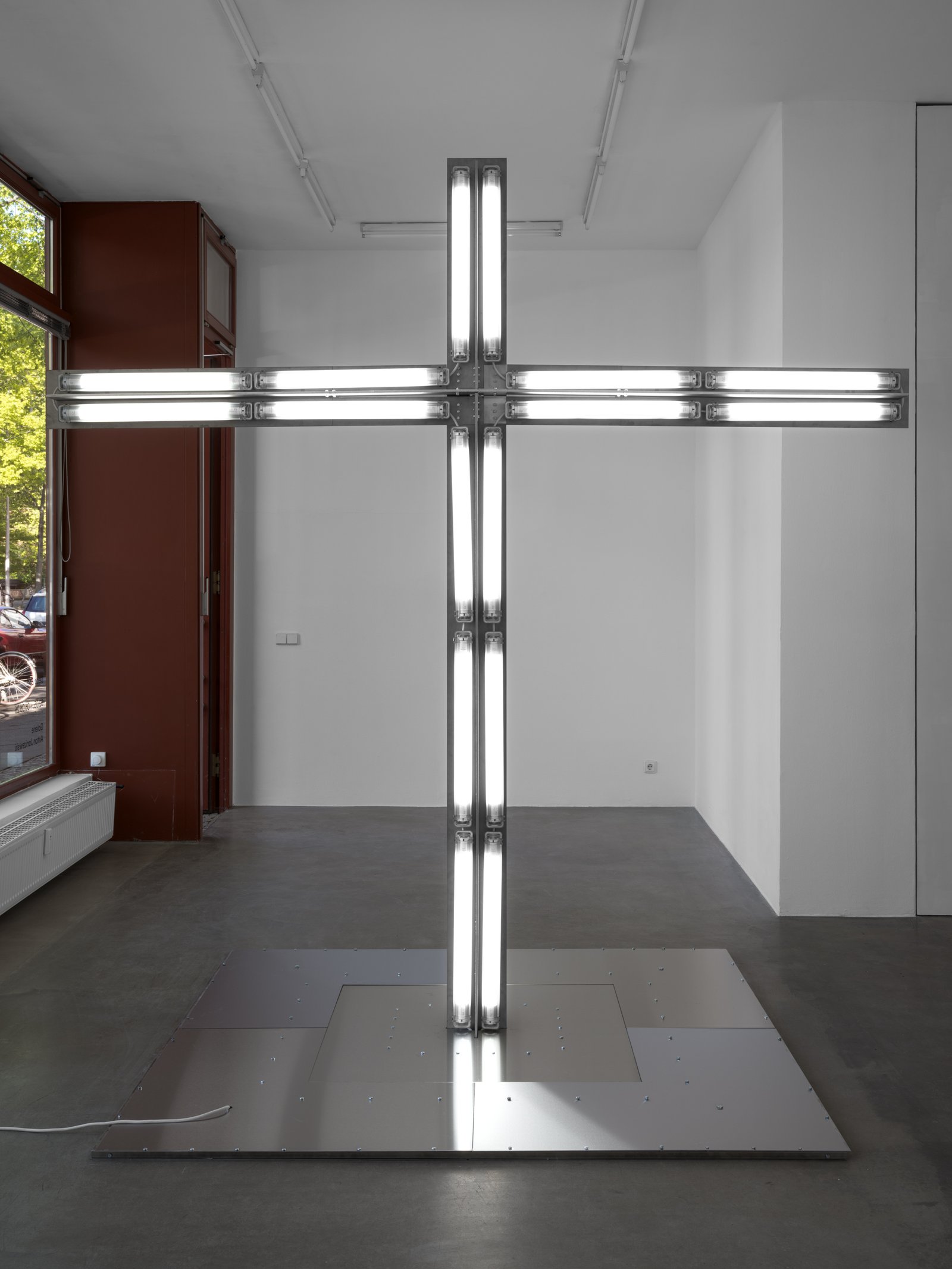
Historically, a “dead end” names a spatial condition – a street that leads nowhere, a passage cut short. Over time, the term has come to describe something less tangible yet equally pervasive: a sense of arrested movement, of directions that fail to open. In Jiyoon Chung’s exhibition at Anton Janizewski, this slippage between physical obstruction and psychological state becomes a point of departure. Dead End unfolds as a site-specific installation that engages with the subtle yet persistent presence of infrastructures that shape how bodies move, hesitate and orient themselves. Crisis here does not appear as rupture but as something absorbed into the ordinary, structuring its rhythms from within. A recurring motif throughout the exhibition is the cross – not as a stable symbol, but as a form that has become strangely weightless. In Untitled (2026), a stain- less-steel structure fitted with LED tubes occupies the space with a quiet insistence. Its geometry is reduced, almost diagrammatic, recalling the history of Minimalism, infrastructural signage as well as the illuminated crosses that punctuate the nightscape of South Korean cities. Yet here, orientation gives way to impasse. The four directions do not extend but terminate. As Chung suggests, the cross becomes a “dead end to the imagination” – a form so saturated with meaning that it begins to empty out, holding attention only momentarily before releasing it again. This sense of suspension carries through the paired works Hyperreal, 0.0 and Hyperreal, 1.1 (both 2026), set on the floor of the gallery. Cast in transparent epoxy, the cruciform structures function as containers – holding distilled water in one instance, and Jack Daniel’s whiskey with dissolved graffiti ink in the other. The latter introduces a trace of the urban exterior: anonymous inscriptions lifted from walls, dissolved and reconstituted as sediment. As the liquid gradually evaporates, what remains are faint deposits, a slow inscription of absence.
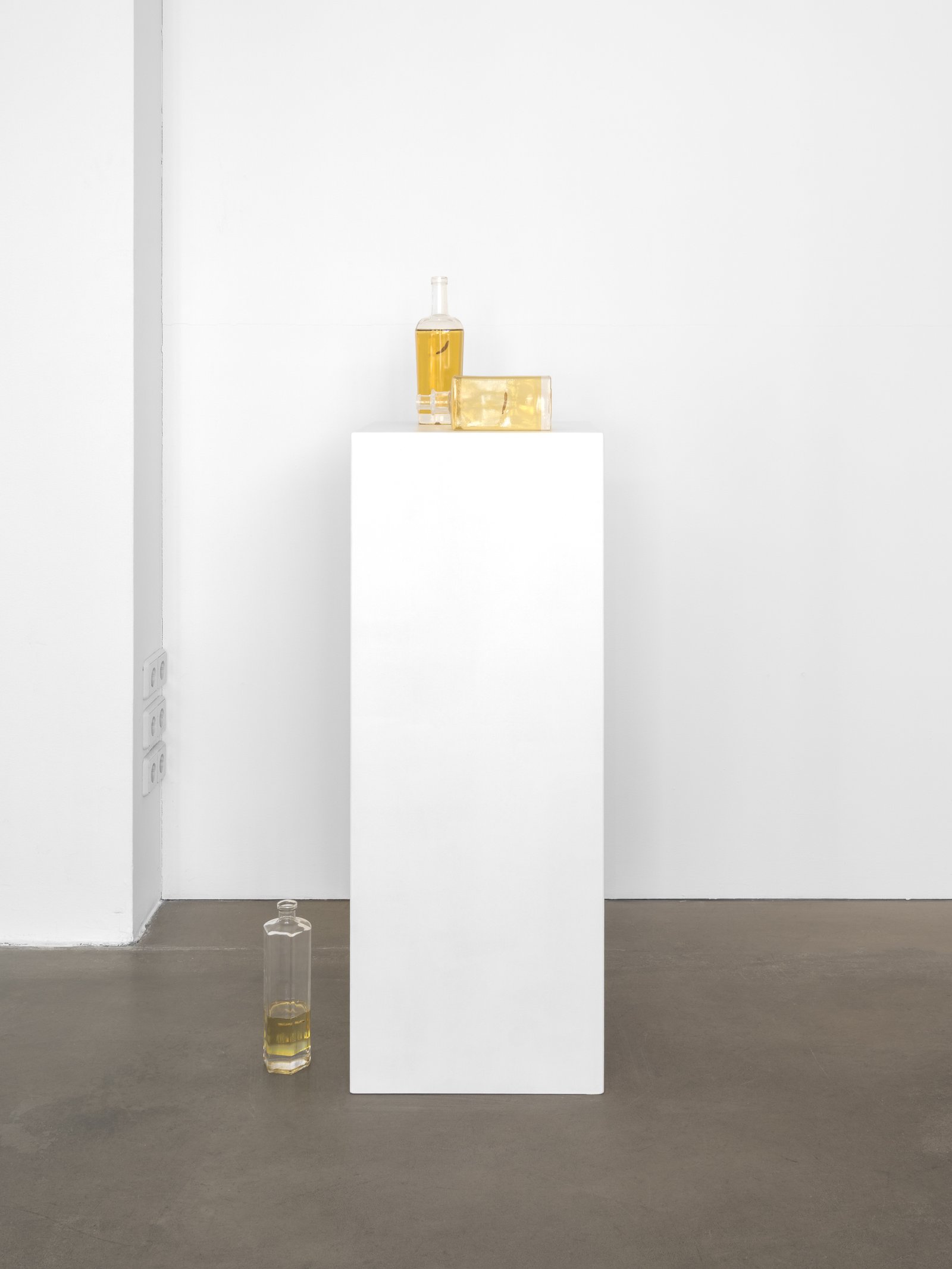
In the series A Lot of Yeses (2025), Chung works with bottles from celebrity-owned tequila brands – associated with figures such as Kendall Jenner, George Clooney and Michael Jordan – which are cast and reproduced in resin. These replicas retain the recognizable form of the original products while rendering them inoperative. Their surfaces simulate transparency while withholding access. Inside each, an agave worm is suspended – the only organic element with- in an otherwise synthetic composition. Once a marker of fermentation, it now persists as a vestige, a sign that has lost its function yet continues to circulate. Between ritual and branding, belief and consumption, the works trace a shift in how value is produced and perceived.
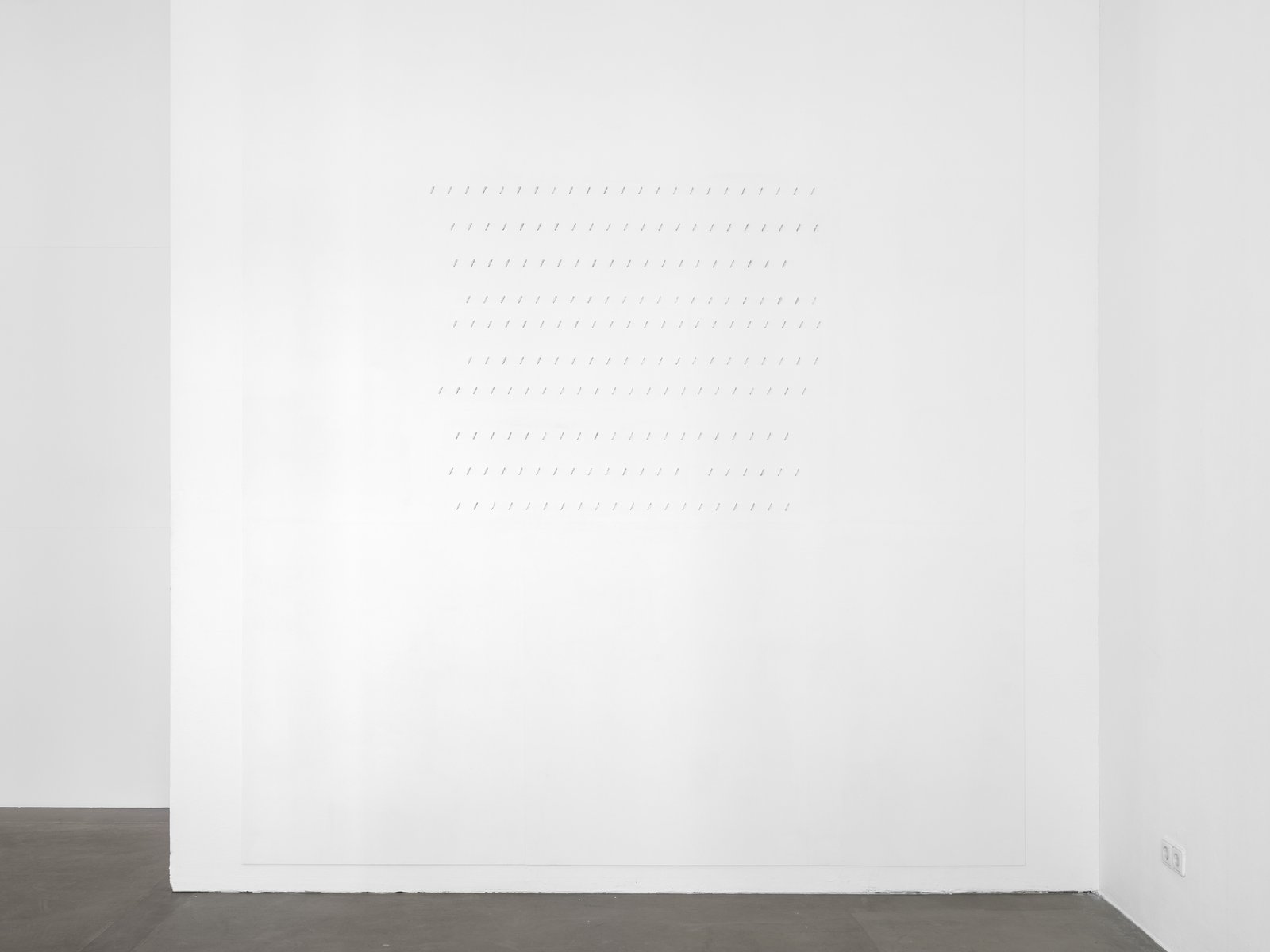
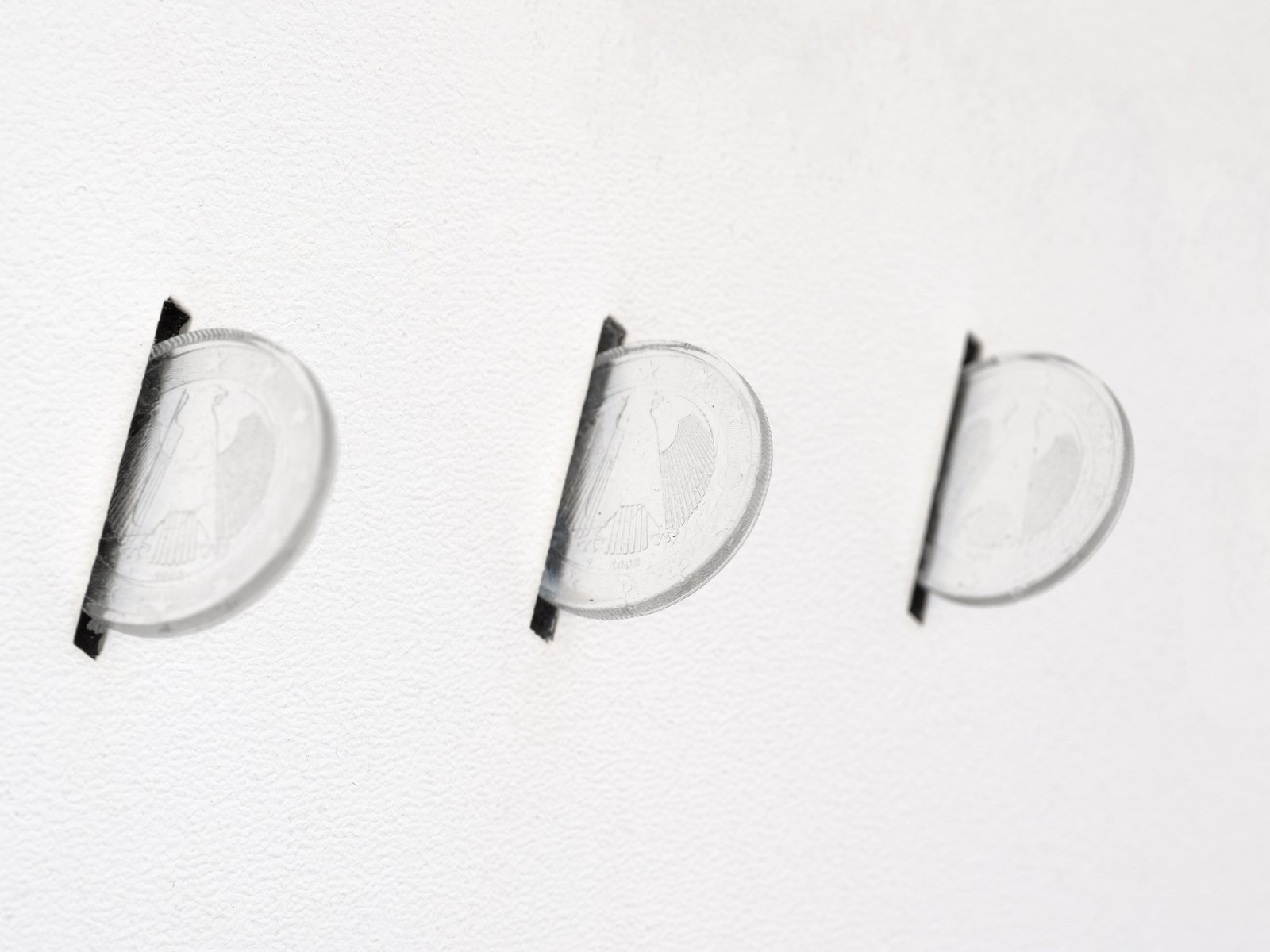
With Dead Flips (2026), Chung turns explicitly to the question of currency. More than 200 Euro coins, cast in transparent resin, are inserted into slits in the gallery wall – as if suspended mid-action, caught in the moment of being fed into a vending machine. Each coin reveals both sides simultaneously, collapsing the binary of heads and tails into a continuous surface. Replicated yet immobilised, they evoke a system of exchange that has stalled. In an increasingly cashless society, where transactions become abstract and contactless, the coin persists as a form of “hard” currency – tangible, weighty and tied to the gesture of insertion. Here, however, that gesture leads nowhere. The promise of access is deferred, held in suspension. Value is both present and inoperative.
Across the exhibition, questions of circulation – of what moves, what is exchanged, and what remains blocked – come into focus. Whether in the replication of branded commodities, the evaporation of liquid residues, or the duplication of currency detached from its function, Chung traces a condition in which systems of value continue to operate even as their meanings begin to thin. Capitalism appears less as a fixed structure than as an atmosphere: pervasive, adaptive, and increasingly difficult to grasp. As the title would suggest, Dead End does not propose resolution. Instead, it lingers in a state of suspension. What emerges is not a singular blockage, but a series of subtle interruptions – moments in which movement hesitates, orientation slips, and the promise of continuity begins to thin. In these intervals, the question is not only where to go, but whether there is, in fact, a way through.
– Carina Bukuts