


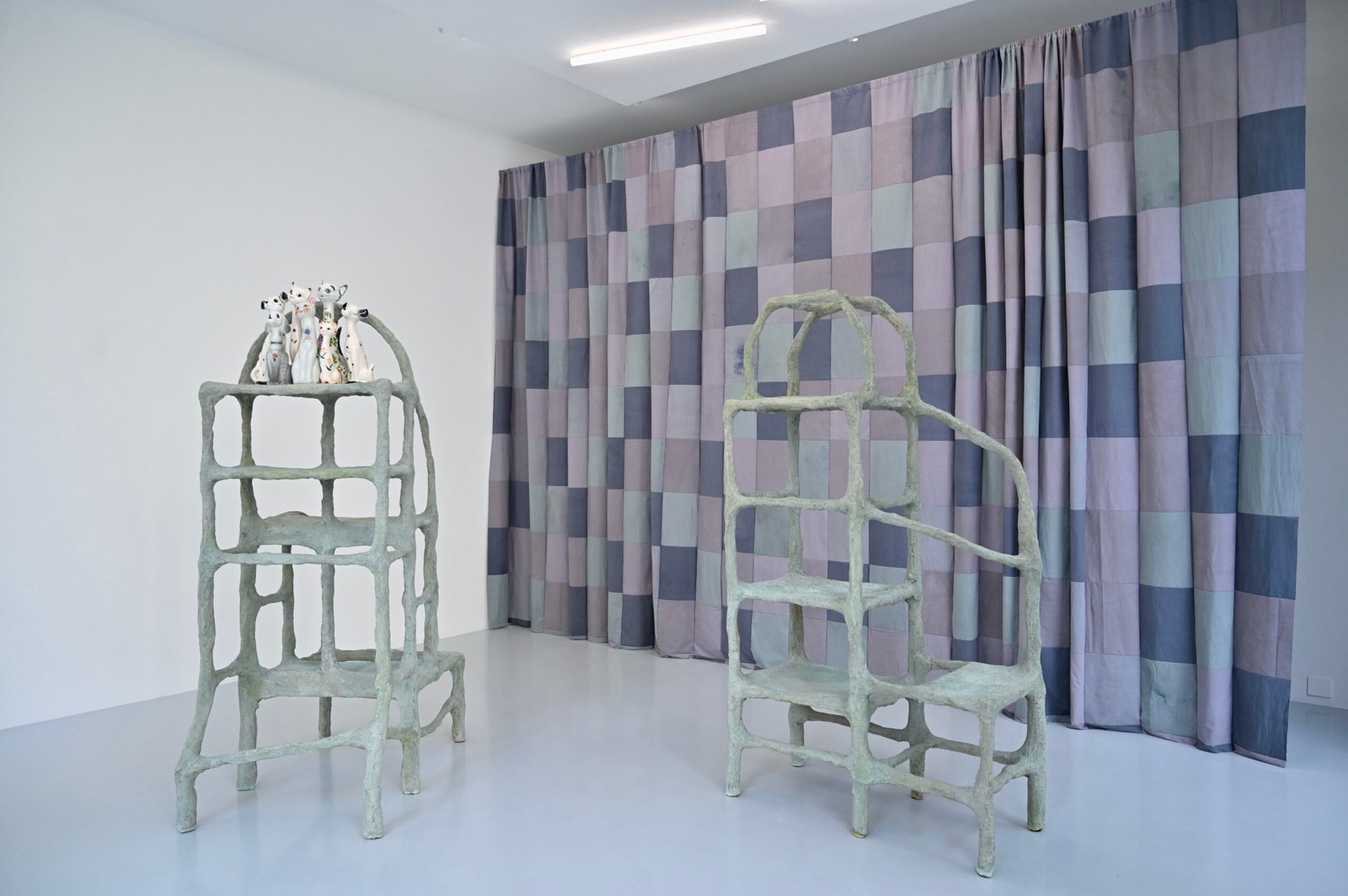
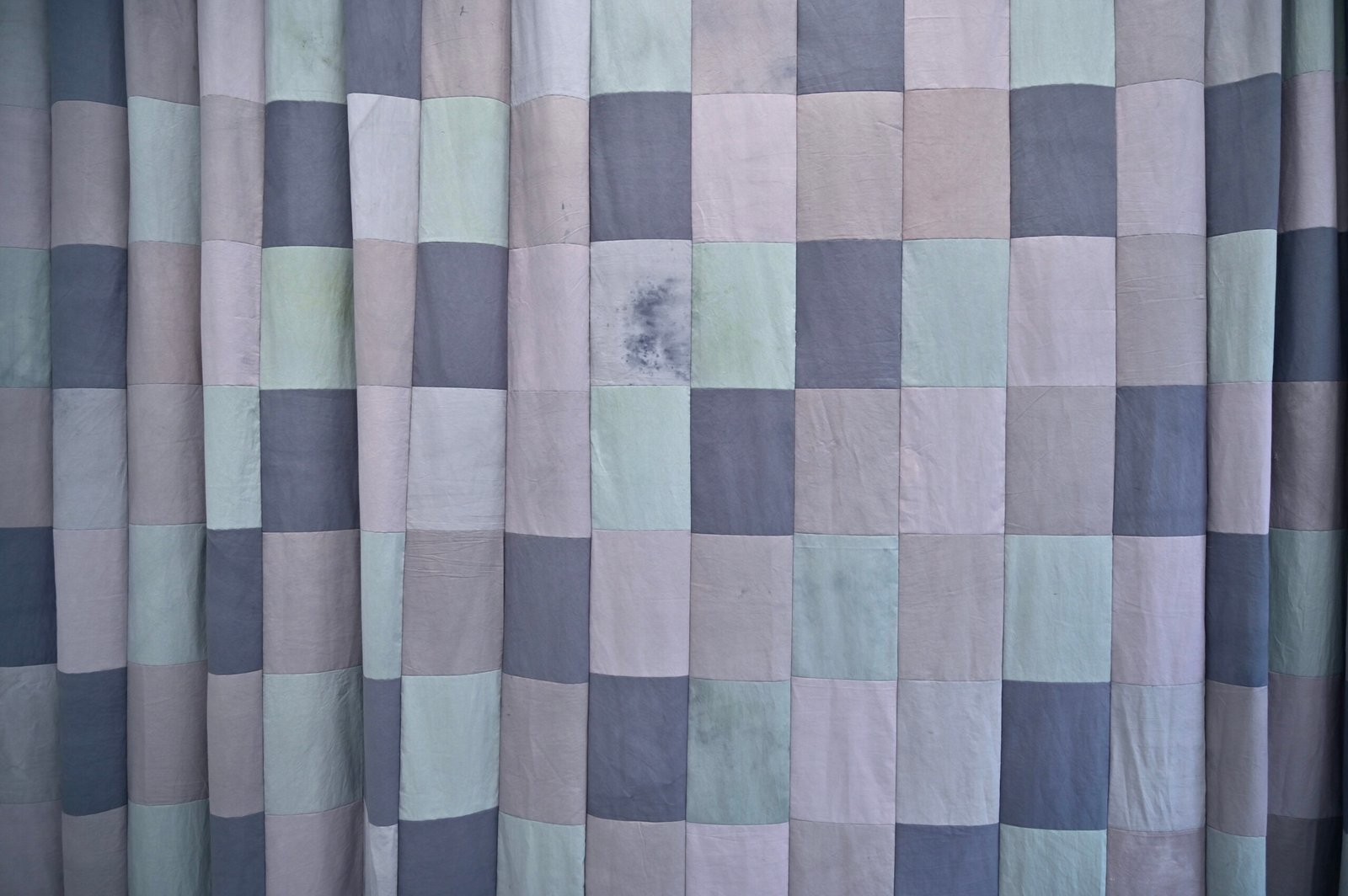
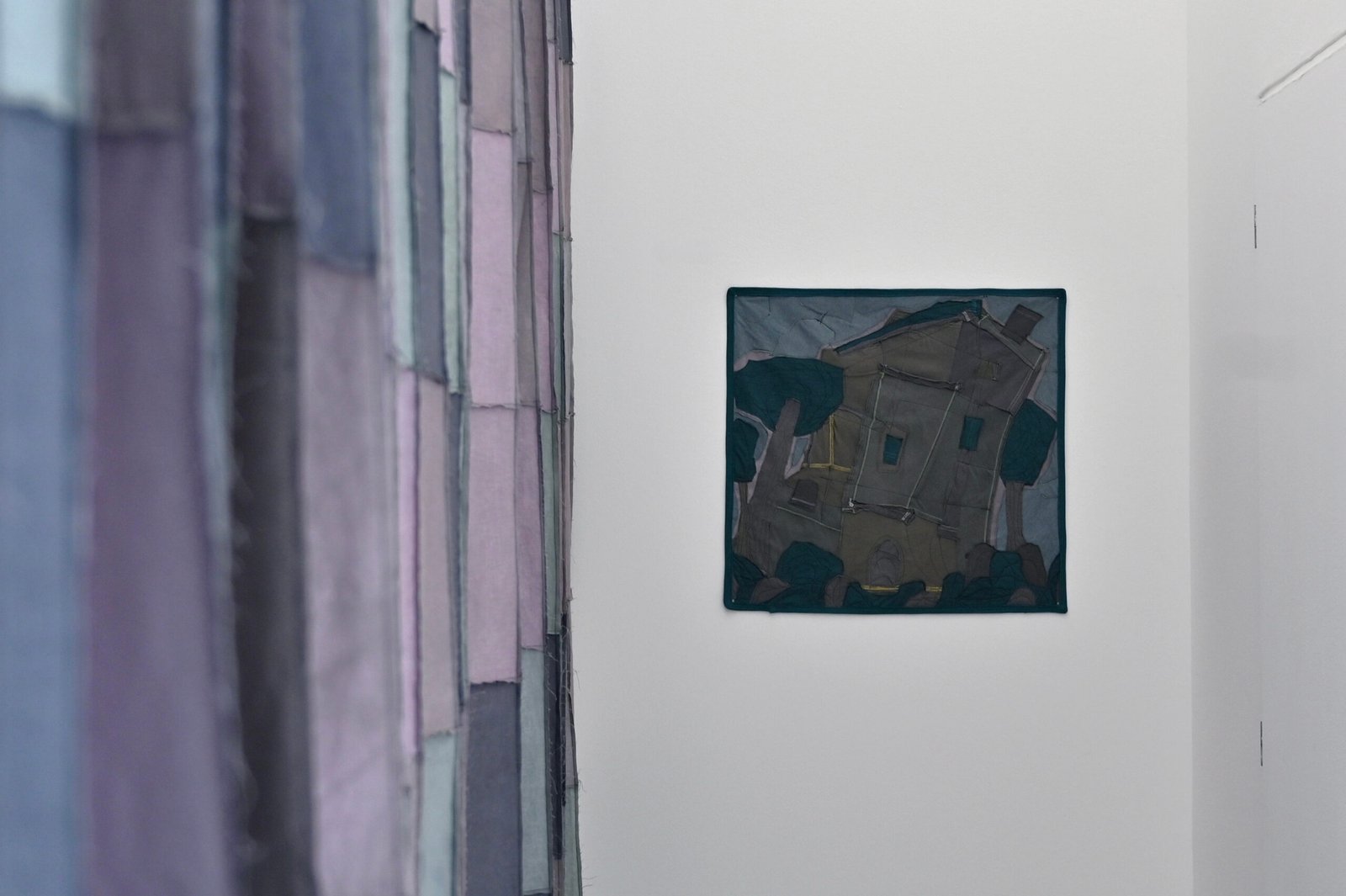
Tom Castinel works with sculpture and installation mainly with textile and concrete. From these materials, he transforms existing objects and displaces their status, between domestic use and sculptural presence. At KOMMET, this approach is embodied in a space designed as a scenery. The shapes are in a pastel palette dominated by a range of greys tinged with green, pink and blue, which soften the contrasts.
This environment originates from a daily workshop practice: making, repairing, assembling, without always knowing why. Working for oneself, demystifying gestures, liberating forms. Customising rather than creating from scratch, giving voice to what already exists. Tom Castinel hunts for and salvages worn fabrics and metal furniture, which he transforms through gestures of assembly, sewing, and upholstery.
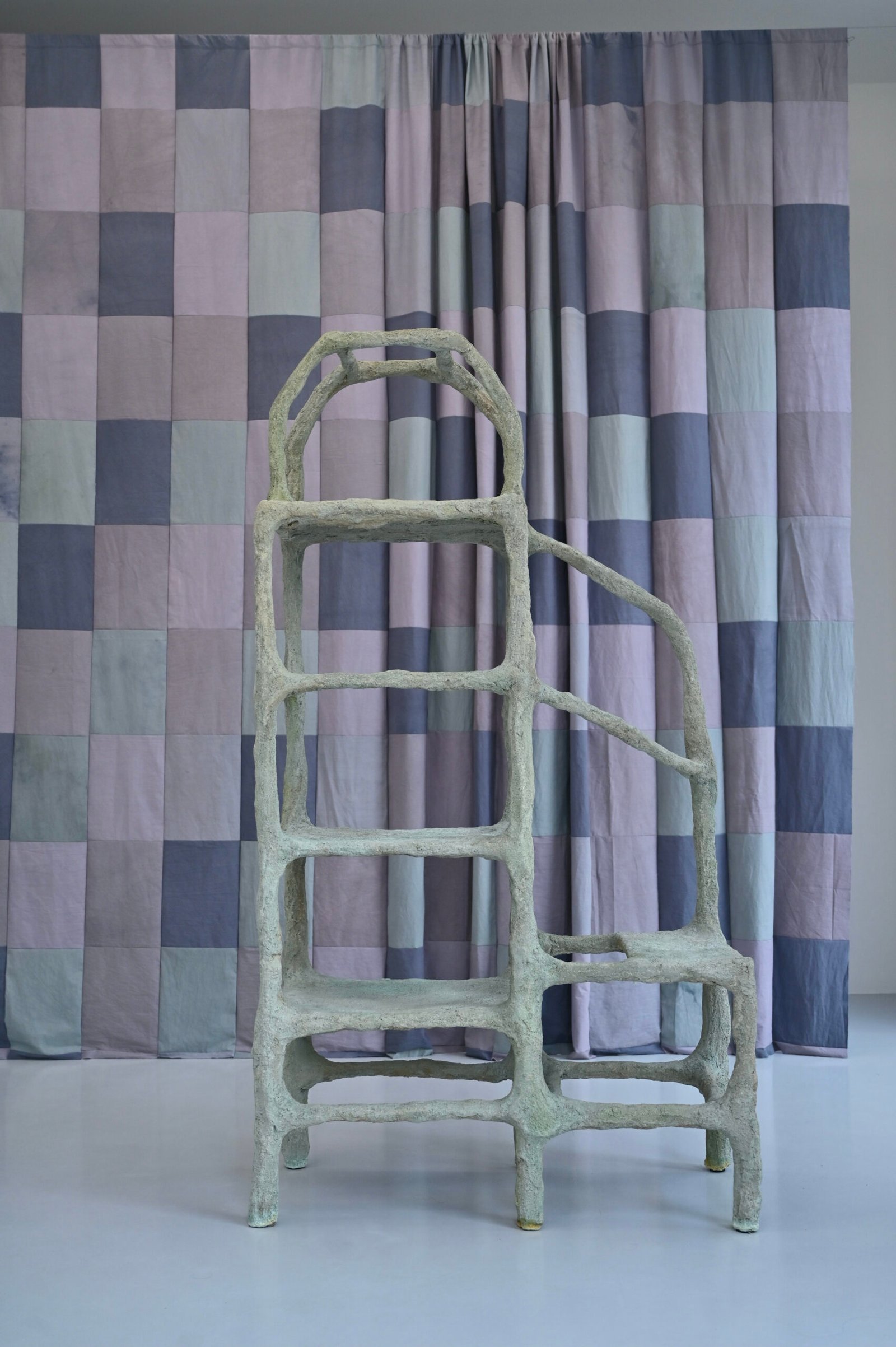
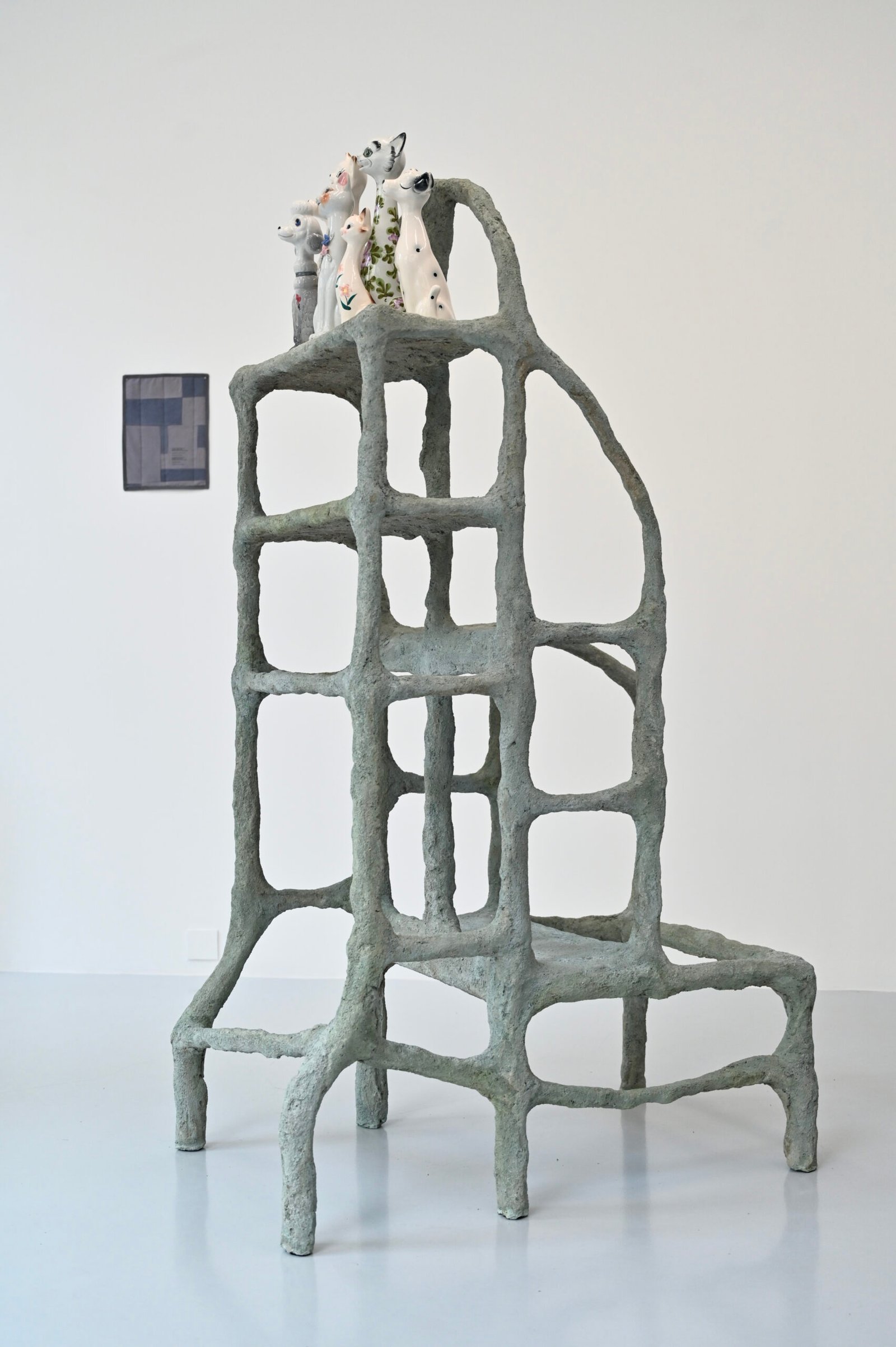
The concrete is worked using the rockwork technique, a decorative process that involves shaping cement over a metal frame to imitate mineral and plant life. Applied by hand, it covers the furniture without erasing its memory. Shelves are still recognizable, but their uprights seem to branch out and fossilize. From a distance, the forms evoke wood, while up close the materiality of the cement is more reminiscent of rock, placing the whole piece in a liminal space.
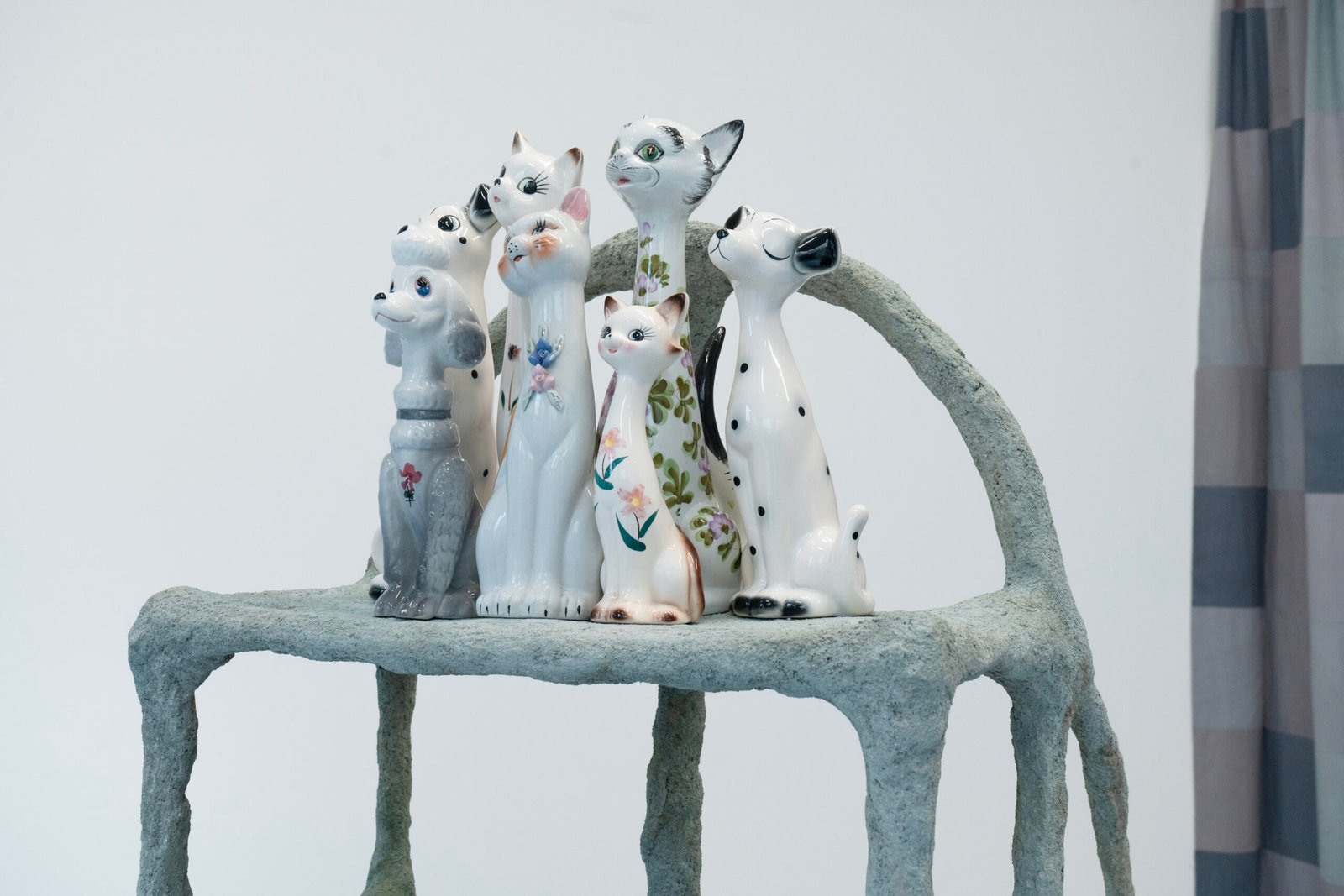
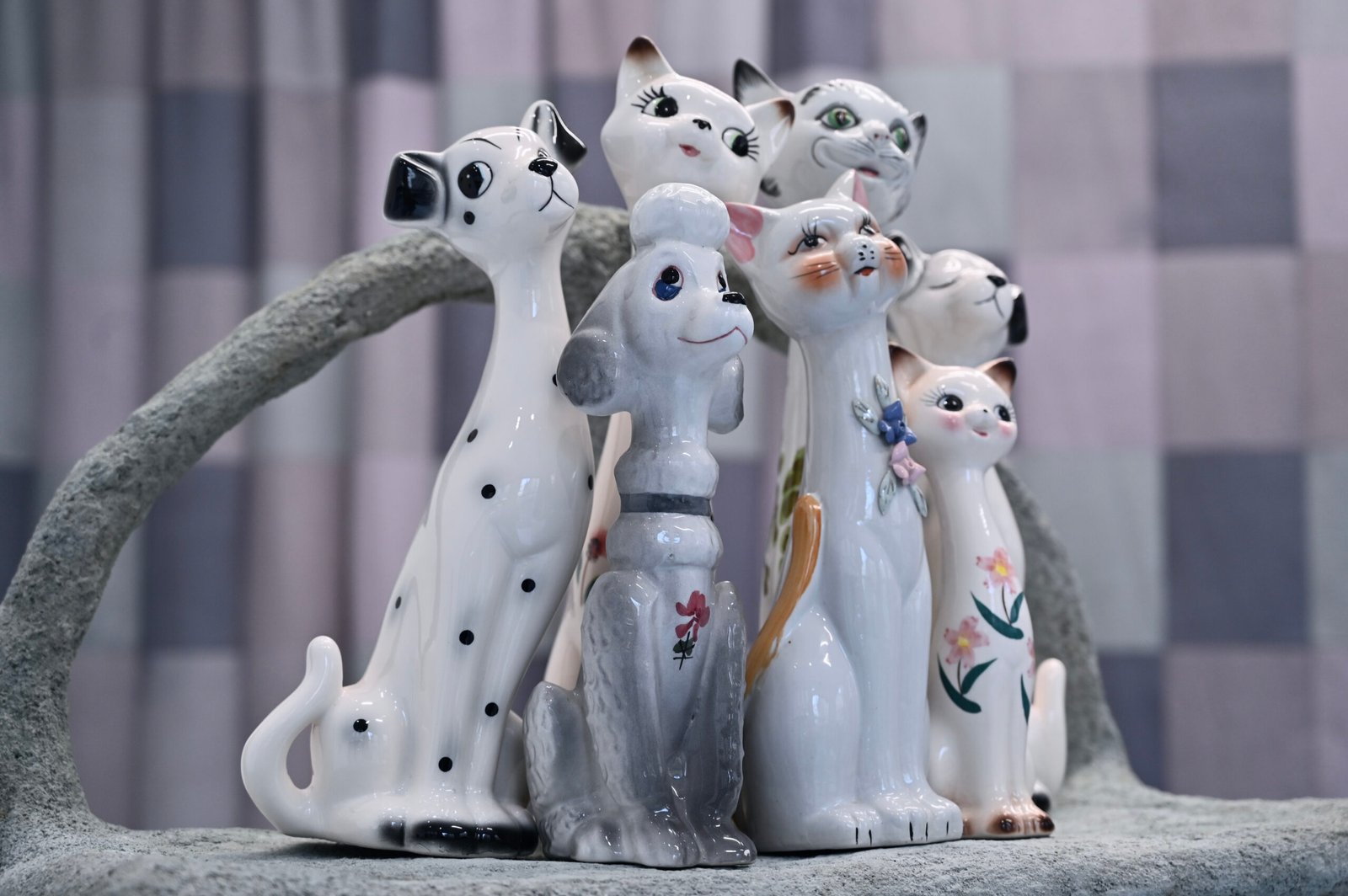
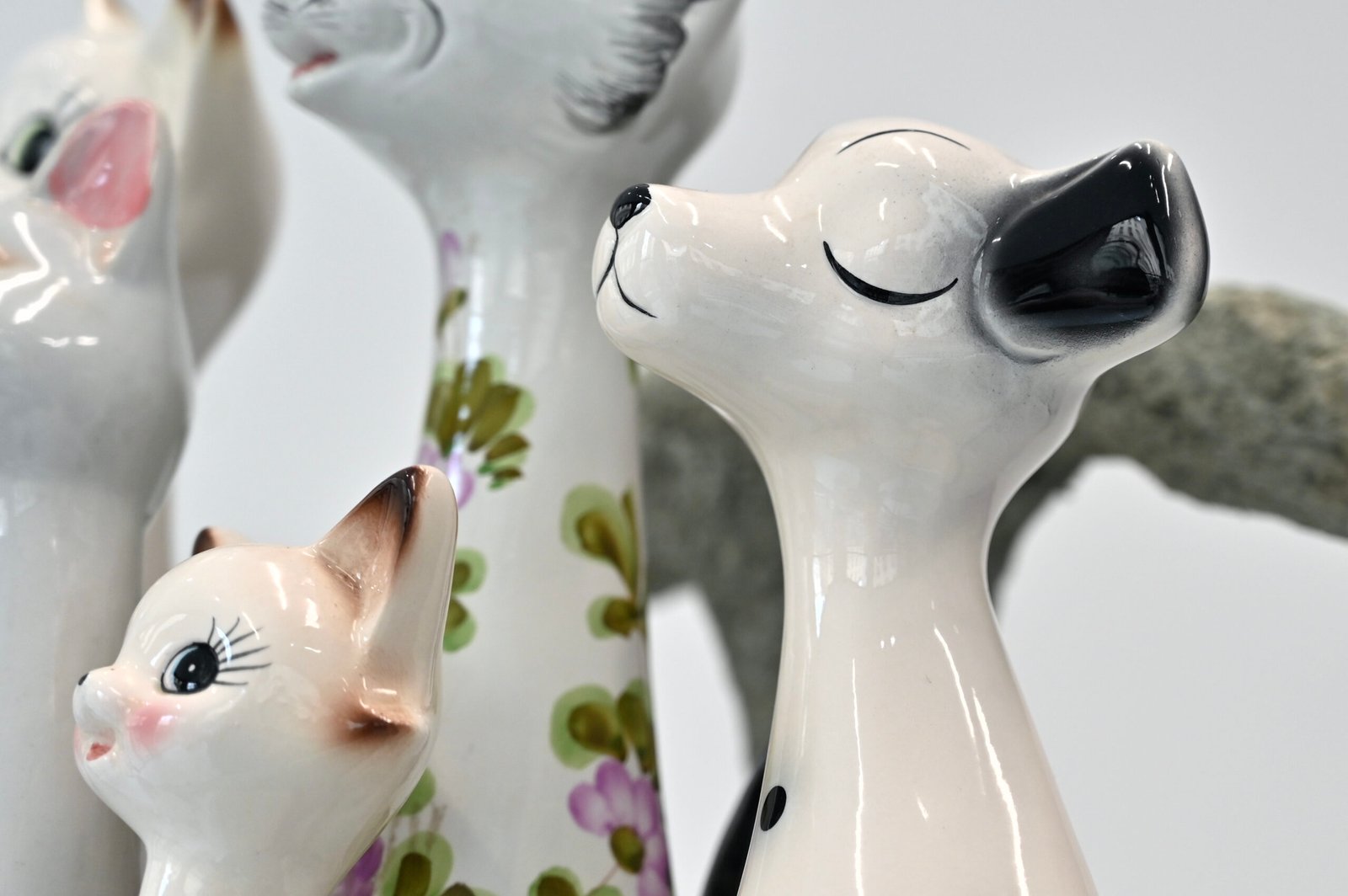
At the same time, he assembles a collection of decorative objects. Sentimental trinkets, modest ornaments, souvenirs of little monetary value but imbued with emotion—at home, as in the exhibition, he arranges them in relation to one another. These statuettes are meticulously placed, almost stuck together, forming configurations where accumulation becomes a principle of composition. At KOMMET, cats and dogs with elongated necks compose a strange group, both elegant and disproportionate. This ensemble reveals a collective portrait, like a family photograph, a group of friends, or a community of shared affinities. It acts as an emotional diorama, structured by subjective attachment as much as by formal correspondence, as if these objects had chosen each other.
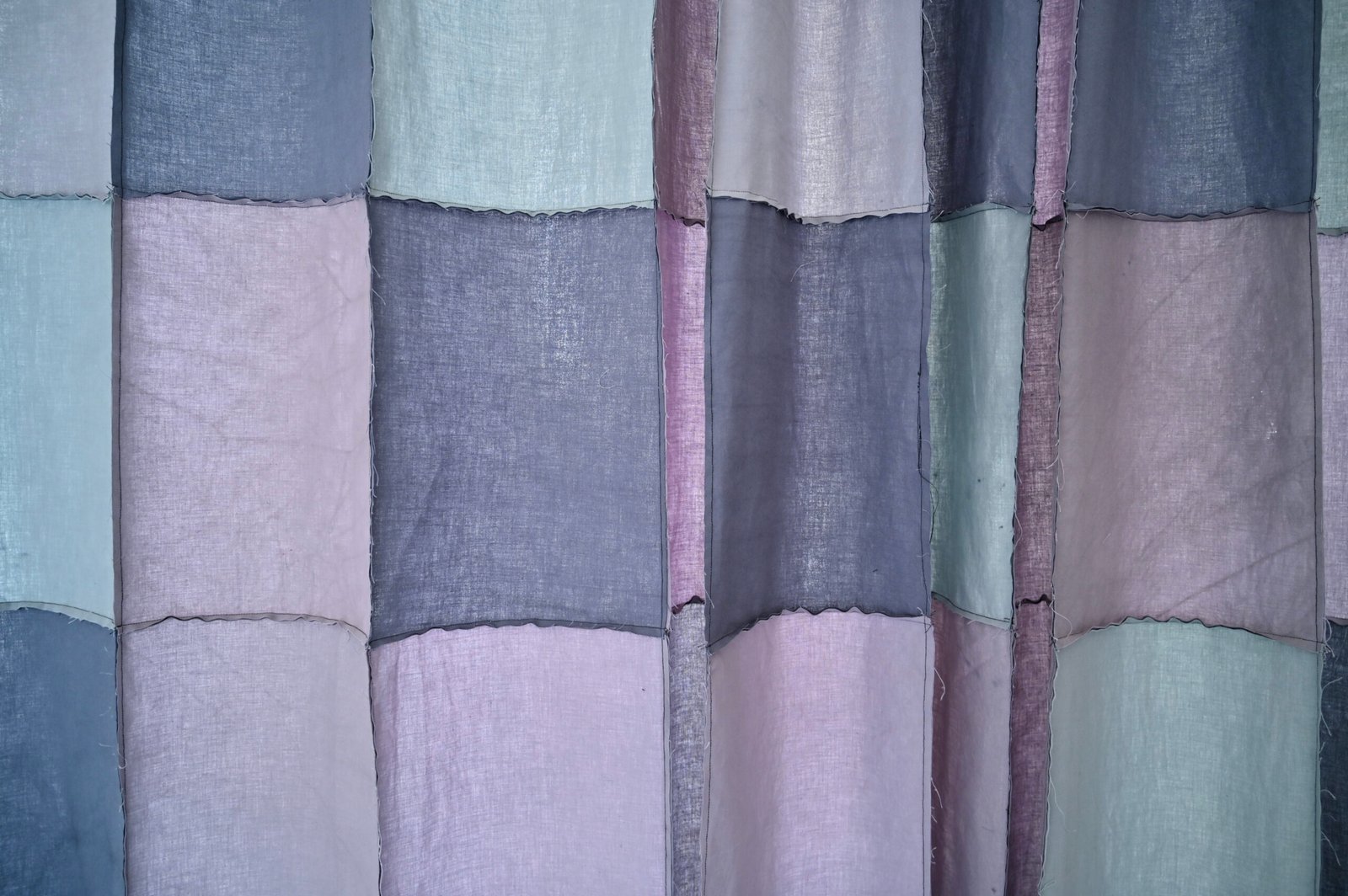
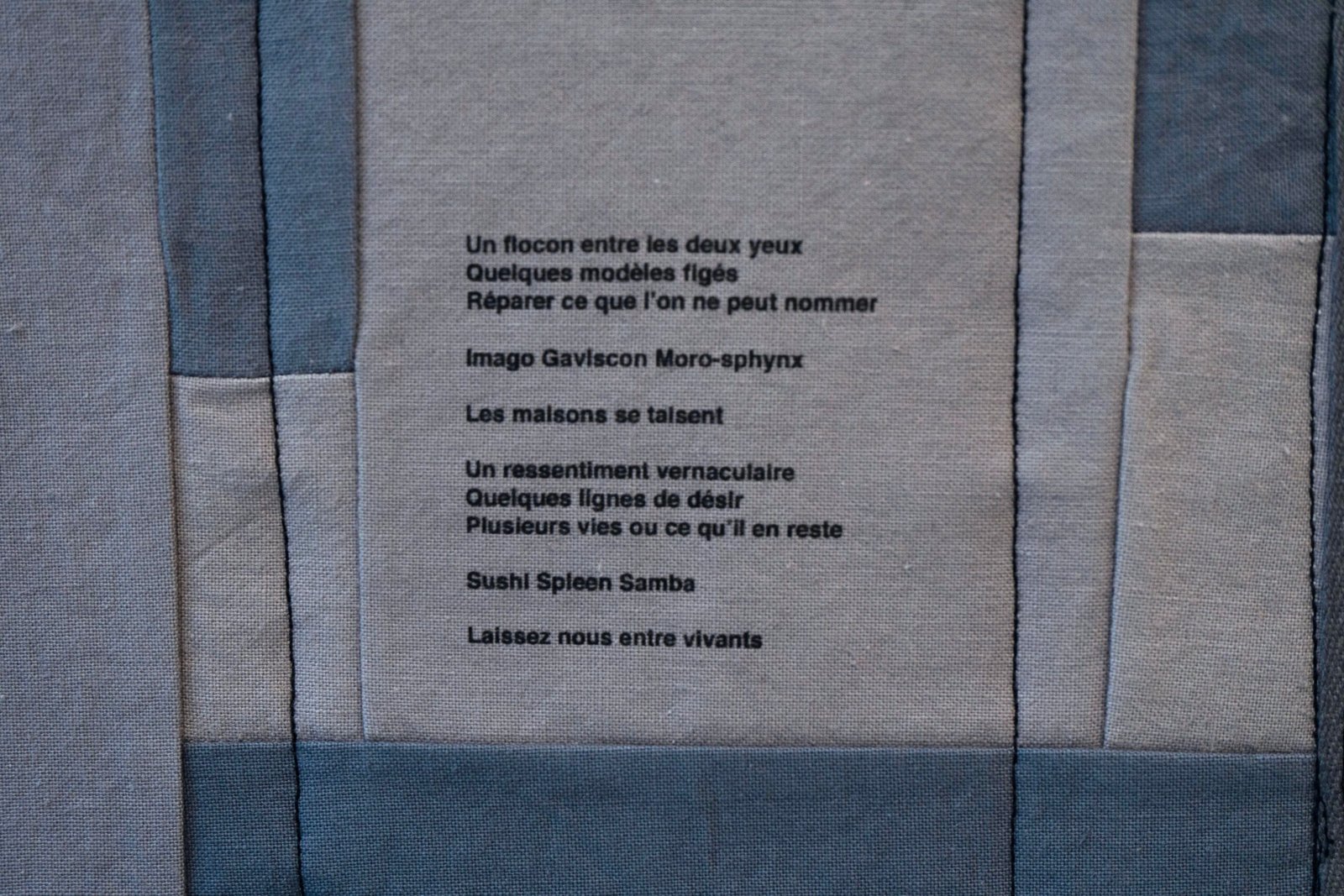
This interplay of associations and collage extends to textile work, where patchwork becomes a way of assembling and drawing through fragments. Fabric is recomposed according to a logic of ornamentation and repetition. The quilting technique, which consists of sewing together several layers of fabric, fixes and consolidates these surfaces. By penetrating the different thicknesses, the stitching inscribes the gesture within a longer timeframe. Assembling also becomes a form of repair, both technical and symbolic. The stitching is not concealed but asserted; it becomes line, rhythm, structure. What was fragmented is not erased, but held together.
The interior of the art centre initially appears peaceful. Yet, something resists the apparent simplicity of the setting. The artworks exist in a liminal space, between domestic comfort and a slight unease. On the shelf, the objects compose a small tableau. Their painted gazes, their frozen smiles, their slightly stiff postures belong to a bygone era. Nothing moves, nothing overflows, and perhaps it is precisely this stillness that is unsettling. The title, Sweet Bitterness, evokes this state. It does not refer to a nostalgia turned toward the past, but to an emotional tension where attachment and lucidity intertwine. The shades of gray, the discreet pastel touches, and the materiality of the surfaces all contribute to this restraint. The concrete is warmed by the curves, the furniture is transformed through grafts, the textiles invite contact.
Whether it be furniture, discarded objects, sculpture, or decorative items, Tom Castinel questions our relationship to domestic objects and the value we attribute to them. In the art center, the works occupy a specific position, but this status remains provisional. True to his logic of transformation, each object remains open to other uses and contexts. The exhibition becomes a space with hidden compartments where questions of attachment, desire, and community are revisited. In this “sweet bitterness,” there is less regret than a movement: that of transforming without erasing, repairing without idealising, and allowing things the possibility of a different future.
List of work
1/ Aigreur douce, 2026
Patchwork and digital printing
25 x 32,5 cm
2/ Diorama affectif, 2026
Rockwork sculpture,
ceramic objects.
Varying dimensions
3/ Hypnée, 2026
Patchwork curtains
Varying dimensions
4/ Molchat doma, 2026
Patchwork
62 x 58 cm